I Found My Husband’s Grandfather in the Holocaust Archives. I Was Wrong.
Researching a family destroyed in the Holocaust can be harrowing. It can also, I have learned the hard way, be misleading.
You go looking for your husband’s grandfather, a man erased so completely that no photograph of him survives, and you find a document.
A name on a Nazi record. A prisoner number. A date. The chronology seems possible. The record appears to fill a hole in the family history.
It feels like proof.
For years, I believed I had found the Nazi documentary record of my husband’s grandfather, Avraham Szurek.
The records were genuine. The man was real.
He just wasn’t our Avraham.
And because I did not know that, the reconstruction I made is now in print.
The document that seemed to answer everything
When I was researching Little Edna’s War, the story of my mother-in-law, Edna Szurek Brill, there were enormous holes in her family history.
Edna survived the Warsaw Ghetto, passed as a Catholic orphan, fought in the Warsaw Uprising and survived German prisoner-of-war camps. Reconstructing what happened to her family meant piecing together testimony, memory and scattered archives.
One of the greatest mysteries was the fate of her father, Avraham.
In 1941, Avraham and his eldest son, Shlomo, went together to Lublin for a Nazi work assignment, believing that volunteering for labor might help protect the family. Yakov, another of Avraham’s sons, later testified that they were sent to work building Majdanek.
Edna told her son, my husband Sam, repeatedly over the years that Shlomo had been with their father when Avraham died and that Shlomo had been forced to put his father’s body into the cremation oven.
Then I found what appeared to be the answer.
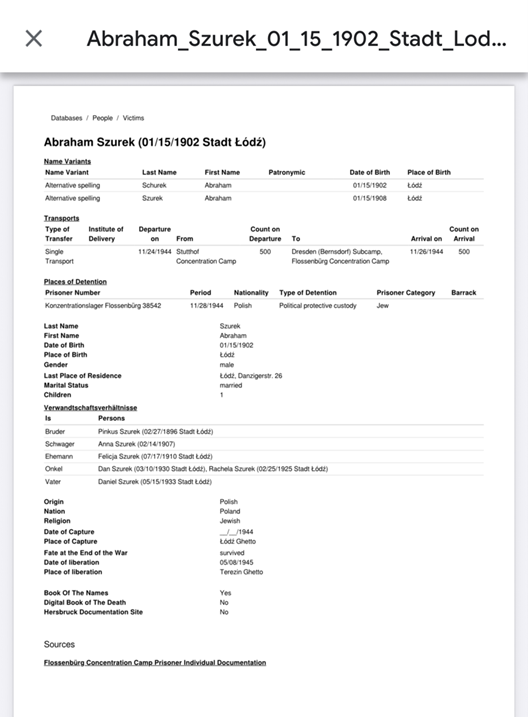
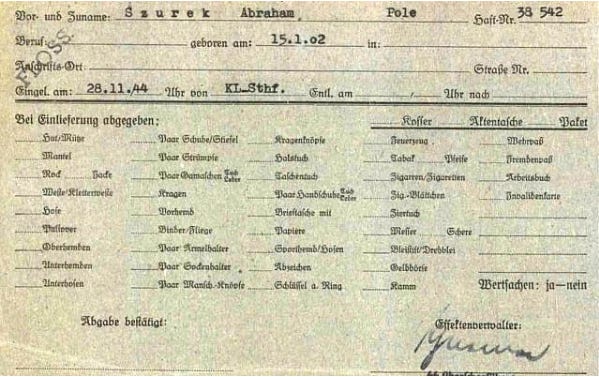
In the Arolsen Archives was a Nazi concentration camp file for SZUREK, ABRAHAM, born January 15, 1902. I had no surviving document establishing my husband’s grandfather’s date of birth. But the name was right, the age plausible, and the record appeared to offer something we had never had: a documentary trail for Avraham through the Nazi camp system.
I believed I had found him.
Suddenly two different kinds of evidence seemed to fit together. The family testimony told me what had happened: Shlomo had been with his father when Avraham died and had been forced to place his body into the oven. The Nazi records appeared to tell me where.
Flossenbürg.
I put the pieces together. In an earlier blog post and later in the epilogue of Little Edna’s War, I wrote that Avraham’s journey had ended at Flossenbürg and that Shlomo, working in the crematorium there, had been forced to place his father’s body into the oven.
I was wrong.
I had also misread part of the Nazi record. I interpreted November 28, 1944 as a date of death. It was an intake or registration date. The document was not recording a death at all.
I had made two errors: I had misread the document and, more fundamentally, identified the man in it as my husband’s grandfather.
The question that changed everything
The contradiction emerged when I tried to document Shlomo’s path.
The family already knew that Shlomo had survived and was liberated at Buchenwald. I also had his Buchenwald prisoner card, and this record contained an identifying detail that led directly back to Edna’s family: it named him as Szlama Szurek, born in Warsaw in 1924, and gave his address as ul. Miła 18, the Szurek family home.
I knew I had the right Shlomo.
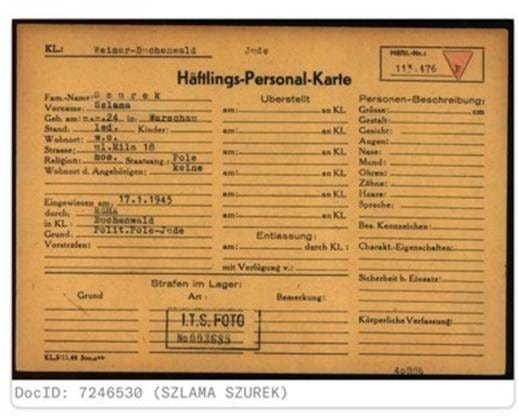
That created a problem I could no longer ignore.
If Shlomo had been with his father when Avraham died, and if Avraham had died at Flossenbürg as I had concluded, where were Shlomo’s Flossenbürg records?
I wrote to the Flossenbürg Concentration Camp Memorial to find them.
I expected another piece of the puzzle.
Instead, their answer dismantled the picture I had assembled.
According to the Memorial’s research, Szlama Szurek was not registered at Flossenbürg or any of its subcamps. Their records pointed instead to Buchenwald and Mittelbau-Dora.
But what they found about Abraham was even more consequential.
The Abraham Szurek in the Flossenbürg records was from Łódź and had been transferred from Stutthof to Dresden-Bernsdorf, a Flossenbürg subcamp.
And he had not died there.
According to the Memorial’s data sheet, he survived the war and was liberated at Terezín on May 8, 1945.
Our Avraham belonged to a Warsaw family. According to the testimony of his children, he had died during the war.
The contrast was impossible to miss. Shlomo’s Buchenwald record led directly back to 18 Miła Street in Warsaw. The Abraham Szurek I had followed through the Flossenbürg records led back to Łódź.
I had the right Shlomo.
I had the wrong Avraham.
The Memorial cautioned that the inconsistencies made the identification doubtful, especially in Abraham’s case.
That was the moment the reconstruction collapsed.
The Nazi document was real. The prisoner was real. I had simply attached the wrong family to him.
I thought I had found my husband’s grandfather’s death. Instead, I had followed another Abraham Szurek, a man from Łódź who survived.