‘I hope that next year we will be in better circumstances’
At this time of year, families exchange New Year greetings with warmth and optimism. Today we might telephone, send a card through the post or simply write an email or text.
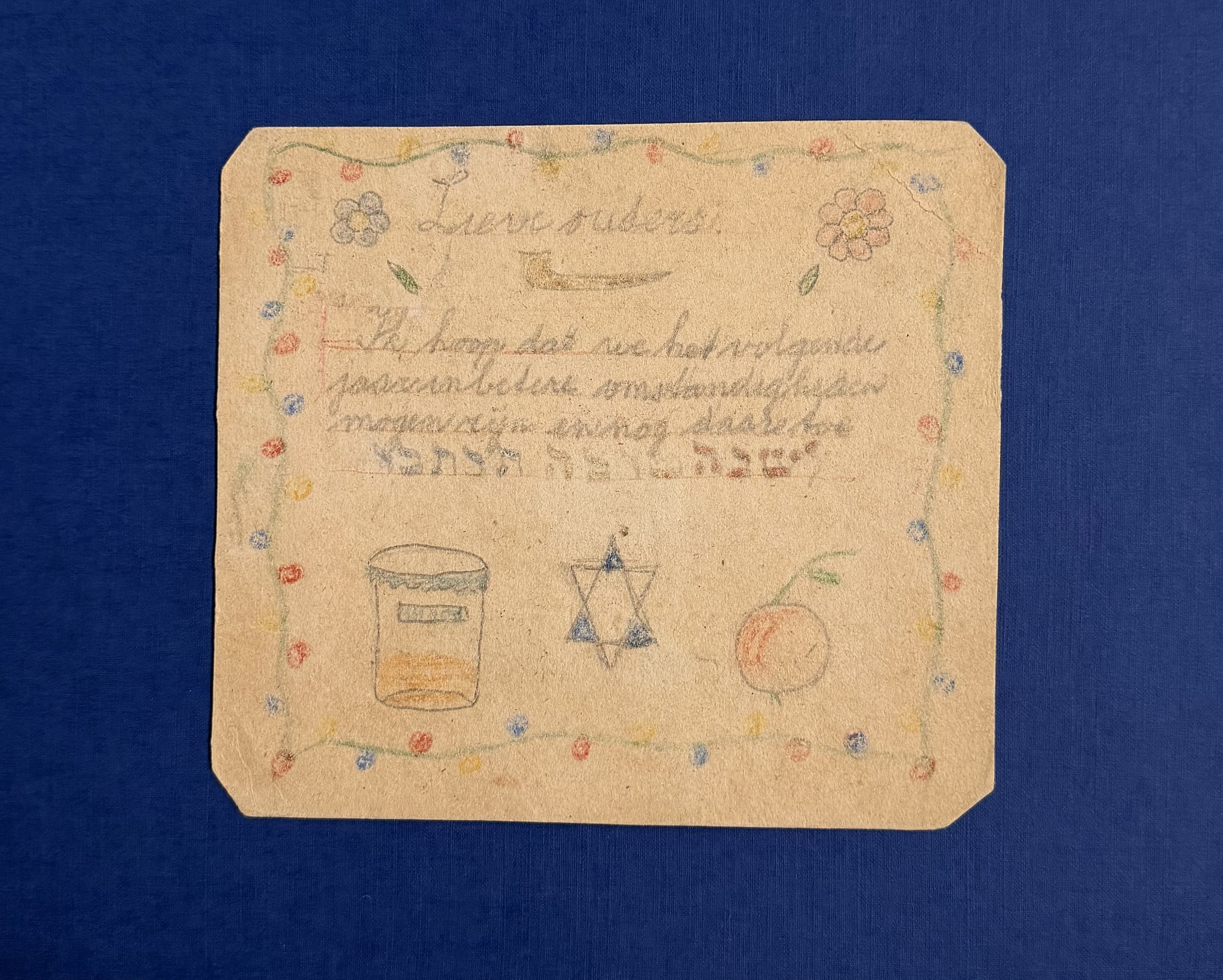
In September 1943, my mother, Zahava Kanarek, then eight years old, made a New Year card for her parents. She was imprisoned with them in Westerbork transit camp, in Holland.
I don’t know much about how and when the card was created. In 1943, Rosh Hashanah fell on September 28. I suspect my mother made it a few days before the new year.
Measuring just 15.5 x 14 centimeters, Zahava’s Rosh Hashanah greeting is made from what appears to be a discarded piece of pale yellow card and remains in remarkable, almost pristine, condition. Most of the message is written in pencil, while the Hebrew lettering has been carefully colored in red, yellow and blue, each word picked out in a different color. Around the edge, Zahava decorated the card with colored dots and flowers and drew several traditional symbols of the Jewish New Year: a shofar (ram’s horn), a pot of honey, an apple, symbolizing the hope for a sweet year ahead, and a Star of David.
Remarkably, my grandmother Rosy preserved this card through Westerbork, Bergen-Belsen and the postwar years that followed. Among the many family heirlooms I have inherited, this small simple card, made with great care by an eight-year-old, is one of the most treasured. It prompts many emotions and questions from audiences when I share my family’s archive and experiences.
The card reads (I’ve translated it from the original Dutch):
Dear Parents,
I hope that next year we will be in better circumstances.
In the meantime, Shanah Tovah veticateivu – Happy New Year, and may you be inscribed in the Book of Life.
By late September 1943, my mother and her parents had already spent four months in Westerbork transit camp, having arrived there in May. No one in the camp knew where they would eventually be sent.
Over the years, I have shared the card with tens of thousands of students, as well as teachers and members of the public. Again and again, it prompts the same questions. For example, many non-Jewish audiences are puzzled by the date. Why was my mother making a New Year card in September, when the new year, surely, starts in January?
Others are drawn to the colors:
“How did she get colored pencils?”
It’s a question I have often asked myself. I did once ask my mother, but she couldn’t remember. It remains a mystery.
My mother spoke of attending makeshift classes in Westerbork. Perhaps the pencils belonged to the teachers and were shared among the children. Perhaps they had been packed before deportation. When families were forced to leave home with only one suitcase, what did they choose to take? Perhaps someone decided that a small box of coloring pencils might help entertain a child.
Sometimes students point to the colorful Hebrew letters and assume they are musical notes.
The main message is written in Dutch, the language spoken by my mother and her family, while the traditional New Year blessing is written in Hebrew. Even this small card expresses who they were: Dutch Jews whose languages, culture and faith were all part of their identity.
Another question asked time and again is:
“How could your mother celebrate the Jewish New Year while imprisoned for being Jewish?”
I don’t know.
Other people ask whether she was able to give the card to her parents openly or whether it had to be passed to them in secret.
Again, I don’t know. So much about this little card remains a mystery.
People often ask how it survived in such extraordinarily good condition. There is scarcely a crease or tear. Rosy had evidently treasured it and kept it carefully concealed; Zahava found it after she died. Where did Rosy keep it? How did she protect it in Westerbork and later through Bergen-Belsen, liberation and the difficult years afterwards? How did something so fragile survive without becoming bent, torn or lost?
I have never found the answers.
There are many things this card tells me and just as many things it does not.
When I look at the card I think of my mother carefully coloring Hebrew letters, drawing the symbols of Rosh Hashanah and wishing her parents a sweet New Year. She was eight years old, doing something ordinary in completely extraordinary circumstances.
It is this ordinariness that some students respond to most strongly. One wrote afterwards:
‘I thought it was very moving, specifically the little card she drew, as it reminded me of the things I drew as a child.’
Another wrote:
“Such a familiar object – the kind of thing every child has made at some point – yet it was made during such a horrific time in her life.”
At a time when hundreds of thousands of Jewish children across Europe were being slaughtered by the Nazis, here was a Jewish child, imprisoned in a Dutch transit camp, making a beautiful, ordinary, lasting document of love and hope.
In September 1943, the Kanareks did not know their future. They could not imagine the hardships that still awaited them. In January 1944, they would be transported from Westerbork to Bergen-Belsen. They could not know that the card would survive to outlive the circumstances in which it was made – and intrigue so many other children.
At Rosh Hashanah we look ahead, wish each other a good and sweet year. My mother, in Westerbork in September 1943, was doing exactly that.
As Rosh Hashanah approaches again this year, I find myself returning to this card and the words my mother wrote over 80 years ago.
“I hope that next year we will be in better circumstances.”