
Head Shrink and Gym Rat
I Look to the Stray Cats for Moral Clarity
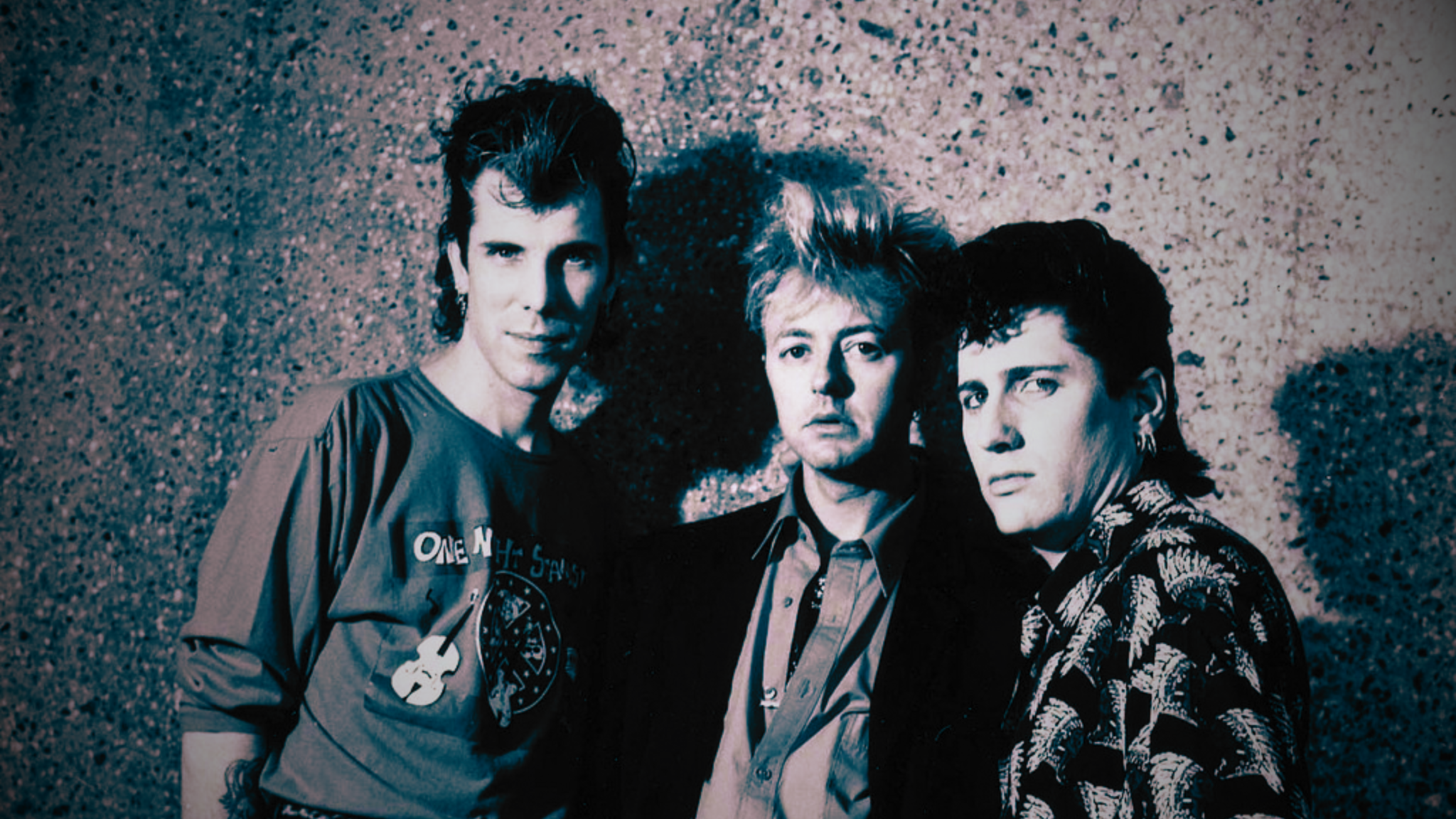
Image: Stray Cats, via Wikimedia Commons. Licensed under CC BY-SA 3.0. Edits applied for color and contrast.
45 years ago, rockabilly punks knew exactly who the bad guys were.
In 1980, the Stray Cats released a song that punched harder than a policy paper: “Storm the Embassy.” Set to a rockabilly-punk beat, it captured a moment of moral clarity that feels almost alien today. The lyrics—raw, urgent, and furious—spoke for a generation that hadn’t yet been trained to apologize for believing in right and wrong.
“Fifteen men taken captive in a hostile foreign land…
No context needed. No abstract theory. Just the gut instinct that something sacred had been violated—and a demand to do something about it. “Storm the Iranian embassy, before they start shooting at you and me.” That was the chorus. That was the mood.
At the time, the Stray Cats were just three kids from Long Island who had decamped to England to soak up the punk scene. They weren’t yet the icons of the rockabilly revival—they were punks in spirit, even if their sound swung with upright bass and slick pompadours. Their rebellion wasn’t nostalgia—it was stripped-down defiance. Storm the Embassy was their one true punk anthem. Politically charged, musically aggressive, and morally unambiguous.
And they were young—just as young, iconoclastic and full of moxie as today’s street-marchers. But they were free of something: forty years of ideological conditioning. Unlike the campus terrorists, their brains hadn’t been marinated in decades of groupthink. They rebelled with creativity, not programming. The Cats didn’t need a critical theory seminar to know that holding Americans hostage was evil. They didn’t need nuance to call out Soviet aggression in Afghanistan. They just knew. And they said so—loudly.
Today, people of that same age march through the streets of Western capitals holding placards that read “Hands off Iran,” as Israel and the United States try to prevent that same regime from acquiring nuclear weapons. The signs are eerily familiar—identical, in fact, to the ones raised for Gaza, and then for Lebanon. Helvetica font. Blood-red dot in the largest letter. It’s obvious: someone has a Canva folder with all the templates ready to go.
Whoever stands against Israel, the U.S., or the West in general—but especially Israel—gets the full cosplay treatment. Hamas, Hezbollah, the Houthis, the IRGC—it doesn’t matter. The same mass of protesters shows up, fists raised, keffiyehs on, slogans loaded. They don’t even pretend to understand the causes they support. They don’t have to. The templates do it for them.
And all the while, another generation has been watching—the Iranian diaspora, scattered across the West, many of whom fled after the Islamic Revolution, or whose families were forced to leave as the regime cracked down on anyone who remembered freedom. These are the sons and daughters of one of the world’s great and ancient civilizations—Persian poets, scholars, and scientists—who now watch in horror as their homeland remains strangled by a death cult in clerical robes.
Since 1979, the regime has murdered nearly 40,000 of its own citizens, waged proxy wars that have killed over half a million people, and armed terror militias across the Middle East to destroy Israel by any means necessary. Their leaders chant “Death to America,” “Death to Israel,” and now, “Death to the UK”—not as metaphors, but as policy goals, declared under banners of nuclear enrichment and martyrdom.
And yet, the kewl kids with their balaclavas and their COVID masks line up to be the cheering squad—right there in the streets of Berlin, London, Brooklyn, and Toronto. Right in front of the very Iranian refugees who actually remember what the Islamic Republic is. Who remember the prisons. The executions. The rapes. The “disappearances.” The fear.
But none of that matters to the new revolutionaries. Their slogans are louder than your memories.
The Stray Cats could never have imagined—and frankly, neither can most of us—that young people raised in the freest, most prosperous, most democratic societies in history would volunteer themselves as useful idiots for the world’s most sociopathic regimes.
What once was youthful rebellion has curdled into ideological servitude. This isn’t rock’n’roll defiance—it’s ritual submission dressed up as resistance. They chant for regimes that murder women for showing their hair, hang gay people from cranes, silence artists, and fund the bombing of buses. And they do it with the moral certainty of saints, the branding of a startup, and the historical awareness of a goldfish. The lives of these young dolts—so eager to play revolution—would become utterly intolerable if their idealized jihadist comrades ever actually showed up on their shores.
Meanwhile, the ayatollahs and autocrats play the long game. Trump wants his deal. The Europeans want their ceasefires and their photo-ops. Like most Western politicians, they’ll be out of office in a few years, off to book tours and consulting gigs.
But the Iranian regime doesn’t measure time in electoral seasons. They think in generations. They don’t need to win the news cycle—they just need the West to forget again.
And long after those diplomats and presidents exit through their revolving doors, Israelis will still be here—having to stare down rockets, riots, and genocidal chants.
This isn’t a thought experiment. It’s not theoretical. It’s not rhetorical.
My friend’s daughter and her husband were visiting for Shabbos when a ballistic missile from Iran flattened their apartment building in Ramat Gan.
They lived—only because they weren’t home. That’s it. That’s the margin.
The IRGC isn’t some distant threat. They have operatives and sleeper cells embedded in cities across the world. They’ve made assassination attempts. They’ve succeeded.
As the prophetic lyric went in 1980:
“Storm the Iranian embassy, before they start shooting at you and me.
Well, they’re already shooting. They’ve been shooting for half a century.
And still, the signs get printed. The chants go viral. The Canva folder stays open.
Related Topics
Related Posts