
Torah Brain, Talmud Mouth
I loved El-Sayed’s answer. I wouldn’t vote for him
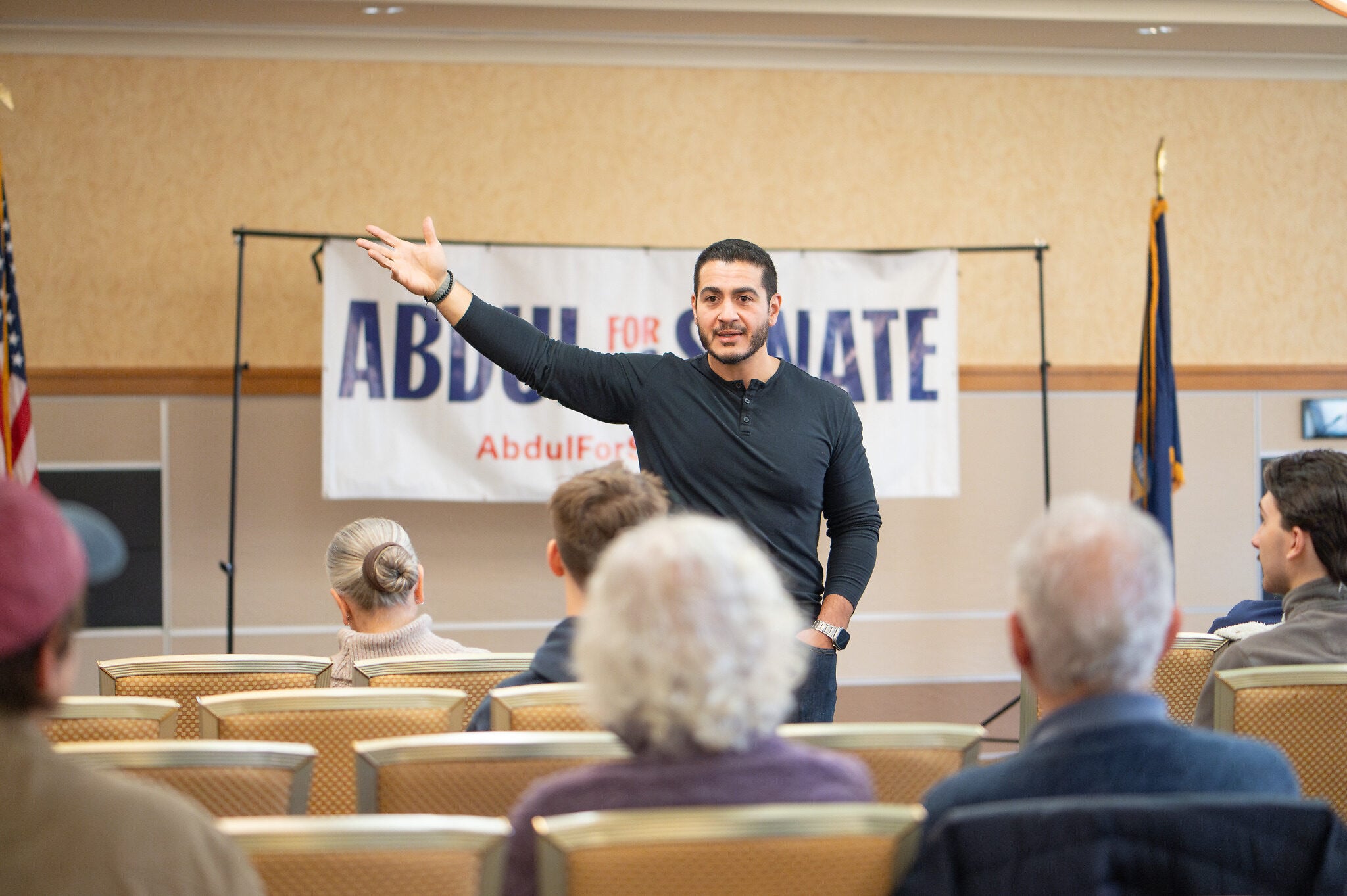
Abdul El-Sayed in 2025. (Conlan Houston/Flickr, CC BY-SA 4.0)
I loved what he said
Last weekend, at a town hall in a red Michigan county, a guy named Tommy (who, it turns out, used to work for Josh Hawley) asked Abdul El-Sayed if he’d disavow the Muslim Brotherhood. El-Sayed said, “Sure. Yeah, absolutely,” then asked why he was being asked. The answer was obvious. Tommy assumed a Muslim candidate would have dual loyalties. El-Sayed called him on it, told him he wasn’t running to be a Muslim senator, and said he’d protect Tommy’s right to practice his faith as a Christian.
I loved it. Jews have been hearing about our “dual loyalties” forever. When I told a friend of mine, a Black writer in his seventies, how much I loved it, he asked the obvious question: then why don’t you like El-Sayed?
It’s a fair question. The short answer is that it’s not his politics. That’s what makes it hard.
On paper, he’s my guy. Medicare for All, money out of politics, tax the billionaires’ wealth. He’s a public health person who got lead out of Detroit schools. If I lived in Michigan, I should be knocking on doors for him. I’m not, and I wouldn’t vote for him. Here’s why.
Hurt people hurt people
In March, a man drove a vehicle into Temple Israel in West Bloomfield, outside Detroit. It’s a Reform synagogue, one of the biggest in the country. That’s my movement, the world I grew up in. There’s a preschool inside, and 106 children were in the building.
The next day, El-Sayed put out a video. He condemned the attack, then said “hurt people hurt people” and talked about the attacker’s family who’d been killed in an Israeli strike in Lebanon. A month later, he said it again, alongside Hasan Piker, a streamer who once said America deserved 9/11. El-Sayed finally apologized in August, after he’d already won the primary.
Try this: a guy attacks a mosque full of preschoolers, and the next day a Senate candidate asks us to consider the attacker’s pain. Everybody would know exactly what that was. That’s how it landed for me.
I’m reading Dara Horn’s new book, The Final Solution to the Jewish Question: A Love Story for the Living, and everyone needs to read it. She writes about Father Charles Coughlin, the radio priest who ran what was basically a megachurch in Detroit in the 1930s. When Kristallnacht happened, he went on the air and explained it as the Germans’ understandable reaction to what Jews had supposedly done to them. Not a planned pogrom, just people pushed too far. Horn sums up that logic in one line: “In both cases, the Jews deserved it.” She’s talking about Kristallnacht and October 7 together.
That’s the move. Nobody says, “I’m glad they attacked the synagogue.” They say, “Imagine what he’d been through.” It’s the same argument wearing nicer clothes, in the same city, ninety years later.
Think about Mother Emanuel. Dylann Roof sat through Bible study with people who welcomed him, then murdered nine of them. He left a manifesto full of grievances. Imagine a Senate candidate going on camera the next day and saying “hurt people hurt people.” Nobody would have stood for it, and they’d have been right.
A foreign government
Then there’s Dana Nessel, Michigan’s attorney general, who’s Jewish. She said she wouldn’t attend her own party’s convention because she didn’t feel safe there. She said she expected to be harassed, screamed at, and booed off the stage, and that something had to change in her party.
When CNN asked El-Sayed about her concerns, he said Jewish safety was a priority. But then he pivoted to the distinction between Jewish people’s safety and political disagreements over Israel. He warned that antisemitism was sometimes invoked to shield a foreign government from criticism.
And this is where I stop believing the reassurances.
A Jewish woman says she’s afraid to walk into her own party’s convention. Instead of asking why, El-Sayed questions whether she’s conflating her safety with her politics about Israel. His answer makes me wonder whose safety he means, and what conditions he attaches to it.
Put that next to the Tommy video. When someone assumed his loyalties were somewhere else because of his religion, El-Sayed called it out beautifully. He understood what was happening and why it mattered. But when a Jewish woman said she was afraid, he questioned how she was framing the problem.
I don’t believe we should have to prove that our fear is legitimate before someone takes it seriously. Jewish safety shouldn’t depend on whether we’re willing to separate it from Israel, or whether our understanding of antisemitism is politically convenient.
I don’t expect every politician to agree with me about Israel. I just don’t trust someone who says Jewish safety matters but seems more interested in challenging the Jews who say they feel unsafe than in listening to why they’re afraid.
And when you treat American Jews as stand-ins for Israel, you’re drawing a line from a war in Lebanon to a synagogue in Michigan. That’s exactly the line the attacker drew. My friend didn’t need me to explain what it’s like to be made to answer for people you’ve never met just because you share something with them.
This isn’t about criticizing Israel
I want to be clear about something, because this is where people get confused about me. My problem isn’t that El-Sayed criticizes Israel. I criticize Israel. I can’t stand Netanyahu. Neither can my Israeli family. I think the settlers terrorizing Palestinians in the West Bank are as much my enemy as Hamas. I’m still close with two Middle Eastern friends from high school. We talk about our kids and what scares us, not slogans.
But I’m a Zionist, and what’s happening in Gaza is not a genocide. On the left right now, those two sentences can end the conversation. It doesn’t matter what else I believe.
And it’s not just him. The DSA, where a lot of the energy on the left is coming from, now calls Zionism a racist, settler-colonial project. Say “Israel has a right to defend itself” and you can get kicked out. AOC has pledged not to vote for any military aid to Israel, defensive weapons included. That means the Iron Dome. That’s the thing that keeps rockets from landing on my cousins.
My friend Jordana Horn Gordon wrote on her Substack: “There is no way I can possibly lend my voice, dollars or vote to anyone who would negate, deny or harm Jewish existence.” She’s a registered Democrat, and she’s drawing a line. She’s not willing to keep debating whether Jews get to exist or whether Jewish safety is negotiable. I get it. I really do. We exist. That’s where I am, too.
Dara Horn’s book helped me understand how that language spread so fast. She follows a young Jewish data scientist who tracked a coordinated group of a few dozen Wikipedia editors who spent years quietly rewriting articles on Jewish and Israeli history. According to her reporting, they redefined Zionism as a colonization project and scrubbed Hamas’s founding charter and its attacks on civilians from Hamas’s own page. Wikipedia and Reddit feed Google and the AI tools people use now, so what gets planted there comes back out as “the answer.”
Horn also points to what psychologists call the Illusory Truth Effect: hear something enough times and your brain starts to believe it’s true. So when a twenty-year-old tells me Zionism is settler colonialism, I don’t think they’re evil. I think they looked it up.
I know because I’m raising one. My son is 21, and he’s an anti-Zionist. He reads a lot, he thinks about the world, and he has come to conclusions about Israel that break my heart. Sometimes I wonder how much of what he’s reading has shaped those conclusions, and whether he’s encountering the full, complicated history of the people he’s part of.
He’s asked himself whether being anti-Zionist makes him a self-hating Jew. I don’t think he’s a bad kid, and I don’t think he’s a bad Jew. He’s my son. I love him, and I respect that he’s trying to figure out what he believes, even when I disagree with him. But I worry about the world he’s learning to see through, and I wish he could see more of what I see.
It breaks my heart a little every time we find ourselves on opposite sides of something that, to me, is inseparable from who we are.
For a lot of progressives, Zionism is a foreign-policy opinion you can put down like any other. For me, it isn’t separate from being Jewish. It’s Reform camp, it’s my family, it’s my whole education. So when anti-Zionism becomes the price of admission, what I hear is: you can stay if you cut off part of yourself. Nobody else in the coalition gets asked to do that.
Politically homeless
And no, the Republicans aren’t the answer.
I haven’t always labeled myself a liberal, and I’m not a party loyalist now. I grew up in Madison, Wisconsin, a very liberal city, and the “you’re either one of us or you’re the enemy” rhetoric, the very smart kids with zero room for nuance, is why I left. In the last presidential election, I would have voted for Nikki Haley. In a lot of ways, I’m way to the left of the Democrats. On foreign policy, I’m a hawk. I don’t think that makes me confused. I think it makes me a person who actually thinks about each issue instead of picking a team and downloading its opinions.
But Haley lost, and the party that beat her is the one I can’t stand. I hate everything about the Republican Party right now. They make my blood boil. They wave Israeli flags and then turn around and feed White Christian Nationalism, and that movement has never had a place for Jews.
Being a Jew on that side of the aisle is scary in a completely different way. I’m honestly horrified by the Jews I know who’ve become Trumpers. Intelligent people. People I thought I understood. I get the fear that pushed them there, because I feel it too. But being scared doesn’t give you permission to stop being who you are, and it definitely doesn’t mean you run toward people who’d never consider you one of them.
So that’s where I am. Too Zionist for the left, too liberal for the right, too hawkish for a lot of Democrats. One side wants me to cut off part of myself, and the other side doesn’t think I belong in the first place.
Homeless. Sometimes even at my own kitchen table.
I’m relieved I live in Delaware. My senators don’t make me choose, and honestly, I feel pretty safe here. Jews are woven into politics in this state. Our governor is Jewish, and so are people in the legislature. We keep an eye on the handful of DSA and Working Families Party candidates who run here, and so far they haven’t gone anywhere. But I watch what’s happening in Michigan, and I don’t take any of it for granted.
I told my friend he didn’t have to agree with me about Israel. I just wanted him to understand why this feels less like a political disagreement and more like grief. He’s a writer, and he’s watched this country decide who belongs for a lot longer than I have. I figured he’d get the difference.
And I told him to read the Dara Horn. She says all of this better than I do, and she’s funnier about it.
Related Topics