
IDF is 12,000 Soldiers Short. With Haredi draft Stuck, Try a Foreign Legion
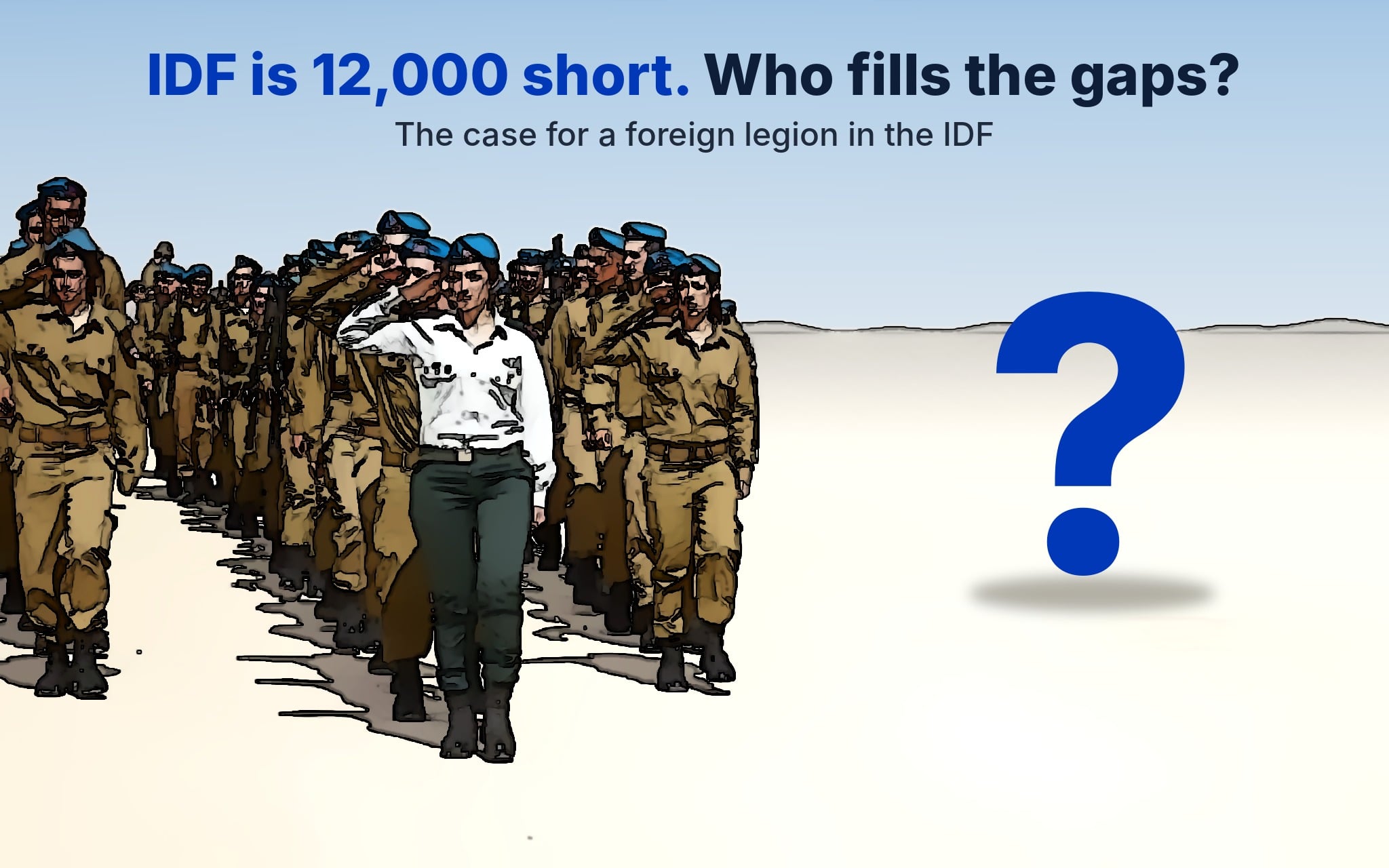
On Monday November 16, IDF Chief of Staff Lt. Gen. Eyal Zamir said again that the army has a shortage of 12000 soldiers. “That has not changed,” he said at Sde Boker (Ynet, 16 November 2026). A day later Channel 12 showed what that already means on the ground. It reported that a battalion commander in southern Lebanon pulled his force out of a village because of a severe shortage of troops. Only a few dozen fighters were left, which would have put them at risk in an emergency. While politicians remain at an impasse over solutions like the Haredi draft, as we now also see during current coalition talks. In an effort to draw in Haredi parties the Eisenkot bloc seems willing to water down their demands on a haredi draft law. So with no political solution in sight any time soon, there is an option Israel has not yet tried: a foreign legion inside the IDF. To see why it deserves a test, start with the numbers.
The IDF has told the Knesset it lacks about 12,000 soldiers, of whom 6,000 to 7,000 are combat troops. Reservists are serving 80 to 100 days a year. Each reservist called up costs the economy about NIS 53,000 a month in lost work and output, according to the Finance Ministry’s chief economist (Calcalist, August 2026). The reservists pay too: about a third say their finances are worse, and many have postponed or given up career or study plans (Latet survey, October 2026).
Many politicians say the answer is to draft the Haredim, most of whom do not serve. But governments have failed for years to get this done, and time works against it. Haredim are about a quarter of those reaching draft age today and are projected to be about 40 percent by 2050, according to the Israel Democracy Institute (The Times of Israel, 10 February 2026). Their political power to block a draft law will only grow. Lengthening mandatory service for those who already serve is no way out either: it would pull more young Israelis out of the labor market and load still more onto the same public that already carries the burden. Israel’s security cannot wait for a political solution that may never come.
That is where a foreign legion comes in. Israel should test it. It would recruit non-Jewish volunteers from abroad, starting with Christian Zionists, the most organized group among Israel’s supporters outside the Jewish world, and widening to others over time.
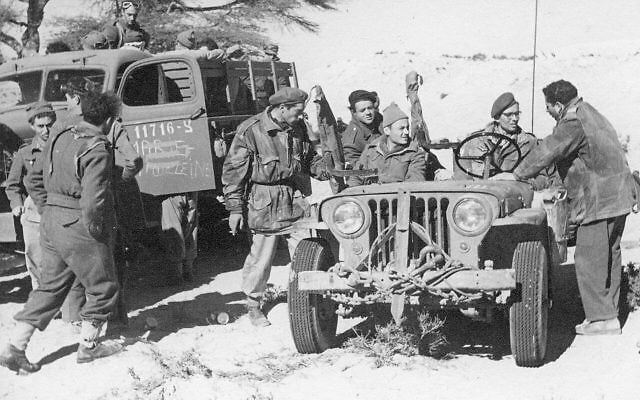
This is not completely new. In 1948 some 3,500 volunteers from overseas, Jews and non-Jews, fought in the new state’s army. Non-Jews flew its aircraft and led its soldiers, among them Derek Bowden, a British paratroop officer who commanded a company in the 72nd Battalion. Of the 119 volunteers who fell, eight were not Jews (Israel Ministry of Foreign Affairs, May 1999). In 1967 foreigners came again, including more than a thousand non-Jews from Britain alone, though to work in fields and hospitals rather than to fight (The Jewish Chronicle, 2 June 2017). Israel has accepted such help before. Today Mahal, the army’s track for overseas volunteers, is open almost only to Jews, and all Diaspora communities together supplied about 1,050 recruits last year (JNS, 6 January 2026). That pool has a very limited ceiling. A wider one has never been tried.
Recruits would be regular IDF soldiers: they would take the same oath, follow the same training and operate under the same code of conduct and command. They would get the same pay as a combat soldier with no family in Israel, about NIS 3,550 a month (Knesset Immigration, Absorption and Diaspora Affairs Committee, 24 March 2026). For practical reasons they would serve in units built around one language, such as English or Spanish, because in combat communication is key. At the start every officer and squad leader would be Israeli and fluent in both that language and Hebrew. Israel, a country of immigrants, has such commanders. In time, recruits who prove themselves could rise to squad leader and beyond, always alongside Israeli commanders. They would learn Hebrew during service, as immigrant soldiers already do, and would sign up for four years instead of the 30 months Israelis serve, to offset the extra costs of vetting and the flight to Israel. Service could be extended on an individual basis if both the IDF and the soldier want it.
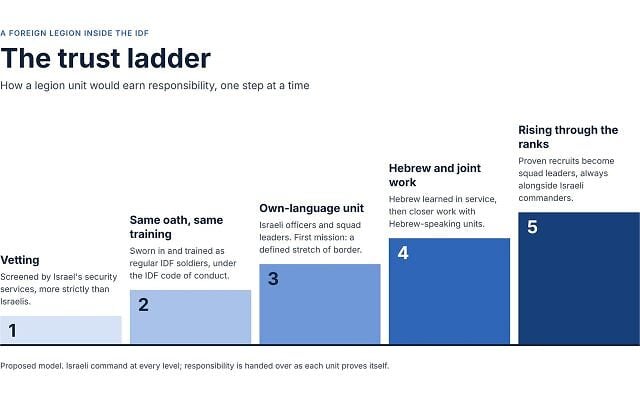
At first these units would get missions they can carry out largely on their own, such as guarding a defined stretch of border, so that language never becomes a danger in combat. As their Hebrew improves they can work more closely with other units where Hebrew is the operating language. Every sector they hold frees an Israeli unit for a front like Lebanon and sends reservists home. One legion soldier spending eight months a year on the line, with the rest going to training and leave, covers the yearly duty of about three reservists. Two thousand of them would relieve some 5,000 to 6,000 reservists a year.
The first charge will be that these are mercenaries. They are not. Mercenaries fight for profit, often in a legal gray zone and outside a regular chain of command. These would be IDF soldiers on a soldier’s pay, under IDF law, IDF rules of engagement and IDF officers. Nobody called the volunteers of 1948 mercenaries.
Trust is the harder question, because these are foreigners who are not Jews. Not being Jewish is no bar in itself: Druze, Bedouin and Circassian citizens already serve with distinction. What is new is that the recruits are foreign. So trust would rest on Israeli command at every level, on deep vetting by Israel’s security services, stricter than for Israelis, and on responsibility handed over step by step as each unit proves itself. There will be hostile headlines abroad about foreign Christians on Israel’s borders. The answer is to be open about what an army can be open about: who the recruits are, the terms they serve on, and the fact that they answer to the same commanders, the same military law and the same military courts as every Israeli soldier. After that, let the units be judged by their conduct.
The terms of service would do part of the filtering. No residency or citizenship would be on offer, and that would be made clear from the start: they serve and they go home. That keeps away anyone looking for a visa, and those who still come will come out of conviction. If too few enlist on those terms, the terms can be reviewed, though never to the point of causing resentment among the Israelis serving beside them. Recruits would be free to practice their faith, but missionary activity would be grounds for dismissal.
Nor is cost an obstacle. A legion soldier costs no more than anyone else who fills the gap, apart from deeper vetting and a flight, and unlike a reservist he takes no worker out of the Israeli economy. A legion will not solve the whole manpower shortage, but even a few thousand soldiers would be a meaningful addition to Israel’s security. And it will not take the draft off the agenda; every family that sends a child to the army while others do not will keep it there.
This is still a strategic idea that needs to be worked out into operational plans, and nobody can say in advance how many would enlist. Christians United for Israel, an American organization, claims ten million members (CUFI, December 2020), but support for Israel is weaker among younger evangelicals (The Jerusalem Post, 18 March 2026). So start by finding out: conduct surveys among key target groups. Check which countries allow their citizens to serve in a foreign army, and how many suitable commanders the IDF can spare. Settle the legal questions, from the recruits’ status under Israeli law to what Israel owes a foreign soldier who is killed or captured. If the answers are good, begin with a first intake of 1,000 to 2,000 and grow year by year, so that vetting and training can keep pace. If it works, make it permanent. If it does not, close it.
No option produces soldiers overnight. Soldiers drafted under a new law would need the same months of training. But every month without a decision is another month carried by the same reservists, their families and the economy. Israel does not have the luxury of waiting for the politicians to finally solve the draft issue, or of ruling out unconventional ideas. A battalion commander in Lebanon has already had to pull back for lack of soldiers. Israel should not wait to find out what comes next.