
Where Objectivity Meets Reality
If Gaza did not exist, it would have had to be invented
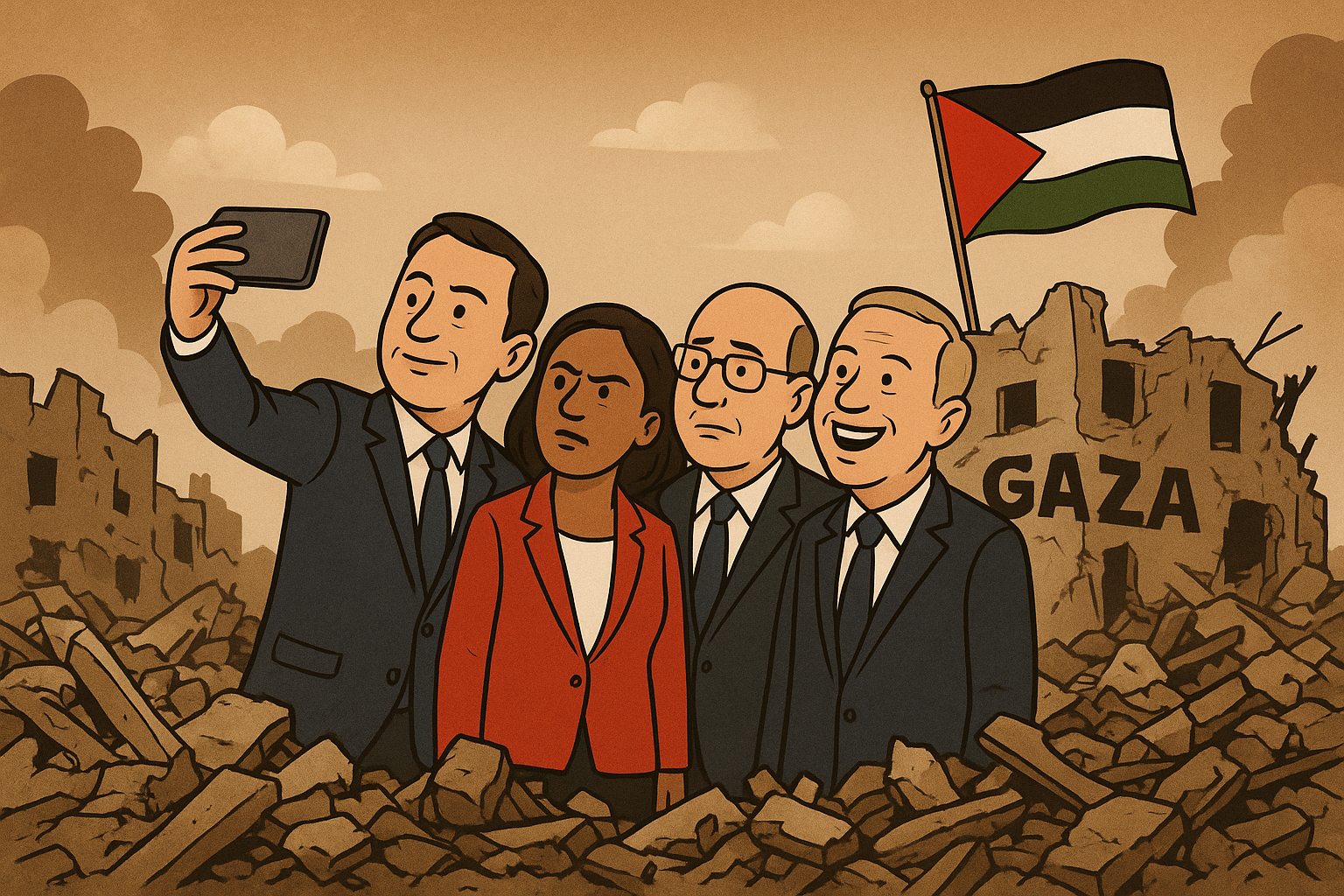
The tragedy of Gaza is universally known. Not because anyone truly cares about the people of Gaza, but because Gaza has become the stage on which Western politicians flex their moral muscles. Gaza is the place where presidents, prime ministers, and foreign ministers can indulge in grandiose words, indignant speeches, and solemn resolutions. Here, they can loudly showcase their principles—without the slightest risk.
No one in Brussels, Paris, or Ottawa really loses sleep over the fate of Gazans. If they did, the same moral outrage would be heard over the hundreds of thousands of victims in Sudan. The same fury would be directed at the Uyghurs in China. Quod non. The difference is obvious: Sudan does not deliver nightly television images that stir electorates, and criticizing China comes with economic costs. Gaza, by contrast, is perfect: a safe storm of indignation, guaranteed to provide a stage and an audience.
Macron vs. Netanyahu: a diplomatic boxing match
Take Emmanuel Macron. He proudly announced that France will officially recognize Palestine at the upcoming UN General Assembly. Benjamin Netanyahu’s response was predictable: such a move would fuel antisemitism and “reward terrorism.” Macron struck back, declaring Israel’s war in Gaza “murderous” and “morally untenable.” His government even called Netanyahu’s rhetoric “abject.”
It is the perfect illustration of what Gaza has become: a performance. Macron knows that the French left and a sizeable Muslim electorate demand strong words. Netanyahu knows that every attack on Macron makes him appear at home as Israel’s unyielding defender. Both score points, both dominate the headlines. And the Gazans? They remain amid their rubble, reduced to extras in a diplomatic boxing match.
Belgium: a coalition in crisis mode
In Belgium, too, Gaza serves as a political lightning rod. Les Engagés, CD&V, and Vooruit push for quick recognition of Palestine and even sanctions against Israel. MR and N-VA categorically block. Prime Minister Bart De Wever declared recognition only “makes sense if conditions are attached”—which in practice means: never.
Foreign Minister Maxime Prévot recently threatened a coalition crisis if Gaza was not taken seriously. He argued for sanctions, trade boycotts, and a ban on the entry of Israel’s far-right ministers. Quite the show of firmness for a country with almost no influence in the region, but one that is exquisitely sensitive to the domestic media cycle.
Even King Philippe joined in, in unusually direct language: Gaza is, according to him, “a shame for humanity,” and the West is “failing morally.” A royal intervention that mainly proves that even the Belgian palace has understood Gaza is a fail-safe way to radiate moral gravitas.
Other stages, same script
Belgium and France are no exceptions. The British government, together with Canada and Spain, condemned Israel’s operations in May 2025 as “ethnic cleansing.” EU foreign policy chief Josep Borrell went further, calling it “the largest ethnic cleansing since World War II.” Such language is not designed to change anything—Europe has no intention of seriously pressuring Israel—but rather to appease voters and parties who might otherwise remind their leaders of moral inertia.
In Canada, Prime Minister Trudeau played the role of outraged statesman with predictable eagerness. In the Netherlands and Ireland, the issue has been used to court progressive voters. Everywhere, the choreography is the same: strong words, no action.
Selective compassion
That is the real point. Gaza is the symbol of selective compassion. Politicians line up to present themselves as defenders of Palestinians, but they are deafeningly silent about Sudan, where hundreds of thousands have been slaughtered. They whisper about the Uyghurs in China—millions locked up, their culture systematically destroyed. And Yemen, where a humanitarian catastrophe has dragged on for years? Not a single parliament seems bothered to pass resolutions.
The difference is simple: Gaza provides an audience. Gaza resonates on talk shows. Gaza brings protest marches that parties can use to rally voters. Sudan does not. The Uyghurs do not. Gaza is therefore not a moral issue but a political stage.
Moral theater without consequences
The beauty of Gaza, politically speaking, is that indignation comes free of charge. One can denounce Israel without paying any real price. No soldiers to be sent, no trade contracts jeopardized, no genuine costs to bear. Gaza is the perfect storm in a parliamentary teacup: loud shouting, fiery words, and yet nothing changes.
That makes Gaza an inexhaustible source of political capital. The left can posture as morally superior, the right can pose as defenders of Israel, and centrist figures can strike the balance of being “reasonable.” Everyone wins. Everyone, that is, except the Gazans themselves.
Conclusion: a play performed on someone else’s back
This is the cynical reality behind the perpetual outrage. Gaza is not only a humanitarian disaster; it is also a political theater piece in which Western politicians play the starring roles. They use the Gazans as background props to polish their own reputations, to soothe leftist and Muslim segments of their domestic electorate, and to project their gravitas onto the world stage.
If Gaza did not exist, yes—then it would have had to be invented.
Related Topics
Related Posts