


CEO of Jewish Federation of British Columbia
If I Don’t Go, Who Will? A Lesson in Courage
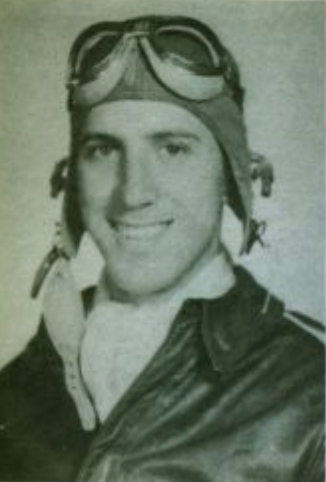
Photo Courtesy of Imperial War Museum, American Archive - 1LT Sidney David Shanken BombardierNavigator 340th BG - 488th BS - 12th AF
On Yom Kippur, far from home, a young Jewish airman sat in a makeshift synagogue, fasting, when word came that he was scheduled to fly. He could have stayed. Then a thought stopped him: if he did not go, someone else would have to. He raced back to the airfield.
That airman was my grandfather, Rabbi Sidney Shanken.
I thought of him on Remembrance Day, which I marked twice this year: in the morning at South Memorial Park in Vancouver, alongside the Vancouver Police Department and the broader community, and in the afternoon at Hillel House at the University of British Columbia, where four Jewish community organizations came together for the first time to mark the day.
At South Memorial Park, the rifle volley made the crowd startle. As the bugle played, a CP-140 Aurora roared low overhead. Then came “In Flanders Fields,” written in 1915 by John McCrae, a Canadian army doctor, after he buried a friend near Ypres.
Children sat on their parents’ shoulders or stood quietly beside grandparents, and I thought of McCrae’s charge to the living:
To you from failing hands we throw
The torch; be yours to hold it high.
I wondered what message we hoped they would carry home.
The obvious answer is sacrifice. But there is another lesson.
Ordinary people choose to do extraordinary things.
At Hillel House, I told my grandfather’s story. He was a freshman at the University of Texas when Pearl Harbor was attacked. He left campus, enlisted in the Army Air Corps and served as a bombardier-navigator over Sicily, Italy and Greece. Aircrews could stop after 25 missions. He volunteered for 25 more, and then again.
My father, Zev Shanken, captured that Yom Kippur mission in his poem “Why My Father Became a Rabbi,” published this year in The Montréal Review:
It was a low-flying mission to bomb German troops.
“That low, they can shoot you down with a rifle,” he used to add.
My father prayed that he not be off-target,
lest he hit the American troops on the other side of the line.
When the photographs came back,
he learned that every bomb had been true.
And that’s why he became a rabbi.
His combat flying ended on his 54th mission, when shrapnel tore through the floor of the plane and into his leg. He nearly bled out.
But his courage did not end with the war.
In 1961, he joined the Freedom Rides. When his synagogue’s trustees asked whom he had represented, he answered in one word: “Judaism.”
In 1963, he was one of 19 rabbis sent to Birmingham, Alabama, to stand with the civil rights movement. He recalled speaking at the 16th Street Baptist Church, where girls asked him to sign their copybooks. That September, a bomb at that church killed four girls.
I have thought often about what it must have taken to make those choices. To leave the relative safety of a university campus and go to war. To return home and, years later, put himself in harm’s way again, this time in the fight for civil rights.
The young airman and the rabbi in Birmingham were the same person. He was not born a hero. He kept answering when history asked.
Neither were the people we honour on Remembrance Day born heroes. They were students, workers, sons and daughters, with futures they expected to live. Wars are fought by the young, who sacrifice so that many of us can grow old together.
This year, that truth came close to home. In October, Private Aidan Goulding of North Vancouver, a young Jewish man of just 23, was one of four soldiers killed when a massive fire overtook a training exercise at CFB Wainwright. Private Hayden Lykkemark of Langley was 19. They died preparing to serve, Canadians who had chosen to stand ready for the rest of us.
First responders make the same choice. So did the young Israelis who, on and after October 7, ran toward danger to protect others.
What connects these stories is not the uniform, the country or even the circumstances. It is the willingness to act when others are depending on you.
That afternoon at Hillel House, I was struck by the generations represented in the room. The Jewish Museum and Archives of British Columbia preserves our memory. The Jewish Seniors Alliance of British Columbia carries our lived experience. The Jewish Federation of British Columbia works to strengthen Jewish life today. And Hillel BC nurtures the young people who will one day lead our community. Four organizations, each doing different work, but all part of the same story.
It brought me back to McCrae’s words. The torch is something we pass from one generation to the next.
And holding our gathering on a university campus was no accident. For Jewish students in Canada, the university has become one of the modern battlefields.
Since October 7, being openly Jewish on campus has become an act that requires courage. They have been asked to defend not only Israel, but their own identities and their place in institutions where they should feel welcome.
I think about what my grandfather might have said to those students. He was not much older than they are when he left university to serve. His circumstances were very different, but the question of personal responsibility remains.
Will they be visibly, unapologetically Jewish when retreat seems easier? Each faces a version of that choice: if they do not stand up, who will?
When it would be easier to remain silent, will we speak? When someone in our community feels isolated, will we stand beside them? When we see something wrong, will we act?
As I told the students that afternoon, facing challenges does not mean we lack the power to be heroes.
Our tradition teaches us that responsibility does not belong to someone else. In Pirkei Avot, Hillel asks, “If I am only for myself, what am I? And if not now, when?”
My grandfather lived that teaching, whether he was flying over Europe or standing alongside civil rights activists in Alabama.
The people we honour on Remembrance Day were once children themselves. Remembrance should do more than salute past courage. It should help cultivate courage in the next generation.
Most of us will never fly combat missions. Our moments will come in classrooms and boardrooms, synagogues and campuses, around family dinner tables. My grandfather’s life taught me that great acts of courage are built on a lifetime of smaller acts of integrity.
This week, we can begin with something simple. Tell your children the story of someone in your family who chose to step forward. Reach out to a Jewish student and ask how they are really doing, then show up for them. And when you hear hatred, be the first to speak, not the last.
In that makeshift synagogue, my grandfather made his choice. He could have stayed. Instead, he understood that if he did not go, someone else would have to.
That is the responsibility we inherit.
One day, others will tell the story of our generation.
May we give them something worth remembering.