

“If I Stay, There’ll Be a Jew”
“If I Stay, There’ll Be a Jew”
Part One: From Pogrom to Sag Harbor
What follows is the story of one of my four sets of great-grandparents: Nathan and Julia Meyersohn. I am fortunate to have unusually clear knowledge of their lives because their story was preserved through conversations with their children: my grandmother Esther, my great-aunt Annie, and my great-uncle Oscar, who was especially determined that I remember it.
The particulars belong to my family, but the larger story belongs to many American Jews whose parents, grandparents, great-grandparents, or great-great-grandparents fled the recurring pogroms of the Russian Empire between 1881 and 1921. Those waves of violence reshaped Jewish life for generations. The survivors came to the United States seeking safety and then built communities that became their homes.
I am sharing this not only to preserve my family’s history, but because it is part of Jewish American history—and therefore part of American history.
This story did not come to me all at once.
I first heard pieces of it as a very young child, in the background of adult conversations. I remember telling my mother that I liked listening to grown-up talk because it was more interesting. That instinct goes back to when I was three, four, or five years old.
At home, my bedroom shared a wall with the living room. When my parents had friends and family over, I would lie in bed listening through that wall. When we visited relatives, I listened while my parents’ generation and my grandparents’ generation talked.
I was quiet, but I was paying attention.
Through those conversations, I learned things long before I fully understood them. I learned that some members of the family escaped Russia and some did not. I learned that letters were exchanged with relatives who remained behind until World War II.
Later, I learned that those who had not escaped did not survive the Holocaust.
The story solidified when I was twenty-two, during the final year of my great-uncle Oscar’s life. He was relentless about telling me these stories. Fanatical, really. He wanted to make certain that I had them.
I am profoundly grateful that he did.
Rabbi Nathan Meyersohn was born in 1856, exactly one hundred years before I was born. He was known within the family by his Hebrew name, Nissan. In America, he became Nathan Meyersohn.
That coincidence in our birth years always struck me. I do not know what it means, but it made him feel close to me long before I understood why.
Nissan lived in a Jewish ghetto village outside Moscow, likely in what is now greater Moscow. He was a rabbi and a leader in his community.
That made him both respected and highly visible.
In Russia at that time, visibility was dangerous.
When the pogrom came, it came deliberately.
According to my great-uncle Oscar, Nissan was asleep when it began. He was awakened by his wife screaming as she was being bayoneted to death.
He woke into that moment.
He reacted immediately. He wrested the rifle and bayonet away from the Cossack soldier who was killing her and killed that soldier with his own weapon. He reached down and knew that his wife was gone.
He ran out of the bedroom.
There were two more rooms. The room to the right held his two oldest sons.
In the common area, another Cossack soldier emerged, already bloodied. With surprise and momentum on his side, Nissan bayoneted him as well.
He entered the bedroom on the right.
His two oldest sons were dead.
In the other bedroom, four younger children were still asleep and untouched.
One of them was Oscar.
Nissan gathered the children in his arms and fled through the back of the house into the woods.
By morning, survivors were finding one another.
The details blur after that. What I know is that it took months for them to reach England. They traveled on foot across Europe and somehow crossed the English Channel.
There, they were placed in a refugee camp funded in part by the Jewish community of London.
That detail mattered to my uncle. Jews who had found safety were helping Jews who were fleeing death.
England limited the number of Jewish refugees it would accept, but this benevolent camp existed to provide people with food, rest, medical care, and enough strength to continue across the Atlantic.
America was opening its doors.
The voyage was harsh. This was no pleasure ship. And yet, according to my uncle, there was Jewish humor.
Arguments broke out over whether someone wanted a first-floor walk-up or feared being stuck on the fifth floor.
About two-thirds of the way across the Atlantic, word arrived that Ellis Island was overflowing. An immigration annex had been opened in Sag Harbor, New York. Nissan’s ship was the second to arrive there, preceded by another ship only a day earlier.
The passengers were inspected and quarantined for approximately five days to a week.
Everyone remained healthy.
Like those of many immigrant families, Nissan’s name was changed upon his arrival. He became Nathan Meyersohn. Later, his adult children simplified the spelling of the family name to Myerson.
When the quarantine ended, a train arrived to take the refugees to New York City. They were greeted by Jews who had arrived roughly twenty years earlier, many of them from Germany, who urged the newcomers to board the train.
That was where Jewish life already existed.
Nathan said in Yiddish that he wanted to remain in Sag Harbor. It was beautiful there.
The German Jews told him:
“There are no Jews here.”
Nathan replied:
“If I stay, there’ll be a Jew.”
Then Nathan did something even more important.
He turned to the hundreds of refugees around him and delivered a powerful speech. He urged them to remain and build a Jewish community together.
About fifty stayed.
They did not know where they would sleep that night. They did not know what they would eat.
But they stayed.
And they thrived.
For years afterward, Nathan went to the docks to meet Jewish immigrants as their ships arrived.
About a year later, another ship brought the woman who would become my great-grandmother, Julia. She was in her late twenties and, according to the history passed down to me, was the sole survivor of her family after another pogrom. Her parents, brothers, sisters, cousins, husband, and children had been killed.
Oscar told me that when Nathan and Julia saw one another, it was love at first sight.
They went on to have eight children together.
Rabbi Nathan Meyersohn became a driving force in the creation of the congregation, its synagogue, and the Jewish community of Sag Harbor. He personally donated $350 for the land, a substantial sum at the time.
He worked alongside a group of congregants to construct the original synagogue. They did not hire contractors. They bought the lumber, pooled their labor, and built it themselves.
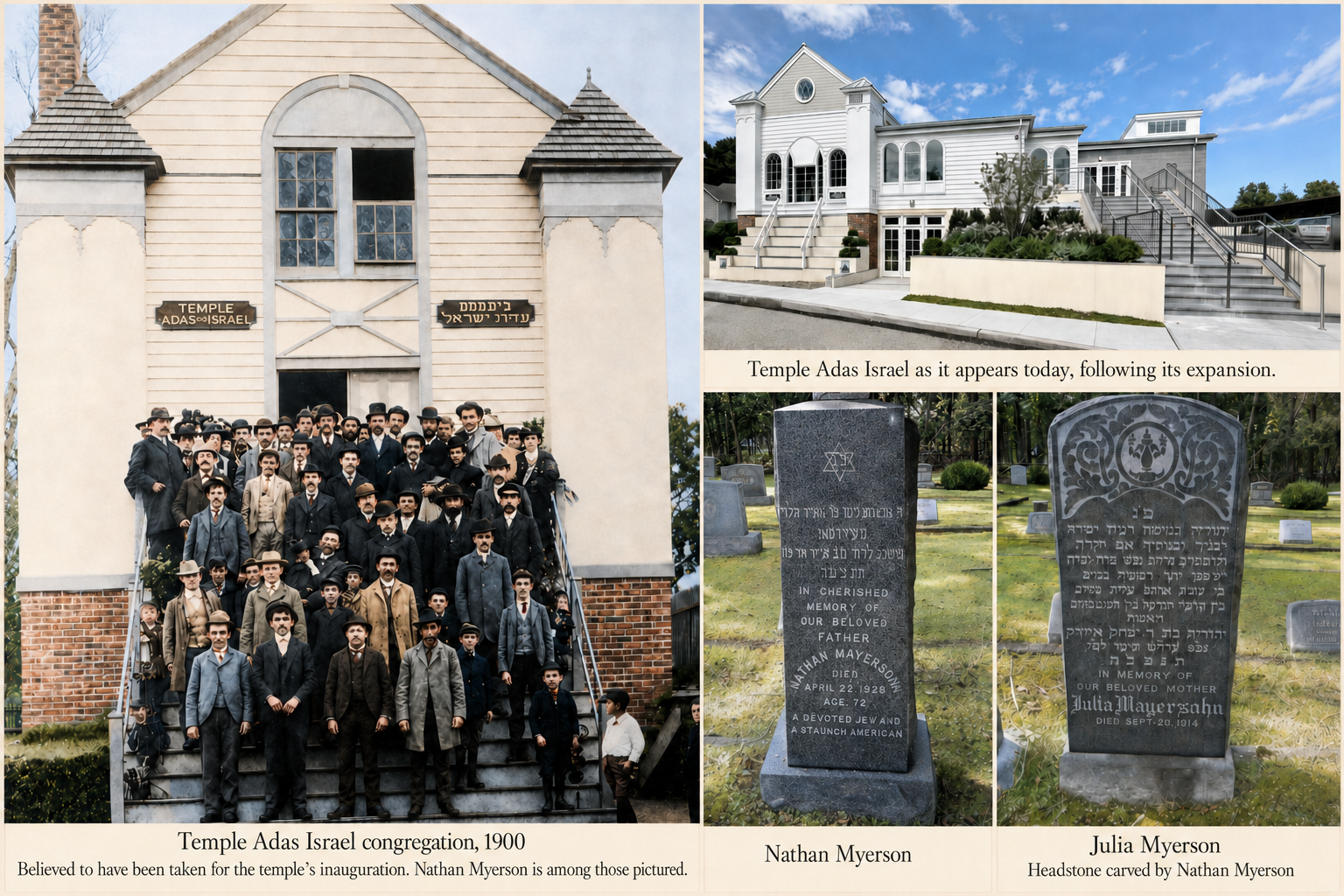
That original structure still stands as the core of Temple Adas Israel, although at least two major additions have been constructed over the years.
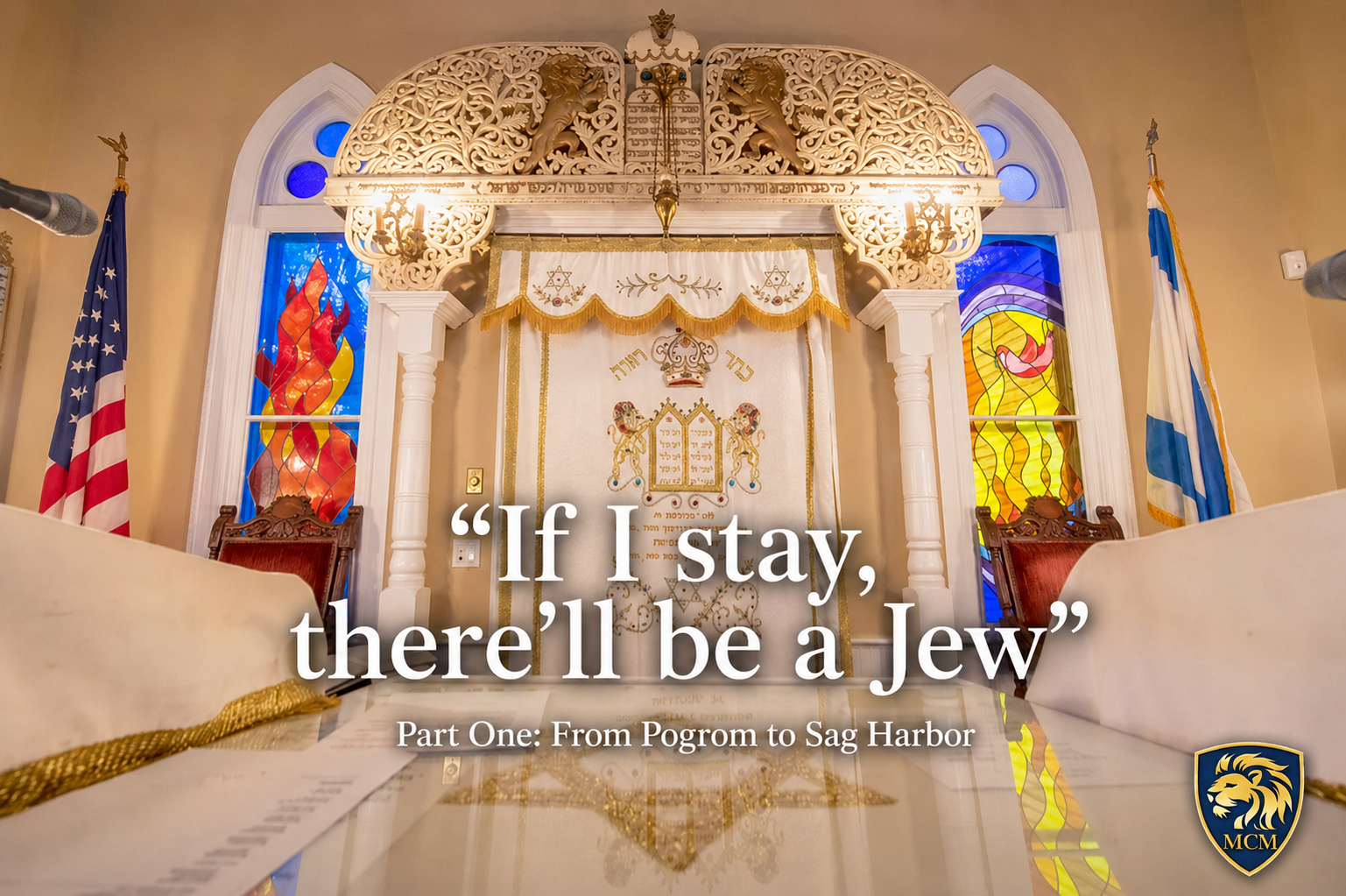
Inside the sanctuary is one of its greatest treasures: the hand-carved wooden lattice surrounding the ark where the Torah is kept.
Nathan carved it himself.
It remains there today, one of the congregation’s great sources of pride.
Nathan was also an artisan and stonecutter. He carved every headstone in the cemetery that predates his death. In the older sections of Sag Harbor, he carved the granite street signs that still stand at historic intersections.
It was one of the ways he earned a living.
His work still marks the town.
His own headstone reads:
In cherished memory of our beloved father, Nathan Meyersohn. Died April 22, 1928. Age 72. A devoted Jew and a staunch American.
Those words matter.
Nathan loved America and embraced his Judaism fully. He was an outspoken advocate for the separation of church and state and wrote editorials arguing that religious freedom and democracy strengthened one another.
He had escaped a world in which being visibly Jewish could bring death. In America, he helped build a synagogue, a congregation, a family, and a community without surrendering either his Judaism or his new American identity.
Nathan and Julia did not merely seek refuge in America.
They became Americans.
They built lives here, raised children here, served their community, and understood their Jewish identity and American identity not as competing loyalties, but as commitments that strengthened one another.
The words on Nathan’s headstone reflect the life he chose to build:
A devoted Jew and a staunch American.
He did not wait for someone else to create Jewish life for him.
He stayed.
And because he stayed, there was a Jew.
Then there were fifty.
Then there was a congregation.
Then there was a synagogue.
And that community still exists and thrives.
The story did not end there.
To be continued.