
If We Decide
If We Decide
Smotrich’s Grammar of Absolute Victory
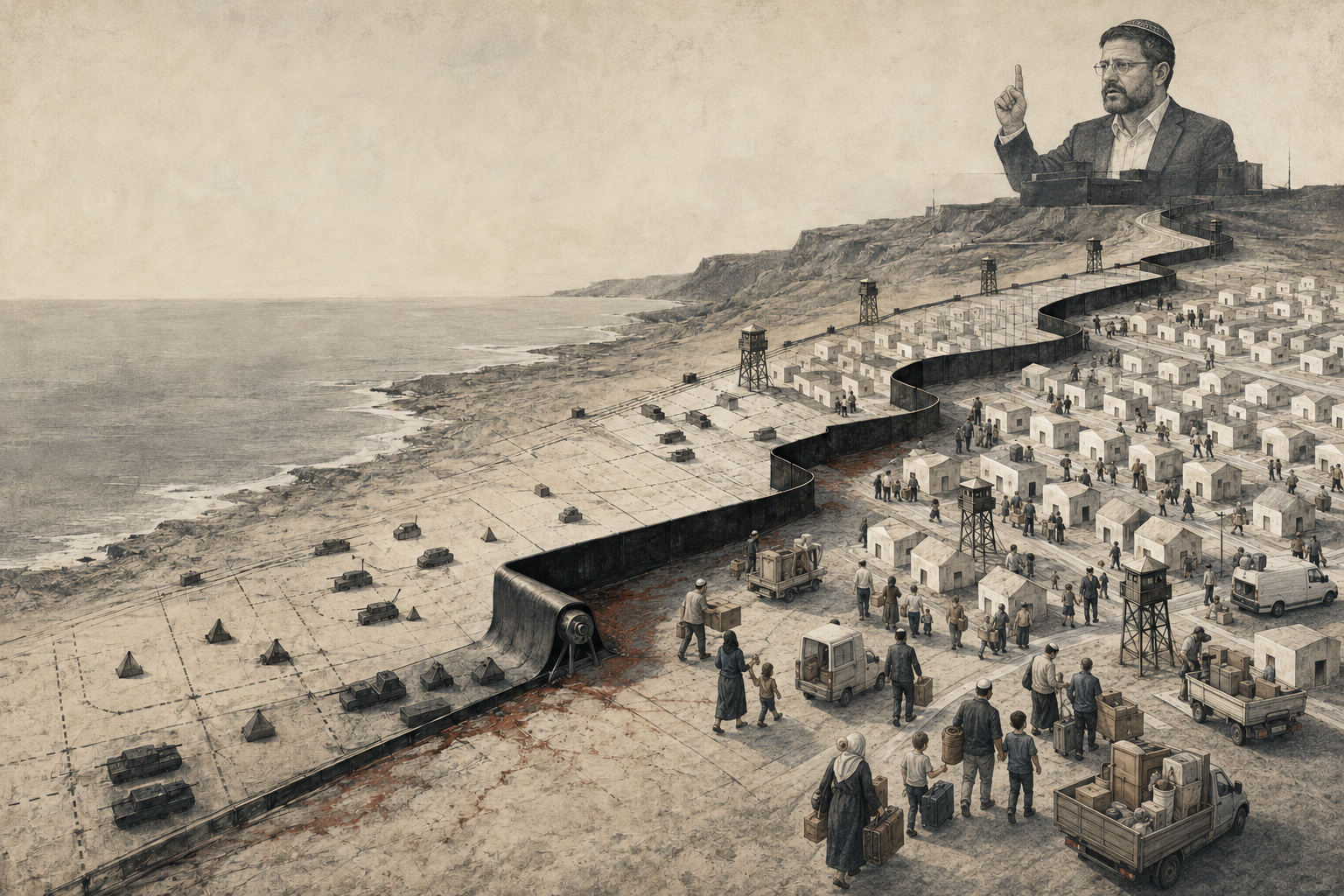
Bezalel Smotrich has defined absolute victory. Not as a general promise to defeat Hamas or as a formula attached to a continuing war, but as a specific sequence of actions. Israel is to conquer and liberate the areas of the homeland in Gaza, settle them, retain the army, and call the resulting permanence security. Only the decision remains conditional: “If we decide, that is what will happen.”
This analysis begins with the Hebrew original, not with an English translation:
אם אנחנו נחליט שהמלחמה הזאת מסתיימת בזה שאנחנו כובשים, משחררים את חבלי המולדת בעזה ומיישבים אותה, זה מה שיהיה. וזה, בעזרת השם, יהיה באמת הניצחון המוחלט — גם בהיגיון הפשוט של גביית מחיר וקיבוע תודעת הפסד למי שעולל לנו את מה שהנאצים האלה עוללו לנו, אבל גם בזה שזה כבר לא עוד סבב. גמרנו, זהו. יש התיישבות, יש צבא, יש ביטחון. המציאות מוכיחה את הדבר הפשוט הזה.
In English:
“If we decide that this war ends with us conquering, liberating the areas of the homeland in Gaza and settling it, that is what will happen. And this, with God’s help, will truly be absolute victory—both according to the simple logic of exacting a price and fixing a consciousness of defeat in those who inflicted upon us what these Nazis inflicted upon us, and because this will no longer be another round. We are finished; that is it. There is settlement, there is an army, there is security. Reality proves this simple truth.”
This is not the language of possibility. Smotrich does not say that Gaza might be conquered, that settlement should be considered, or that a permanent Israeli presence could emerge under favourable circumstances. His sentence contains only one condition: אם אנחנו נחליט — “if we decide.” What follows is expressed as certainty: זה מה שיהיה — “that is what will happen.”
The Hebrew verb כובשים — kovshim can mean conquering, capturing, occupying or taking control. There is no reason to choose an English equivalent merely to intensify or soften the statement. What matters is the relationship between Smotrich’s own verbs. He does not say only כובשים — we conquer. He immediately adds משחררים — we liberate. Conquest and liberation are presented as one movement.
The first verb describes a military action; the second determines its meaning. The object of both is חבלי המולדת בעזה — the areas of the homeland in Gaza. The army conquers territory, but that territory has already been designated as part of the homeland. Its conquest can therefore appear as liberation.
The decisive work is performed by מולדת — homeland. In Smotrich’s language, the army does not enter a territory whose status will be determined later. Its status is already contained in the sentence before the action begins. What is to be conquered has already been named part of the homeland. The noun establishes the title before the verb sets the army in motion.
Then comes מיישבים אותה — we settle it. Settlement is not introduced as a separate possibility or as a reward for military success. It belongs to the definition of how the war is to end. If areas of the homeland have been liberated, settlement gives that liberation a permanent form.
The sequence as a whole receives a name: הניצחון המוחלט — absolute victory. The term is not an isolated slogan. Smotrich specifies its content. In this statement, absolute victory means a war ending with the conquest and liberation of areas of the homeland in Gaza and their settlement.
The meaning of מוחלט — absolute, complete, final is developed through its opposition to עוד סבב — another round. Smotrich says: “This will no longer be another round. We are finished; that is it.” Victory is to be absolute not only because the enemy has been defeated militarily, but because there will be no return to the arrangement from which another round could begin.
Settlement performs this function. A military operation can end, and military control can prove temporary. Settlement changes the character of the presence. The result of war acquires a civilian form whose continuation requires the presence of the army. Smotrich therefore moves directly from “we are finished; that is it” to the sentence: “There is settlement, there is an army, there is security.”
The order of these words must be preserved. Smotrich does not say that security will first be established and may eventually make settlement possible. He says: יש התיישבות, יש צבא, יש ביטחון — there is settlement, there is an army, there is security. Settlement precedes the army, and the army precedes security. The threefold יש — there is presents them as elements of a single final condition.
Within this construction, settlement is not a monument to victory or its decorative aftermath. It is part of the mechanism that makes victory absolute. Settlement retains the army, and their combined permanence is called security. Smotrich closes the formula with המציאות מוכיחה את הדבר הפשוט הזה — “Reality proves this simple truth.” He does not present the relationship as a hypothesis. Within his statement, reality has already confirmed it.
Another element of absolute victory is גביית מחיר — exacting a price. The Hebrew expression refers to collecting or exacting what is due. Smotrich joins it to קיבוע תודעת הפסד — fixing a consciousness of defeat. This does not mean producing a temporary feeling of having lost. Kibua means fixing, consolidating or making something permanent.
Exacting a price and fixing a consciousness of defeat belong to the same construction as conquest, liberation and settlement. The price acquires a territorial dimension because the outcome of the war is to change the condition of the land. The consciousness of defeat is attached to a result that does not disappear when the military operation ends. The consciousness of the enemy and the condition of the territory are to be changed together.
Force is not the final condition here. It begins a movement leading from conquest to liberation, from liberation to settlement, and from settlement to the permanent presence of the army and security. The border is no longer merely a line defended by force. It becomes a line set in motion by force.
Nothing needs to be added to this statement. There is no need to attribute intentions to Smotrich that he did not express or to replace his terms with the language of an external judgment. Nor should one write that he is merely “considering,” “envisioning” or “seeking to promote” such an outcome. That would add uncertainty absent from the Hebrew original.
It is enough to preserve his words, their order and their subject: אנחנו — we. This “we” decides, conquers, liberates and settles. The same “we” exacts the price, fixes the consciousness of defeat and establishes the condition called absolute victory. Between the political “we decide” and the material “that is what will happen,” Smotrich places no additional condition in this sentence.
The judgment does not belong to the author of this article. Smotrich delivered the definition publicly and in Hebrew: conquer and liberate the areas of the homeland in Gaza, settle them, end the succession of rounds, and establish a condition in which there is settlement, there is an army, there is security. He called that condition absolute victory.
Only one question remains for those included in his political “we”: Will you take responsibility for it?
Yochanan Schimmelpfennig