
Writing on Jewish life, relationships, trauma, and resilience
If Your Child Can’t Tell You the Hardest Truth, Nothing Else Matters

Illustrative. AI image created by the author.
Making our homes places where our children’s hardest truths are welcomed, not feared.
A few months ago, a friend told me about her daughter. Sixteen years old, good student, close with her parents — or so they thought. It was only by accident, scrolling through an old group chat she wasn’t supposed to see, that my friend learned her daughter had been dealing with an antisemitic incident at school for nearly a semester. Not once had her daughter mentioned it.
When my friend asked her why, her daughter said something that has stayed with me since: “I didn’t want you to make it a bigger thing than it already was.”
That sentence is the reason I’m writing this.
Her daughter wasn’t afraid of her parents’ indifference. She was afraid of their intensity.
In my last piece for these pages, I argued that the most important question facing American Jewish parents isn’t which political strategy keeps Jews safest — it’s whether we’re raising children grounded in worth or in wound. This essay is about the practical work of getting there. Because worth isn’t transmitted through what we tell our children about being Jewish. It’s transmitted through what happens when they tell us something hard.
Much of my work—and this essay—draws on the teachings of the pioneering family therapist, Virginia Satir, who believed that children grow not simply through protection but through emotional congruence: relationships where difficult truths can be spoken without fear of rejection. The question isn’t only whether our children are safe. It’s whether they feel safe enough with us to tell us when they aren’t.
Why children don’t tell us the hardest truths
Many children do not stay silent because they lack courage. They stay silent because truth-telling has not felt safe enough.
Jewish parents today worry constantly about what our children might be facing — at school, online, at camp, on campus, even in shul. We scan headlines, check in with teachers, watch for signs that something is wrong. But the safety that matters most isn’t only what happens out there. It’s whether our children feel safe enough to bring what happens out there back in here — into honest conversation with us.
Most of us say we want our children to tell us anything. We mean it. Yet many children quietly decide that some truths are too risky to share with their parents, and learn instead to carry those truths alone.
It is rarely because they lack courage or vocabulary. It is because they have learned, through experience, that telling the truth doesn’t feel safe enough.
Sometimes they fear judgment. A teenager who has heard a parent mock other kids’ mistakes, or speak with contempt about people who see Israel differently, may reasonably think: if I admit this, you’ll see me the way you see them. When the most painful truth touches on sexuality, mental health, doubts about Judaism or Israel, or an experience of antisemitism, that fear intensifies. A child who isn’t sure how she feels about a protest at her campus Hillel, or who got into an argument she’s ashamed of with a friend over Gaza, may decide it’s easier to say nothing than to risk being measured against a standard she isn’t sure she meets.
Sometimes they fear overwhelming us. Children are astonishingly attuned to their parents’ emotional states. A child who has watched a parent shut down, panic, or explode over distressing news will quietly conclude that bringing hard truths home is dangerous: if I tell you, you’ll fall apart, and then I’ll have to take care of you. Protecting the parent becomes more important than telling the whole story.
Sometimes they fear losing control of what happens next. A child who previously shared something painful and then watched a parent immediately call the school, post online, or confront other adults without asking first may decide that silence is safer than unleashing a storm.
And sometimes they have simply been dismissed. It’s not a big deal. You’re too sensitive. I’m sure they didn’t mean it. After a few such experiences, children learn that the hard stories will either be minimized or met with advice instead of understanding. Silence starts to feel more respectful of their own experience than talking.
None of this means parents are uncaring. It means our understandable fear, anger, and urgency have sometimes made it harder for our children to trust us with what hurts most.
Emotional safety starts with us
If we want to make it safe for our children to tell us what hurts them most, we cannot begin with them. We have to begin with ourselves.
Emotional safety for children is not the absence of parental feeling. It is the presence of parental steadiness.
When a child hints that something serious has happened — a frightening interaction online, an antisemitic comment at school, a situation that feels like bullying or worse, a deep doubt about their Jewish identity — our bodies respond before our words do. Our hearts race. Our minds start solving, defending, protecting. If we speak from that flooded state, even with the best intentions, our tone will carry alarm and control more than curiosity and care. Our children can feel the difference instantly.
The first step is simply noticing: I’m having a strong reaction. I feel scared. I feel protective. I feel angry. The second is choosing not to let those feelings run the conversation. That doesn’t mean suppressing them. It means taking a breath, softening our voice, and remembering that the child in front of us is deciding, right now, whether it was a mistake to start talking.
We can say something simple and honest: “I’m feeling a lot inside as I hear this. I care about you and I want to stay present. Tell me what happened at your pace.” This does two things. It names our feelings honestly, which builds trust. And it reassures the child that we are committed to staying grounded while they speak.
Listening before fixing
Most of us are problem-solvers. When our children are hurt or afraid, we want to act — call the teacher, write the email, contact the rabbi, change schools, confront whoever needs confronting. Sometimes those actions are exactly what’s needed. But action taken too quickly can unintentionally silence the very truth we want to honor.
Children who share something hard are testing whether we will first understand, or first take over.
When the difficult conversations involve shame — I didn’t speak up. I went along. I froze. I made a choice I regret — they need our listening more than our strategy.
Listening before fixing means giving space to the story. Tell me from the beginning. What was that like for you? What was going through your mind? It means reflecting back what we heard: You felt alone. You were scared and didn’t know what to do. You thought no one would believe you. That kind of reflection tells a child: I am with you. I see you. Your experience matters.
Only after the story has been heard and felt do we turn to what should we do? And when we reach that point, we can invite collaboration rather than announce a decision: “There are some things we may need to do to keep you safe. Before we decide, I want to hear how you feel about the options.” This keeps the child inside the decision, not just subject to it. It lets them experience themselves not only as someone something happened to, but as someone with agency in what happens next.
Listening before fixing is not passivity. It is the foundation that makes any action worth taking.
Naming hard Jewish feelings as acceptable, not forbidden
If we want children to tell us the hardest truths, we have to make it unmistakably clear that the hardest feelings are allowed in our home.
Your inner life can live here.
That means saying, often and sincerely, that anger, jealousy, confusion, shame, doubt, and fear are not “bad emotions.” They are signals. It means replacing “you shouldn’t feel that way” with “it makes sense that you feel that way.” When a child admits I feel ashamed, or I’m angry at God, or I’m not sure I believe what I’ve been taught, or even I don’t know how I feel about Israel right now, the words we say next can either open a lifelong channel of truth-telling or close it for years.
We can respond: “Thank you for trusting me with that. I know it might have been hard to say.” That simple sentence tells a child their inner world is not forbidden territory. It says: your inner life can live here.
In a Jewish context, this matters with particular weight. Our children are absorbing messages about antisemitism, Israel, faith, and belonging from a dozen directions at once — friends, social media, teachers, rabbis, us. If they learn that certain feelings or doubts will cause us to panic, lecture, or dismiss, they will keep those feelings to themselves. We will retain our sense of having raised strong Jews. We will have lost the chance to actually know the Jewish child sitting in front of us.
Repairing after we get it wrong
No parent responds perfectly every time. We will get loud when we meant to stay calm. We will interrupt when we meant to listen. We will rush to action when we meant to validate.
The good news is that emotional safety does not require perfection. It requires repair.
Emotional safety doesn’t mean children expect us to approve of everything they say. It means they trust that telling us the truth won’t cost them the relationship.
Repair sounds like: “Yesterday, when you tried to tell me what happened at the protest, I got angry and started talking instead of listening. I’m sorry. My fear took over. If you’re willing, I’d like to try again and hear more of what it was like for you.” This is not self-flagellation. It is leadership. It shows our children that adults can own their mistakes, settle themselves back down, and recommit to connection — which is precisely the skill we hope they’ll carry into their own difficult conversations, Jewish and otherwise, for the rest of their lives.
Repair can also include clarifying boundaries in advance: “If you tell me something that affects your safety or someone else’s, I may need to take action. I promise I’ll talk with you about it first, so you’re not surprised.” Children are far more willing to share hard truths when they know, ahead of time, when and how we might need to act.
Every time we repair, we send the same underlying message: our relationship can survive difficult conversations. You do not have to protect me from the truth.
Creating everyday spaces for truth
The hardest truths rarely emerge in formal family meetings. They slip out in ordinary moments: in the car after school, during dishes after dinner, at the edge of a Shabbat table, in the doorway at bedtime.
We cannot force those moments. But we can create the conditions that make them more likely.
That might mean intentionally building quiet, low-pressure time with each child — a weekly walk, a regular drive, a shared chore — without an agenda attached. It might mean asking open questions instead of closed ones: “What did you notice today?” rather than “Did anyone bother you?” It might mean occasional invitations that don’t demand an answer on the spot: “If anything ever happens at school or online that bothers you — even if you’re not sure how you feel about it yet — you can bring it to me. I’ll work hard to listen first.”

It can also mean telling some truths of our own, not to burden our children but to model honesty. “When I was your age, there were things I didn’t tell my parents because I was afraid of how they’d react. I’d like our relationship to be different. If you’re ever unsure whether to tell me something, you can even start with that: ‘I’m not sure I want to tell you this.’ I’ll try to show you, in that moment, that it’s safe.”
Creating everyday spaces for truth is less about technique and more about the atmosphere our children live inside. If that atmosphere feels mostly tense, judgmental, or rushed, the painful realities will hide. If it feels mostly curious, steady, and loving, they will eventually find their way to the surface.
Why this matters for Jewish families now
We are living through a time when many of the hardest truths our children carry touch directly on what it means to be Jewish: antisemitism at school or online, confusion about Israel and Gaza, doubts about faith and practice, questions about where they belong, and the quiet, painful realities of mental health and identity that run through every community.
We cannot control all of those realities. We can control whether our children have to face them alone.
If we want to raise children whose Jewish identity is grounded in worth rather than wound, we have to make it safe for them to bring their wounds home.
If we want them to experience Jewish life as a place of refuge and relationship, our homes have to be the first place where truth is welcomed rather than feared.
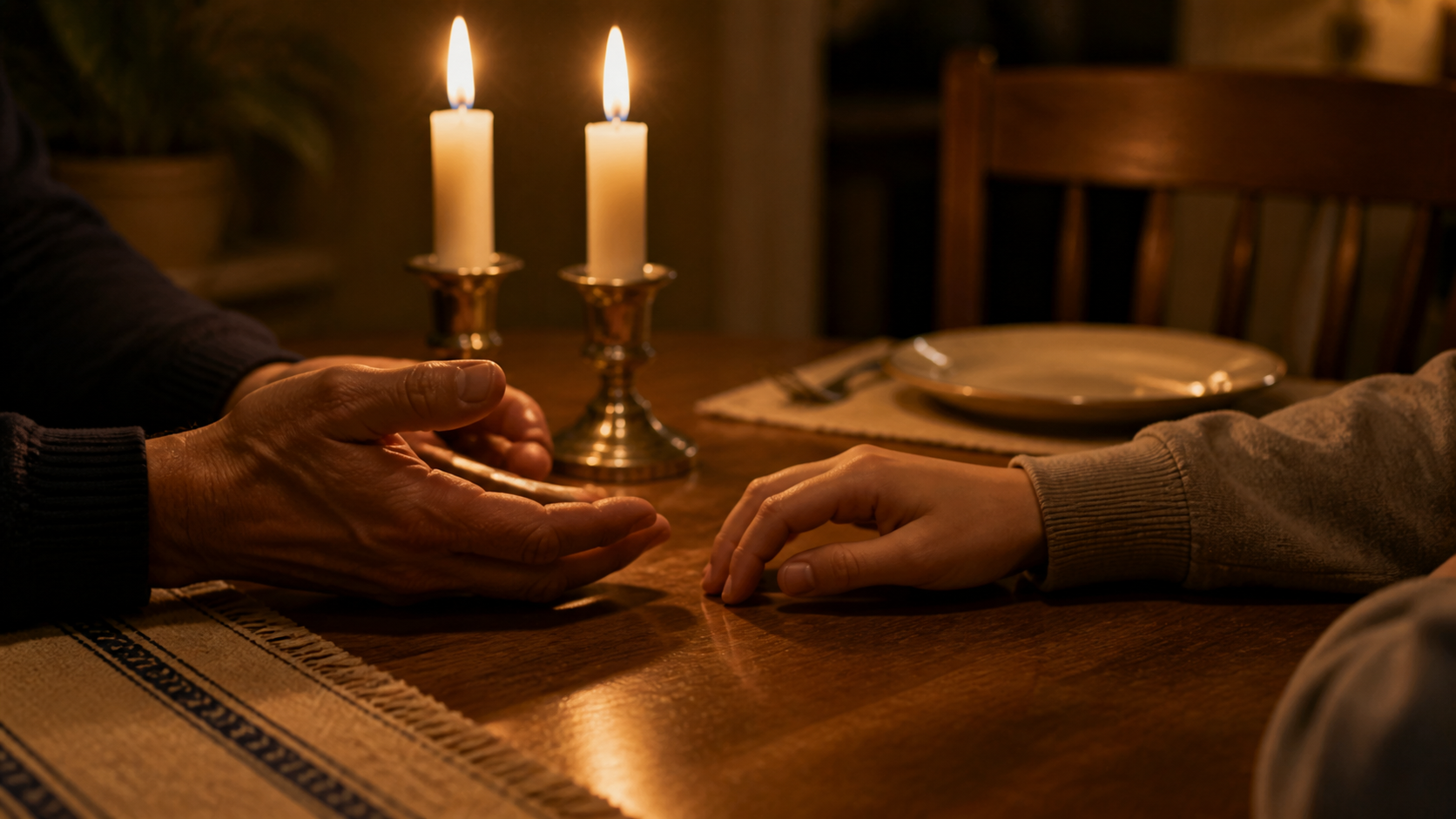
Our children will inherit much more than our opinions about antisemitism, politics, or theology. They will inherit the way we respond when their voice trembles. They will remember whether our eyes narrowed or softened, whether we reached first for questions or for control, whether our love felt safe enough to hold their hardest truths.
We cannot promise that nothing painful will happen to them. We can promise — and show, again and again — that when pain comes, they will not have to carry it alone.
That promise is made one conversation at a time: at a kitchen table, in a parked car, on a Friday night when the candles are lit and the world is quiet enough for a child — or a teenager, or a grown son or daughter — to say, “There is something I need to tell you,” and trust that the person across from them will be able to hear it.
Long before children remember what we advised, they’ll remember whether telling us the truth felt safe.
Related Topics