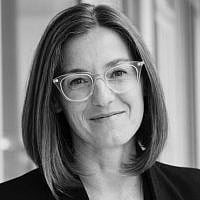
Representing Montana's 30th District
Featured Post
I’m a Montana state senator and I’m fighting Jew-hatred. You can too
When I recognized the same silence that doomed my family in the Holocaust, I stopped waiting and began using every tool I have to act, from state legislation to this very essay
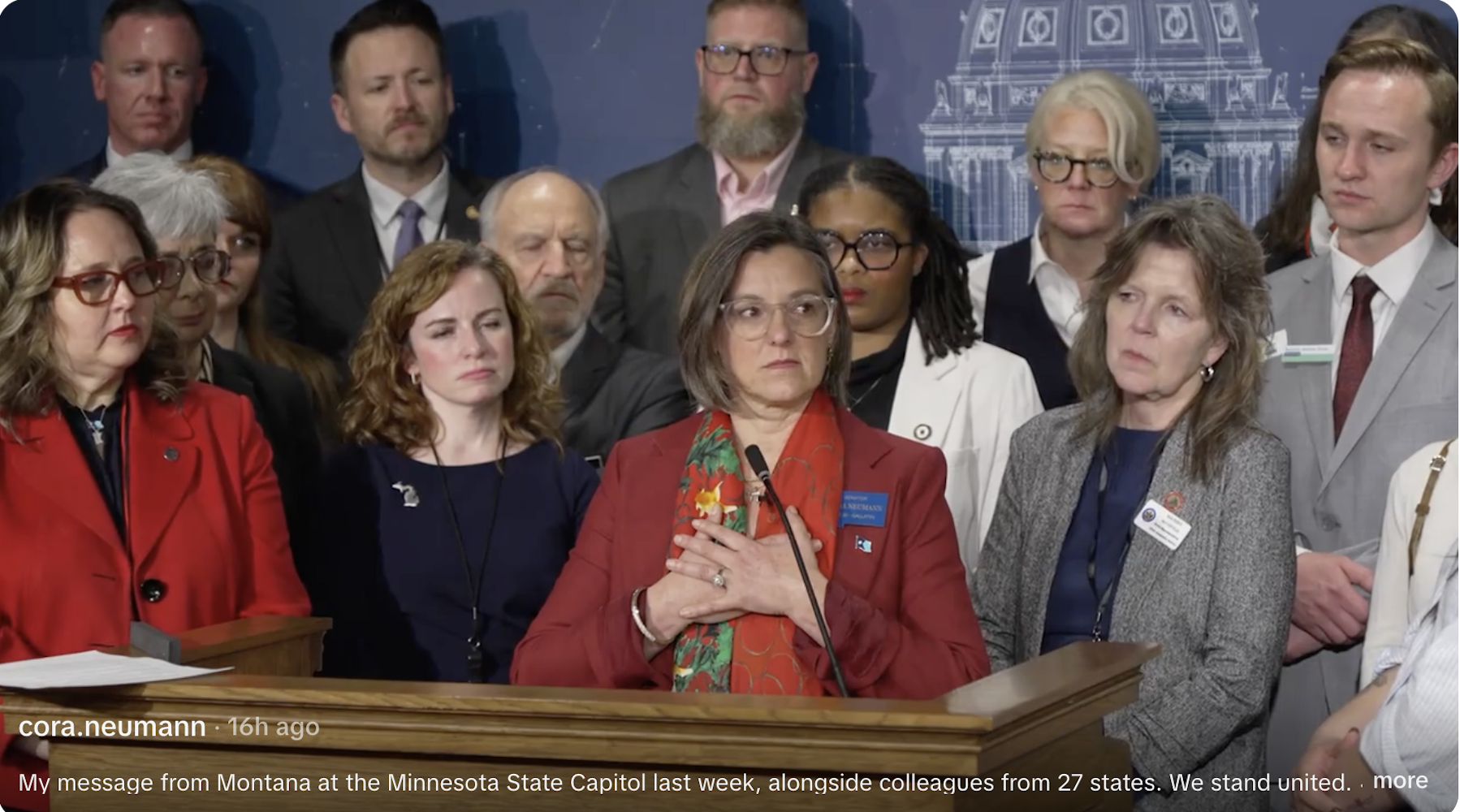
Montana state senator Cora Neumann speaks at the Minnesota State Capitol, on February 1, 2026, alongside colleagues from 27 states, protesting the actions of ICE in Minneapolis, Minnesota. (Screengrab, via Instagram)
I am a state senator in Montana. A Democrat in a red state. I have spent my career building bridges — working on public health equity with Indigenous communities, partnering with First Ladies Bush, Obama, Biden and more on global health initiatives, building bipartisan coalitions that have garnered attention from The New York Times and CBS National News. I believe in finding common ground, in compromise, in tomorrow being better than today.
And for over two years, I waited for tomorrow.
I waited for people to see that their proclaimed opposition to US aid to Israel has unleashed unbridled antisemitism and Jew-hatred worldwide. That the campus protests, the social media campaigns, the “anti-Zionist” movements — whatever their stated intentions — have given permission for the world’s oldest hate to explode. I’ve been waiting for them to connect their activism to the attacks on Jews in Paris, Toronto, Melbourne, Manchester, Jackson.
Like every generation before, they have not seen it.
And like Diaspora Jews throughout history — including my own grandparents in 1930s Germany and Austria — I kept waiting for tomorrow. For people to wake up, to see the pattern, to make the connection.
But as an elected official, I’ve learned that what happens isn’t inevitable, but the results of choices that we make collectively. Which means that we can choose differently.
My grandparents waited for tomorrow too. I thought I would be different. This is me saying: I’m done waiting. Tomorrow isn’t coming.
When it comes to fighting unchecked antisemitism, there is only today.
The Stories They Told Me
My grandparents left Germany and Austria, respectively, in the nick of time.
My grandmother, Johanna, was born in 1908 into a well-established Jewish family in Bingen, Germany. Her father owned Ferdinand Seligmann & Söhne, a timber, coal, and building materials business on the Rhine that had been in the family for generations. They even engaged in timber rafting on the Rhine – photos show logs piled by the Rhein-Nahe corner near their lumber yard. Johanna was academically brilliant. After the anti-Jewish Nuremberg Laws were passed and she was expelled from her German university, she did not give up, and pushed to earn her PhD in political history from the University of Bern in Switzerland, writing a dissertation on 19th-century German diplomacy, even as Germany’s anti-Jewish laws were making her and her family’s lives untenable.
My grandfather, Alfred, was born in Vienna, Austria, in 1910. His father died of tuberculosis after fighting for the Austro-Hungarian Empire in World War I—part of a generation of Jews who had served loyally, only to face growing antisemitism afterwards. Alfred earned his JD from the University of Vienna in 1934. He attended Sigmund Freud’s invitation-only Wednesday Society. He held a government position in Vienna. He built a career, a life, a future.
And then, piece by piece, they each had their lives taken away.
The Seligmann family’s generations-old business was forced to close. Their homes were ransacked. My grandmother finally found work teaching at Jewish schools in Germany. My grandfather watched his Austrian government position disappear and his legal career end. Jews were systematically stripped of civil rights, of livelihoods, of dignity.
Friends stopped speaking to them. My grandfather’s mentor — a man who had been like a father to him — crossed the street when he saw my grandfather coming. Just looked away. My grandfather told me it was one of the most heartbreaking moments of his life.
They kept waiting for people to wake up, incident after incident. “We thought our countries were too advanced,” they told me. “This couldn’t happen in Germany. Not in Austria.”
In March 1938, after the Anschluss, my grandfather was marked for deportation to Dachau. His mother bribed officials to give him 72 hours to flee. He escaped through Sweden and arrived in New York on September 10, 1938.
My grandmother left in 1937. Her parents followed in 1939. They were lucky; they got out.
Her uncle Ludwig was deported in 1942 and died in Theresienstadt. Her aunt Emilie was deported “to the East” in 1942 and did not survive. Cousins caught and killed. The family timber business that had stood on the Rhine for generations – erased.
Tomorrow never came. Eighty percent of our family died in the Holocaust.
My grandparents met at Columbia University’s School of Social Work, retraining—their European degrees worthless. They married in 1941 and spent the rest of their lives helping other refugees rebuild what they had lost. My grandfather was the executive director of Jewish Family and Children’s Service in Denver for nearly 30 years, helping Holocaust survivors, refugees fleeing Communist Russia, and eventually anyone in need, regardless of religion. In the 1960s, he traveled to Mississippi to join the civil rights movement, working alongside Rabbi Perry Nussbaum and other activists who believed that Jews who had survived persecution had a moral obligation to fight for others’ freedom.
As a child, listening to their stories, I thought: I would see it. I would act right away, I would never wait for tomorrow.
I was wrong.
October 7, 2023
October 7, 2023 was one of the most terrifying days of my life. Not just because of the massacre — 1,200 people murdered, mostly civilians, in their beds, at a music festival, while feeding their kids breakfast — but because of what I felt in my body. A fear I didn’t know I carried. An ancestral terror rising up from somewhere deep and primal. My grandparents’ stories flashing before me. Homes invaded. Families torn apart. People hunted.
I thought about my young adult children. What if they had been at that music festival for peace? They could have been. What if it had been them — dragged from their beds, taken hostage, abused, mutilated, raped, burned.
Within hours of the attack, before Israel had even responded, before any military action, before any policy decisions, antisemitic incidents surged 585 percent worldwide. By October 8th, the very next day, before the hostages’ families even knew if their loved ones were alive, protests had already erupted on college campuses and city streets around the world.
And from Day 1, we heard: “We are protesting military aid to Israel; this has nothing to do with Jews or antisemitism.”
Maybe tomorrow, I told myself. Maybe when people have time to process, they’ll realize this overnight surge reveals something deeper.
But the pattern emerged immediately and globally. Thousands descended on the Sydney Opera House, lit in blue and white to mourn victims, chanting, “Fuck the Jews” and “Where’s the Jews” — not “End the occupation,” not “Free Palestine.” Molotov cocktails were thrown at synagogues in Germany. At Cornell, threats appeared online: “If you see a Jewish ‘person’ on campus, follow them home and slit their throats.”
Educators at progressive liberal arts colleges across the United States could have said: “Not here. Not at our school.” Instead, they normalized it, and Jewish students faced violent threats.
And I waited for tomorrow.
Who Was Attacked?
An 88-year-old woman in Paris was beaten until her teeth were broken, for wearing a Star of David necklace, in June 2024.
A 12-year-old girl in France was raped while her attackers called her antisemitic slurs.
Five-year-old girls at Bais Chaya Mushka Elementary School in Toronto were shot at on May 25, 2024, and again on October 12, on Yom Kippur. Shot at a third time on December 20, 2024. Little girls who have never lobbied the government, who do not determine foreign aid budgets.
December 6, 2024, in Melbourne, Australia: The Adass Israel Synagogue was firebombed. The congregation was there to pray. Later, we learned Iran was involved — state-sponsored terrorism targeting a house of prayer.
Yom Kippur 2025, in Manchester, England: A man attacked the Heaton Park Hebrew Congregation synagogue. Two people were killed. The attacker claimed allegiance to ISIS.
December 15, 2025, Bondi Beach, Sydney, Australia: Sixteen people murdered as families gathered to celebrate the first night of Hanukkah. Two gunmen opened fire on children lighting candles, on parents watching the sunset, on grandparents singing prayers.
January 10, 2026, Jackson, Mississippi: Beth Israel Congregation burned in an arson attack. In 1967, the KKK bombed that synagogue because my grandfather and other Jews were fighting for civil rights. Sixty years later, it burned again.
These victims aren’t politicians. They aren’t soldiers. They aren’t making policy decisions. These are children, grandmothers, people at prayer.
This has nothing to do with foreign aid policy. This is radical and religious extremism targeting Jews for being Jews.
The Pattern across History
Over 2,700 years — from the Assyrian captivity to October 7, 2023 — there have been more than 30 major expulsions, massacres, and systematic persecutions of Jewish people. Medieval massacres blamed Jews for the plague. The Spanish Inquisition targeted Jewish religious practices. Eastern European pogroms scapegoated Jews for economic hardship. The Holocaust blamed Jews for Germany’s defeat in World War I.
Different centuries. Different continents. Different excuses, and every generation thought it was the exception to the pattern.
These days, hate is guised as opposition to “US aid to Israel.” It’s a different rationale, but the same hate. Same certainty that this time it’s justified. That this time, Jews actually deserve what they get.
But every generation thought its scapegoating and violence was justified. And every generation was wrong.
The Selective Outrage
Some will say: “It’s not antisemitic to criticize the Israeli government.” I agree. Criticizing any government is legitimate and necessary. But here’s what I cannot ignore as a legislator who works on human rights:
- China operates concentration camps holding over one million Uyghur Muslims. US economic ties to China dwarf aid to Israel — over $500 billion in annual trade, trillions in corporate investment. Where are the calls to boycott China? The protests outside Chinese consulates? The attacks on Chinese-Americans?
- Saudi Arabia, a regime that executes dissidents, murders journalists, and bombs Yemeni civilians, receives over $10 billion in US arms sales. Where’s the outrage about US complicity in Yemen’s humanitarian catastrophe?
- Afghanistan: The US spent $2.3 trillion over 20 years, funding a war that killed more than 70,000 Afghan civilians, then abandoned women to the Taliban’s gender apartheid. Where is the fury about that?
- Iran has massacred thousands of protesters in recent months. Videos show hundreds of body bags piled in makeshift morgues. Where are the campus encampments? Where’s the sustained fury?
- Settler colonialism: The US was founded on land taken from Native Americans. I live on this land. You probably do too. It’s one of the largest systems of settler colonialism in history. Why aren’t we returning the land we live on to the Wampanoag, the Lenape, the Blackfeet, the Crow?
The answer is simple, and everyone knows it: Because it’s easy to blame Israel. Because antisemitism has always been the socially acceptable prejudice.
Sweden: When I Stopped Waiting
Sweden saved my grandfather’s life by giving him safe passage out of Austria in 1938 when every door was closed. Sweden is the reason I am alive today.
In October 2025, the Jewish International Film Festival in Malmö was canceled. The festival was to celebrate 250 years of Jewish life in Sweden. Every cinema in the city refused to host it. Multiple venues explicitly cited security concerns, though the Malmö police had offered to provide security and there had been no threats against the festival. Sweden’s Culture Minister called it “an absolute catastrophe for Swedish society.”
That’s when I finally understood what my grandparents tried to tell me: tomorrow isn’t coming. No one is going to wake up. I have to act today.
Two years and 10 days after October 7, I stopped waiting.
I began drafting explicit anti-hate crime legislation for Montana. I joined the “50 States One Israel” trip to Israel with state legislators from across the US, Democrats and Republicans, willing to fight antisemitism and support Israel’s right to exist and defend itself. I started building coalitions with progressive but Israel-supporting Democrats and with Republicans who understand what we’re facing. We’re strategizing on how to wake Americans up to this increasing hate and violence.
I cannot change US foreign policy. I cannot make Sweden show Jewish films. I can’t protect Jews in Paris or Sydney or Toronto. But I can protect Jewish families in Montana. I can work to pass state legislation. I can build coalitions with other state legislators across the country. I can use the platform I have as an elected official.
The Violence Accelerating
Since October 7, France has seen a 1,000% increase in antisemitic incidents. The UK: 600%. Germany: 350%. Austria: 500%. Australia: 738% — culminating in the Bondi Beach massacre. The US recorded over 10,000 antisemitic incidents last year, the highest ever recorded. The UK: 4,103, also the highest ever.
This is systematic, global, and sustained — and it is accelerating.
Where Do We Run?
My grandparents survived because they saw a pattern and ran.
But this antisemitism is happening everywhere, all around the world, all at once. I know hate isn’t inevitable, but too many people are choosing silence, choosing to look away, choosing to treat antisemitism as collateral damage.
My grandfather told me: “The moment I knew we had to leave wasn’t the violence.….The violence came because the silence gave permission.… By the time they came to round us up… we’d already been abandoned.”
These days, the silence is deafening.
It gives permission for the antisemitic attacks. And none of it advances Palestinian rights or brings peace closer. The only people who win when Jews are targeted are those who never wanted peace to begin with.
What I’m Asking You
My grandfather waited for “tomorrow” until he had 72 hours to flee.
I waited for tomorrow for two years.
How long will you wait?
Will you admit you got something wrong? That’s not weakness. That’s courage.
You don’t have to be an elected official. You don’t have to agree with every Israeli policy. You don’t have to stop advocating for Palestinian lives.
But you do have to decide whether you’ll act today.
Tomorrow Is Today
I’m done waiting for tomorrow. When it comes to antisemitism and Jew-hate, tomorrow never comes.
I’m using every tool I have as a state legislator to fight this — introducing legislation to combat hate crimes, building bipartisan coalitions across the country with Democrats and Republicans who understand that the world’s oldest hate is finding a new excuse.
This essay is my refusal to wait. My legislative work is my commitment to create change today.
And my challenge to you, even if you don’t agree with every word I’ve written, is just this: Will you act today, or will you keep waiting for tomorrow?
Tomorrow never comes. There is only today.
Related Topics
Related Posts