
I’m no Bibi fan, but why condemn him and not others?
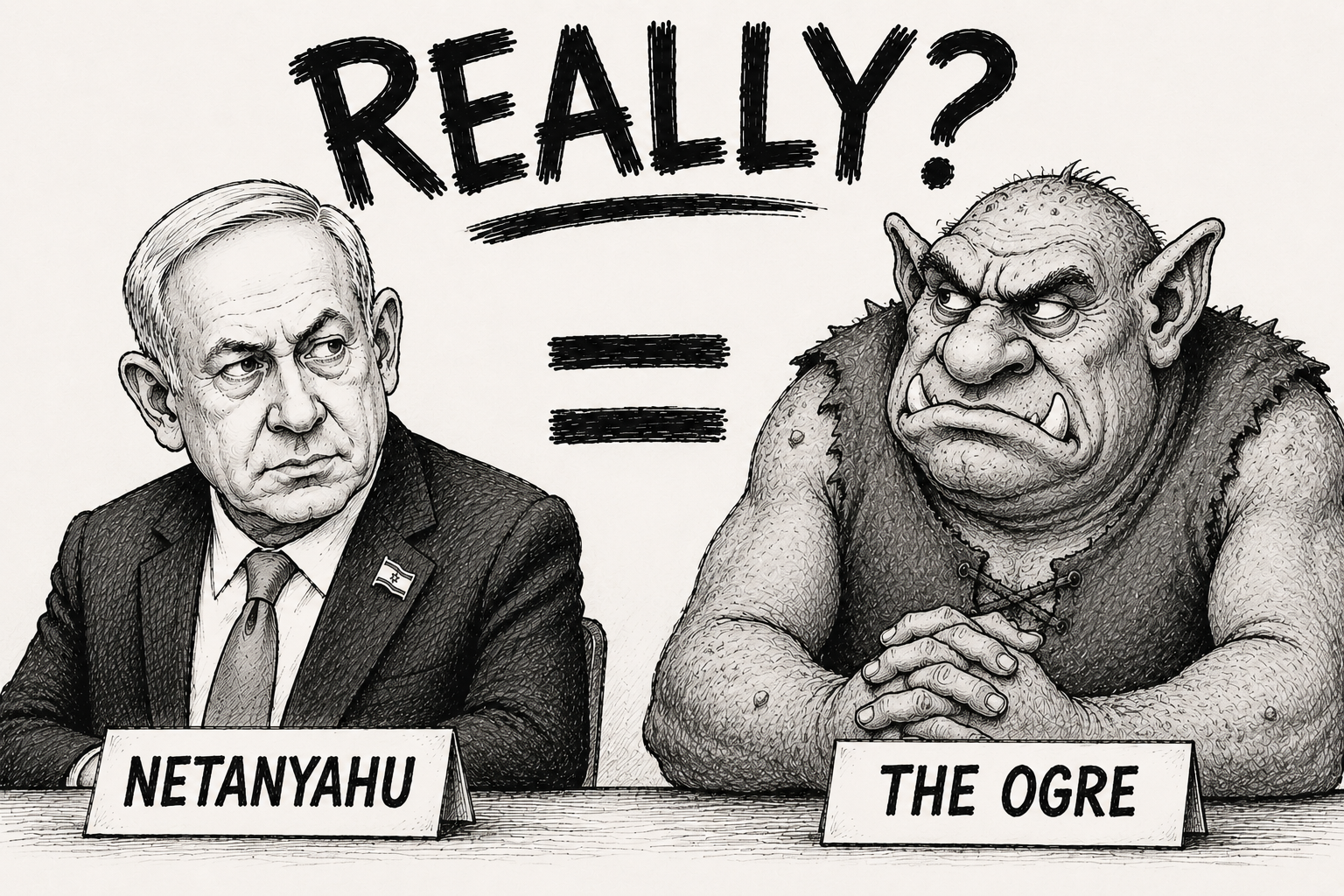
I am no Bibistit — the Hebrew term for a devoted supporter of Benjamin Netanyahu.
I opposed his judicial reform initiative, which deeply divided Israeli society. I was disappointed when he formed a government with Itamar Ben Gvir and Bezalel Smotrich, after leading many voters to believe he would not. I was also troubled by what I viewed as his efforts to prevent the agreed rotation in the prime ministership with Benny Gantz from taking place. I believe he has been too slow to accept personal responsibility for the failures that led to October 7 and insufficiently present for many of the families whose lives were shattered by that day.
Yet I find myself increasingly troubled by the way Netanyahu is discussed in some American political circles.
Many Americans, particularly on the political left, describe Netanyahu as uniquely evil, uniquely corrupt, uniquely racist, uniquely authoritarian, or uniquely responsible for instability in the Middle East. Some compare him to history’s worst leaders. Others speak of him as though he is among the world’s foremost human rights offenders.
This raises an obvious question.
Compared to whom?
The United States maintains close relationships with Egypt, Jordan, Saudi Arabia, Qatar, and the United Arab Emirates. Their leaders receive American military assistance, intelligence cooperation, diplomatic support, and high-level meetings in Washington.
Egypt’s Abdel Fattah el-Sisi presides over an authoritarian government that has imprisoned political opponents, journalists, and dissidents. Saudi Arabia’s Mohammed bin Salman oversees a country without national democratic elections and whose record includes the murder of journalist Jamal Khashoggi. The Saudi-led intervention in Yemen contributed to one of the world’s worst humanitarian disasters. Qatar hosted Hamas leaders and for years transferred funds into Gaza with the knowledge of multiple governments that hoped doing so would preserve stability. Jordan and the UAE are generally more moderate and stable than many of their neighbors, but neither approaches Israel’s level of democratic openness.
Yet none of these leaders seems to occupy the same place in the moral imagination of many American progressives as Benjamin Netanyahu.
In many of the political discussions I encounter, Netanyahu is mentioned more often than virtually any other foreign leader. Donald Trump may be the only political figure who receives comparable attention. Yet many of the people engaged in these discussions rarely mention Sisi, Mohammed bin Salman, Bashar al-Assad, Ayatollah Ali Khamenei, or other leaders whose records on civil liberties and political repression are far worse.
To be clear, democracies should be held to higher standards than dictatorships. That is entirely appropriate. Israel also receives substantial American aid, and Americans have every right to debate the policies of a close ally.
But holding democracies to higher standards is one thing. Reserving uniquely intense moral condemnation for the elected leader of the Middle East’s only liberal democracy is something else.
Consider some of the language used by prominent American lawmakers. Senator Bernie Sanders has described Netanyahu’s government as “extremist and racist.” Representative Rashida Tlaib has called him a “war criminal” and argued that he should be arrested. Senator Elizabeth Warren has accused Netanyahu and his government of creating a “massive humanitarian disaster.”
People are certainly entitled to hold those views.
To be fair, many of these same lawmakers have strongly criticized Mohammed bin Salman, particularly after the murder of journalist Jamal Khashoggi. But there is an important distinction. Critics can point to a specific murder in the case of MBS, mass political repression in the case of Sisi, or large-scale atrocities in the case of Assad. Yet Netanyahu is often portrayed as a uniquely malevolent figure even though critics rarely point to a specific offense that would explain why he belongs in a category of his own. Many critics would cite the war in Gaza, a subject to which I will return shortly. But even then, the question remains why Netanyahu occupies such a singular place in our moral imagination when other leaders with far worse records are discussed far less frequently.
What makes this especially striking is that many accusations commonly leveled at Netanyahu do not fit comfortably with his actual record.
He is frequently described as a warmonger. Yet for years Netanyahu was criticized inside Israel for avoiding war. Critics on the Israeli right accused him of excessive restraint toward Hamas, Hezbollah, and Iran. He repeatedly chose deterrence over escalation. Many Israelis now believe those decisions were mistakes. But it is difficult to portray a leader who spent years trying to avoid major conflicts as someone eager for war.
He is frequently described as anti-Arab. Yet he also promoted the economic integration of Arab citizens, expanded relations with Arab states through the Abraham Accords, and often emphasized that Israel’s conflict was with terrorist organizations and hostile regimes rather than Arabs as a people.
He is frequently described as extraordinarily corrupt. The allegations against him are serious and should be adjudicated by the courts. Yet they involve gifts, regulatory decisions, and dealings with media organizations. Even compared with corruption allegations involving leaders of democratic countries, the accusations against Netanyahu are hardly exceptional. They bear little resemblance to the vast kleptocratic systems, political repression, and human rights abuses associated with many authoritarian governments around the world.
None of this means Netanyahu should be immune from criticism.
The question is not whether Netanyahu deserves criticism.
The question is why he is so often treated as uniquely beyond the pale.
Part of the answer lies in assumptions many Americans make about Israeli public opinion.
There is often an implicit belief that Israelis think as they do because Netanyahu has persuaded them to do so. I believe the causation often runs in the opposite direction.
Many Americans seem to assume that Netanyahu created Israeli skepticism regarding Palestinian intentions, concerns about territorial withdrawals, or support for strong military responses.
But many Israelis arrived at these conclusions because of their own experiences.
They lived through suicide bombings during the Second Intifada. They watched Israel withdraw completely from Gaza only to see Hamas transform the territory into a launching pad for attacks. They endured years of rocket fire from Gaza and Lebanon. They witnessed the October 7 massacre and the largest slaughter of Jews since the Holocaust.
Critics often point to Netanyahu’s support for allowing Qatari funds to enter Gaza. Many Israelis now view that policy as a grave mistake. But the policy reflected a broader assumption, shared by officials in Israel, the United States, and elsewhere, that economic incentives and relative stability might moderate Hamas’s behavior. The collapse of that assumption on October 7 shaped Israeli public opinion far more profoundly than Netanyahu’s rhetoric ever could.
Some people view Israeli actions primarily through the lens of power. Israelis often view them through the lens of vulnerability.
When Israelis support military action against Hezbollah, it is not because Netanyahu persuaded them. It is because tens of thousands of Israelis remain displaced from communities near the northern border due to Hezbollah attacks and because Hezbollah openly proclaims its commitment to Israel’s destruction.
The dynamic is visible today. Many Americans see military operations against Hezbollah primarily as Netanyahu’s choice. Many Israelis see them as a necessity. Even Israelis who are highly critical of Netanyahu often believe that no responsible Israeli government can allow large portions of northern Israel to remain uninhabitable indefinitely. If attacks can permanently empty one community, then the next community simply becomes the new frontier. In a country as small as Israel, that is not a sustainable strategy for national survival. They believe Israeli leaders must be prepared to withstand international pressure when Israeli civilians remain under threat.
The Gaza war provides another example of how context is often omitted.
The suffering of civilians in Gaza was real and should not be minimized. Every innocent life lost was a tragedy.
But discussions of the war often omitted key facts: Hamas initiated the conflict through the October 7 massacre, embedded military infrastructure among civilians, systematically operated from civilian areas, and openly sought Israel’s destruction.
Military experts such as John Spencer of West Point, retired General David Petraeus, former chairman of the Joint Chiefs of Staff Mark Milley, and retired Lieutenant General David Deptula have emphasized the extraordinary challenges posed by urban warfare against an enemy that deliberately embeds itself among civilians. Several have also noted the unusual measures Israel employed to reduce civilian casualties, including advance warnings, evacuation corridors, phone calls, text messages, leaflet drops, and the postponement or cancellation of operations when civilians were believed to be present. Reasonable people can debate whether those measures were sufficient. But evidence that complicates the prevailing narrative is often ignored.
The tendency to view Netanyahu as a uniquely malevolent figure may also reflect a misunderstanding of how Israelis relate to their leaders.
Jewish tradition has never encouraged blind loyalty to leaders. Quite the opposite.
The Torah records that Moses provided a detailed accounting of the materials used in constructing the Tabernacle so that no suspicion of misuse could arise.
The Talmud relates that the women of the House of Avtinas — the family responsible for preparing the Temple incense — refrained from wearing perfume lest anyone suspect they had personally benefited from their sacred service.
The Jewish instinct is not to excuse leaders but to scrutinize them.
That is one reason Netanyahu has been criticized so fiercely by Israelis themselves.
Yet it does not explain why he occupies such a singular place in the moral imagination of so many people outside Israel. There is another possibility worth considering. History teaches that Jews were rarely criticized merely for ordinary failings. More often they were portrayed as uniquely malevolent, uniquely dangerous, or uniquely responsible for society’s problems. Every era developed its own vocabulary. The pattern remained remarkably consistent.
That does not mean criticism of Netanyahu is antisemitic. Israelis themselves have spent years vigorously debating Netanyahu’s leadership, his policies, and his vision for the country.
But when the leader of a democratic country is treated as morally worse than leaders whose records are far worse in terms of repression, imprisonment, torture, and the denial of basic freedoms, it is worth asking why.
Perhaps the answer lies in media attention. Perhaps it lies in the central role the Israeli-Palestinian conflict plays in progressive politics. Perhaps it reflects unrealistic expectations placed on democracies.
Or perhaps, in some cases, the habit of treating Jews as singular moral offenders has survived even as the language used to describe them has changed.
I am not asking readers to admire Benjamin Netanyahu.
I am asking them to apply the same standards they would apply to any other leader.
If Netanyahu deserves condemnation, then surely leaders who jail dissidents, suppress elections, torture political opponents, and deny basic freedoms deserve at least as much. If they do not occupy the same place in our moral imagination, we should ask ourselves why.
The answer may tell us something important — not only about Benjamin Netanyahu, but about the standards we apply to Israel, the assumptions we make about Israelis, and the lenses through which we view the Jewish people.