
In an Alternate Universe, Iran Hangs Mamdani as a Zionist
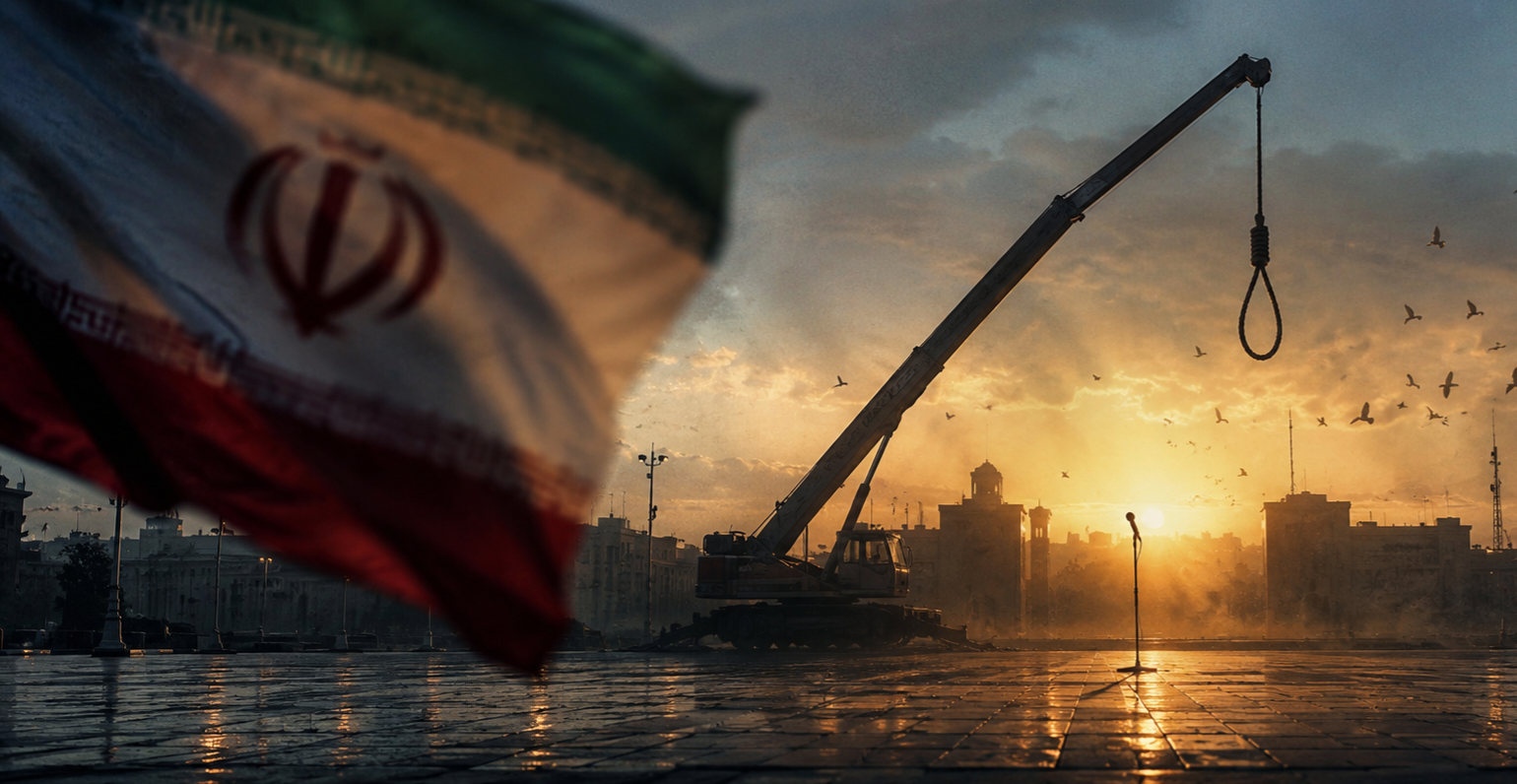
On February 28, the mayor of New York stood in front of a camera and called his own government’s war “a catastrophic escalation in an illegal war of aggression.” Bombing cities. Killing civilians. Opening a new theater of war. His words, posted while American bombers were still in the air. The video reached roughly twenty million views.
The punishment arrived fast. The president insulted him on social media. Columnists demanded an apology. A councilwoman accused him of shilling for Iran. That was the whole cost. Zohran Mamdani returned to City Hall, to the budget, to planning his reelection. In the United States, accusing the most powerful man on earth of waging an illegal war costs a politician one bad news cycle.
The price is low because of the machinery that surrounds him. A First Amendment that puts his speech beyond the reach of any prosecutor. Courts that answer to the Constitution rather than to the man he insulted. An election, months away, as the only tribunal that can judge him. A press free to attack him and still obliged to quote him. He has never needed to name these protections, which is the surest sign of how completely he owns them.
Borrow Doctor Strange’s multiverse for a moment. Nobody has to believe in it; the thing is on loan from Hollywood, and it will be returned the moment we are done with it. Now change only one variable: the passport. The same man, the same gift for the camera, the same instinct for confronting power, is a rising politician in Tehran. Everything that follows already exists in this universe and carries a citation. Call him the Tehran Mamdani. The original, the New York Mamdani, stays behind, safe inside the machinery just described; the two will meet again at the end.
He breaks the first law immediately. Iran’s Islamic Penal Code contains the crime of efsad-fil-arz, “corruption on earth.” Article 286 defines it to include spreading lies on an extensive scale against domestic or external security, and the penalty is death. The state decides what counts as a lie and what counts as extensive. A video calling the government’s war illegal, seen by twenty million people, sits in the middle of that statute.
This is not theory. Ruhollah Zam, an exiled journalist and son of a reformist cleric, ran a popular Telegram channel that exposed corruption and shared protest logistics. Iranian agents lured him from Paris, abducted him in Iraq, tried him for corruption on earth, and hanged him in December 2020. That was the price for running a messaging channel. The Tehran Mamdani has twenty million views and a press office.
The prosecutor has options. Article 282 covers moharebeh, enmity against God, and offers death, crucifixion, amputation of the right hand and left foot, or internal exile. Crucifixion remains written into a criminal code in force in 2026.
For lighter treatment, there are Articles 500 and 514, propaganda against the system and insulting the Supreme Leader, worth a year or two each. These are the soft charges. A dissident collects them until the file is thick enough for the capital ones. If no written article fits, Article 220 lets the judge step outside the code and sentence on the basis of Islamic sources and fatwas. A man can hang in Iran for a crime no statute describes.
What would the Tehran Mamdani say? He condemns the ballistic missiles aimed at Israeli apartment blocks the way the real one condemned bombs falling on Tehran. He questions a nuclear program that looks to him like the pursuit of a bomb. He calls the closing of the Strait of Hormuz an assault on free navigation and on the livelihoods of half the planet. He condemns the strikes on Gulf neighbors and mourns the tens of thousands of protesters killed in the streets in January 2026. Those Gulf states are Sunni governments, but their peoples are Muslims all the same, and he asks what faith is served by burning their ports.
He skips the ritual his New York twin never skips: the balancing clause, the symmetrical condemnation of the other side that keeps the speaker employable. The real Mamdani has practiced that ritual on the record. His condemnations of the war arrived fastened to a description of Iran’s government as brutal toward its own people. When ten rabbis asked him privately to temper his rhetoric on Israel, he gave them the hour and a promise to listen.
In Tehran the ritual has no exchange rate. Those qualifiers circulate only in free societies. A Revolutionary Court offers no discount for evenhandedness. The charge is the criticism itself. No apology, no clarification, no walk-back would count. The only words the court wants are the confession, and that script is written after the verdict.
That is one speech. It is also his last.
Here the experiment collapses into a single afternoon. There is no Tehran career to chronicle, no file thickening over years, no reelection to plan. He finishes speaking, and the men from intelligence are already waiting by the exit. New York gave Mamdani a decade of confrontation and a city to run. Tehran would give him one microphone, once.
The verdict was never in doubt. The interesting question is the charge. Tehran would hang Mamdani as a Zionist.
In October 2025, after the twelve-day war, a new law entered into force: the Intensification of Punishment for Espionage and Cooperation with the Zionist Regime. It classifies collaboration with Israel as corruption on earth. Its reach goes far past spying. The text prescribes death for any direct or indirect assistance knowingly done to approve, strengthen, consolidate, or legitimize Israel. Weapons and intelligence are almost beside the point. Acts that merely make Israel look legitimate qualify, and indirect ones count.
The charge would write itself from the transcript. A politician who mourns Israeli civilians on camera, defends the shipping lanes that feed the enemy’s economy, and casts public doubt on the program meant to erase the Zionist entity has knowingly rendered indirect assistance that legitimizes Israel, on an extensive level, in front of millions.
One afternoon of speech is the entire case file, and the case file is capital.
Anyone tempted to treat this as satire should check the news. Last week Iran executed a man for allegedly ramming police officers “in support of the Zionist regime”. No espionage appears in the announcement. The word that hanged him was support.
The procedure would be brisk. Arrest by intelligence agents. Weeks in Section 209 of Evin prison, no lawyer, no phone call. A confession recorded and aired on state television before the trial begins. Iranian courts accept such confessions even when defendants later describe torture. In one recent espionage case the physical evidence against a condemned man consisted of an empty pistol magazine and a can of pepper spray.
Then a Revolutionary Court. Branch 15 in Tehran belongs to Judge Abolqasem Salavati, long nicknamed the judge of death. Trials there have lasted minutes. An appeal exists on paper and stays on paper: the Supreme Court reviews the file at a desk, without a hearing. When it does overturn a sentence, the retrial court tends to reimpose it.
Last year the chief justice instructed courts to accelerate cases involving cooperation with hostile states. From arrest to execution can take less time than a New York mayoral campaign. In July it took Mehdi Khanaki, a 26-year-old law graduate arrested after the winter protests, five months.
The method is hanging by slow suspension: no drop, no broken neck, minutes rather than seconds. When the state wants an audience, the gallows is a mobile crane parked in a public square.
Numbers give the gallows its true scale. Iran hanged at least 1,639 people in 2025, the highest total in decades. The war made 2026 worse. By midsummer Amnesty had counted at least 52 people executed on political grounds alone since January, half of them protesters from the winter uprising, alongside hundreds more hanged for drugs and murder. July ran at a near-daily rhythm: 71 hangings in a single month , sixteen of them on one Wednesday.
Whatever the alternate universe does to Mamdani, it does to someone real, without cameras, most mornings of the week.
An honest accounting owes one concession. The United States executes people too. No American has ever been put to death for a speech, a video, or a prayer at the wrong grave. Both systems kill. The difference lies in what a citizen must do to be killed, and in only one of them the answer can be speech.
Which brings the experiment to its finding. In New York, councilmembers and commentators call Mamdani Tehran’s agent. A Revolutionary Court, given one afternoon with the same man, would hang him as Tel Aviv’s. The maximalists of both camps have examined him and returned the same verdict: enemy.
At that point the verdict stops measuring the man. It measures the courts. One system lets its loudest critic run the largest city in the country and argue his case before voters. The other has hanged more people this decade than any state on earth except China, and still watches an abolition movement called Tuesdays Without Executions spread through 56 of its own prisons. Even the condemned are no longer frightened enough.
The sharpest reading belongs to the mayor himself. Mamdani is a practicing Muslim, and more pointedly a Twelver Shia, the same branch of the faith in whose name the Islamic Republic governs. Shared creed would buy him nothing; the charge is Zionism.
The secular republic he once called fascist protects his mosque, his office, and his microphone. The Islamic Republic he declines to condemn with matching energy would, by its own written law, hang him. A Muslim is freer to be a Muslim in New York than in Tehran. That sentence ought to be impossible. The October law turns it into arithmetic.
The experiment accepts other subjects. Any defender of the Islamic Republic who lives free and comfortable in the West, on any campus, in any parliament, behind any microphone, can run it with his own biography. The exhibits change; the afternoon ends the same way.
Time to return the borrowed universe. In this one, Mamdani spent the week governing and being insulted for it. In the other, the confession has already aired, and a crane idles at the edge of the square. How long can a man keep calling this universe the evil one, when of the two, it is the only one in which he is alive?