In each other’s faces; in a sukkah of one’s own
If you’re Jewish in Israel, whether you’re religious or not, you have Shabbat dinner with family. For years, my brother-in-law and his wife made the two-hour drive every Friday from Kiryat Shmona on the northern border to my in-laws in Ramat HaSharon so as not to miss the family meal.
By contrast, once I left New York for New England and, later, the West Coast, I saw my parents once every few months, and this was the norm. This process of drift started in my parents’ generation. My mother grew up in a close-knit neighborhood of cousins in the Bronx, but adulthood took her first to the Mecca of Manhattan, where she met my father, a displaced New Jersey boy, and later to Queens. Along with the rest of their generation, my parents’ extended families scattered across the greater Metropolitan area, and then across the country
Perhaps the centrifugal forces of American society – education, employment, cultural opportunities – pulled them apart. Maybe they needed to escape the smothering family embrace. But later, they mourned what they’d lost. In my generation, it was considered normal to make your adult life far from where you grew up and to see your parents a few times a year, and I followed suit. By moving to a country the size of a postage stamp, my sabra wife and the three kids we have raised reversed this process. Triangulating weekly from Kfar Saba to Ramat HaSharon or Petach Tikvah, we have sort of recreated the Bronx shtetl of my mother’s childhood.
This family-centered ethos, coupled with the geographic proximity imposed by the borders of our tiny state, means my kids ate with their grandparents and cousins every Friday night for most of their lives.
Family is privileged above everything: over work, over school, over all other commitments. The compactness of the country means we gather in person not for annual pilgrimages, but all the time, the holiday season being only an extreme case in point.
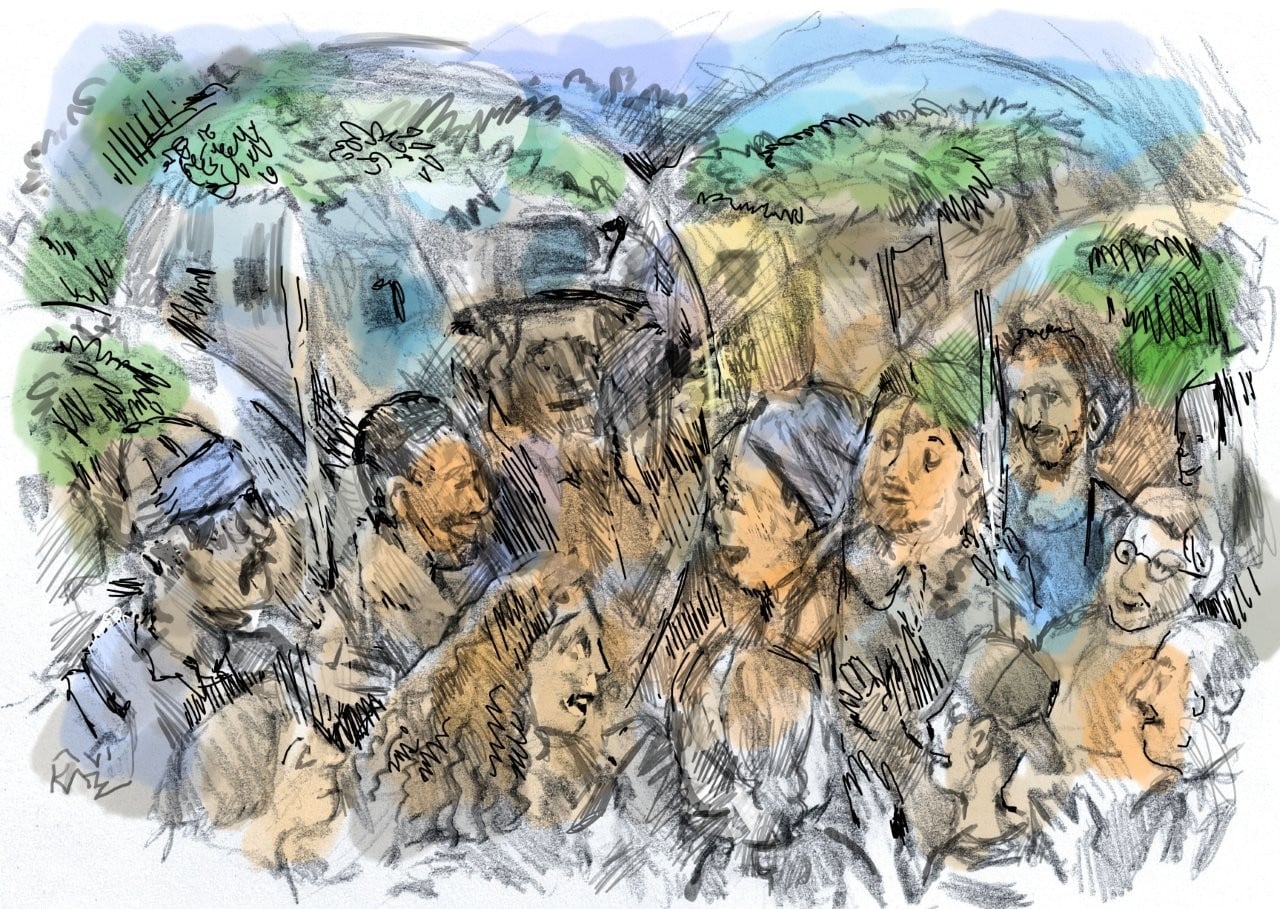
Living in such a small country also means that people of all religious, ethnic and political stripes are in each other’s faces. This in-your-face-ness shapes how we come together in our all-too-frequent crises and disasters, and how we get on each other’s nerves in the lulls between catastrophes.
It is virtually impossible to disconnect from politics. Events never seem so remote that they have nothing to do with you, and we chafe against feeling powerless to affect them. Our lives are always at stake. The future is always on the line.
This can seem overwhelming. When it’s not our security on the line, it’s the direction of our society. The sense, shared by so many different groups in Israel, that some other group is taking the country away from them, does not make for serenity.
But it also leaves little room for apathy, alienation and depression. We feel engaged, challenged, responsible. Hence, soldiers report for duty despite unfathomable stress and exhaustion, civil society leaps in when government services go AWOL, and tens of thousands take to the streets weekly to make their voices heard. Amidst angry, raging debates, Israelis routinely earn high scores on the Happiness Index compared to other Western societies.
It means there is always connectedness and there are always connections. And yet, we live in a thousand separate bubbles, and each of us moves through only some of them. My own circle is a mixed lot: Masorti-Conservative, hiloni-secular, dati-religious, leftists, centrists and settlers. The staff at the NGO I direct is divided between Jews and Arabs, politically and religiously all over the map in both sets of communities. And yet, I hardly know any Haredim.
It is as if every group has its own sukkah. This enables and encourages us to cut ourselves off from the outside world, but not completely. We are partly visible from the outside, and we can see out through the semi-solid walls, but our view is obscured. We sort of know what’s going on inside other sukkahs, but we cannot be sure.
When we acknowledge how little we know about the warp and woof of people’s lives in groups distant from ourselves, we usually think of this as a problem, as a threat to solidarity. And to be sure, this separateness does pose a serious obstacle to compassion and empathy, which at its worst, can boil over to resentment or degrade into hatred. It’s when we start talking about “them” – any them – that we get in trouble.
And yet, in such a small and seething society, I’ve come to think that it’s good for our mental health, perhaps necessary, or even crucial, to have a sukkah of one’s own.
It helps to know where you belong, and maybe, where you don’t. We may not have sorted ourselves as rigidly as blue and red states, but when I drive through a neighborhood littered with Bibi signs, I’m relieved that I don’t live there.
We each need our own sukkah, a home to retreat to, a place for authentic and intimate contact with whoever is invited inside, while the world outside is just there, still heard and glimpsed but at the slightest remove.