

Shaping the Future by Remembering the Past
In Memory of the Jews of Mongolia
I did not know there were Jews in Mongolia. After Richard Bloom, an award-winning Holocaust film documentarian and friend, sent me a Chabad article about Jews and Mongolia, I learned.
Jews in Mongolia – Yes and No.
Documented Jewish presence in Mongolia dates back to the 19th century, when Jewish fur traders and merchants established economic relationships with Mongolians. The Jewish community significantly grew when Russian Jews fleeing the Russian Civil War (1918-1922) arrived. They sought safety in the Far East from the bloodletting and antisemitism unleashed following the Bolshevik overthrow of the Russian monarchy.
In 1921, virtually the entire community was coldly massacred by the anti-Semitic warlord and White Russian Army leader, Baron Roman von Ungern-Sternberg. Ungern, born in Graz, Austria, a descendant of German Baltic Crusaders, was born a Christian, later converting to mystical Buddhism while a Don Cossack fighting for the Czar during WWI in the Far East.
The fall of the Russian monarchy ripped his tightly ordered world apart. He blamed the Bolsheviks. He blamed the Jews even more. Ungern appointed himself a Lt. General. He organized an army from chaos, an army that practiced extreme terror and brutality as it marched on the skulls of untold numbers of victims.
Ungern attacked Mongolia ostensibly to liberate the country from the Chinese. His real goal was to reestablish a new Russian Monarchy that would stretch from the Far East to Moscow. February 1-4,1921, Ungern attacked Ulaanbaatar, the Capital of Mongolia. They blasted open the gates, unleashing pillaging, rape, and murder as the city fell. They found an estimated 800 Jews. Ungern immediately ordered his subordinate Captain Feodoroff to exterminate every Jewish man, woman, and child. Feodoroff completed his task with relish.
The Mongolian community was shocked, incredulous by the ferocity directed at the Jews. Antisemitism had been unknown in Mongolia.
Reportedly, at least one Jewish family survived. His name was Israel-Eli (Alexander) Zanzer.
Zanzer had been foundational to the development of the Mongolian gold mining industry. He assimilated into Mongolian society, being conferred a noble title and station. Zanzer, using his Mongolian connection, bribed Ungern and escaped to Lutsk, Poland. He would die in the Holocaust.
Seven months later, Baron Roman von Ungern-Sternberg and his White Army were defeated by the Red Army. Ungern’s own men turned him over to the Reds to save their own skins. A “Show Trial” was ordered for the “Mad Baron.” The prosecutor was Minei Izrailevich Gubelman, the son of a poor Jewish family from Chita, Siberia.
Gubelman, later known by his Russified name Yemlyan Yaroslavsky, rejected his Jewish ethnicity, adopting a new universal God, revolutionary Bolshevism. He joined the Russian Social Democratic Labor Party in 1898. His meteoric career saw him rise to prominence as a Communist, Soviet Historian, journalist, and chief anti-religion propagandist of the Communist Party. When he died in 1943, he was honored by burial within the Kremlin’s walled grounds.
After a 6 ½ hour “trial”, Ungern was shot, September 15, 1921, by a Red Army firing squad. His body was dumped into a mass grave with other White Russian soldiers. The site is unknown. Today, extremist, modern Russian monarchists revere Ungern’s memory as a quasi-deity.
In the early 1990s, an Israeli businessman, Yair Jacob Porat, relocated to Ulaanbaatar when a major economic opportunity presented itself. Porat, an observant Jew living in a barren Jewish world, single-handedly transformed his home into a mini-Jewish Mongolian community center for Jewish travelers. He imports kosher foods and has established regular Shabbat and holiday dinners. His small home is transformed into a synagogue with a recently donated Torah scroll.
Jacob knew of the stories of the once living Jewish community in Ulaanbaatar. Where they were buried was a mystery. He wanted to give them memory. To recite Kaddish for them.
Jewish tradition spiritual practice honors those who have passed. It comforts the living. It preserves cultural and religious continuity.
In Jewish tradition, remembering the dead is not a morbid obsession, but rather a spiritual practice meant to honor the dead, comfort the living, and preserve cultural continuity. Judaism recognizes that every human being is made in the image of God. The body is sacred and holy because it houses the soul given by God. Remembering the deceased is an act of religious kindness and respect. Memory is a commitment to the future when the annual Yahrzeit, the anniversary of a person’s death, is remembered. They are remembered because of them, because of who they were, their Jewish values and identity, a Jewish world continues.
Jacob, as he prefers to be called, began a search for the resting place of the Jews of Ulaanbaatar, the Jews of Mongolia.
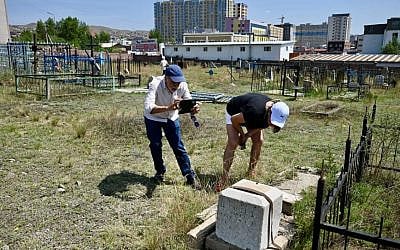
His search was long, arduous, and dedicated. With the help of a few other Jews who had made their homes in Mongolia, his search was as close to successful as possible.
Captain Feodoroff ordered that the Jews massacred that terrible February in 1921, many were buried in the Evreiskii (Jewish) Necropolis of Ulaanbaatar’s Russian Orthodox cemetery. Today, the site is virtually abandoned, overgrown, and forgotten. Jacob found and documented Jewish burials. One chilling gravestone, more of a cement block with a Star of David on it and the number 15 for 15 Jews buried in a mass grave, emerged from the past.
Porat resolved to do the right thing for them. A Jewish burial site is required to be enclosed by a wall or a fence from the outside. He needed funding to build a series of fenced areas around Jewish graves he could identify. He needed to give them a stone of memory.
When Richard Bloom sent me the article about Porat’s efforts in Mongolia, he knew I and the Jewish American Society for Historic Preservation, www.JASHP.org, would respond. It took a while, contact with Porat was established, funding for the gravesite fencing was sent. JASHP proposed immediately that an appropriate historical stone of interpretive memory be placed. We knew it was impossible to find all the graves of the Jewish dead, but we could remember them.
JASHP’s motto is “Shaping the Future by Remembering the Past.” We have had considerable effort in providing memory when the world would prefer that Jews be forgotten.
Jacob navigated the labyrinthine complexity of the at-times very difficult political maneuvering for site permission. Together, a text was prepared and revised because of sensitivities not Mongolian.
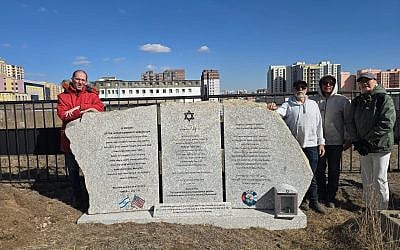
The passing of another hard Mongolian winter and the three language, English, Hebrew, and Mongolian, Jewish Mongolian interpretive stone was recently unveiled beneath a Star of David, and the logos of the crossed flags of the U.S. and Israel, and Jewish Mongolia at the bottom.
The Jewish Mongolian interpretive memorial is not without its detractors and continuing tensions. But it is there, finally, after over a hundred years.
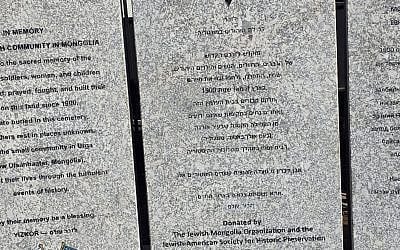
The text reads:
“Dedicated to the sacred memory of the Jewish men, soldiers, women, and children who once lived, prayed, fought, and built their lives on this land since 1900. Some are buried in this cemetery, while others rest in places unknown. From the small community in Urga (now Ulaanbaatar, Mongolia), many lost their lives through the turbulent events of history. May their memory be a blessing. Yizkor
– Hebrew
Erected 2026 by Jewish Mongolia Organization,
The Jewish American Society for Historic Preservation”.