In One Breath: Claire Tabouret at Grand Palais
“Love is like a tree: it grows by itself, roots itself deeply in our being, and continues to flourish over a heart in ruin. The inexplicable fact is that the blinder it is, the more tenacious it becomes. It is never stronger than when it is completely unreasonable,” Victor Hugo wrote in The Hunchback of Notre-Dame. His novel intertwines stories of marginalisation and social injustice with a plea to preserve the world-renowned cathedral, whose stones and spires have carried the stories of centuries.
Built in the twelfth century under Bishop Maurice de Sully to accommodate the faithful on the Île de la Cité, Notre-Dame de Paris expanded through the Renaissance, survived the Revolution, and underwent major restorations in the nineteenth century. It has now been a year since the cathedral reopened following the devastating fire of April 2019.
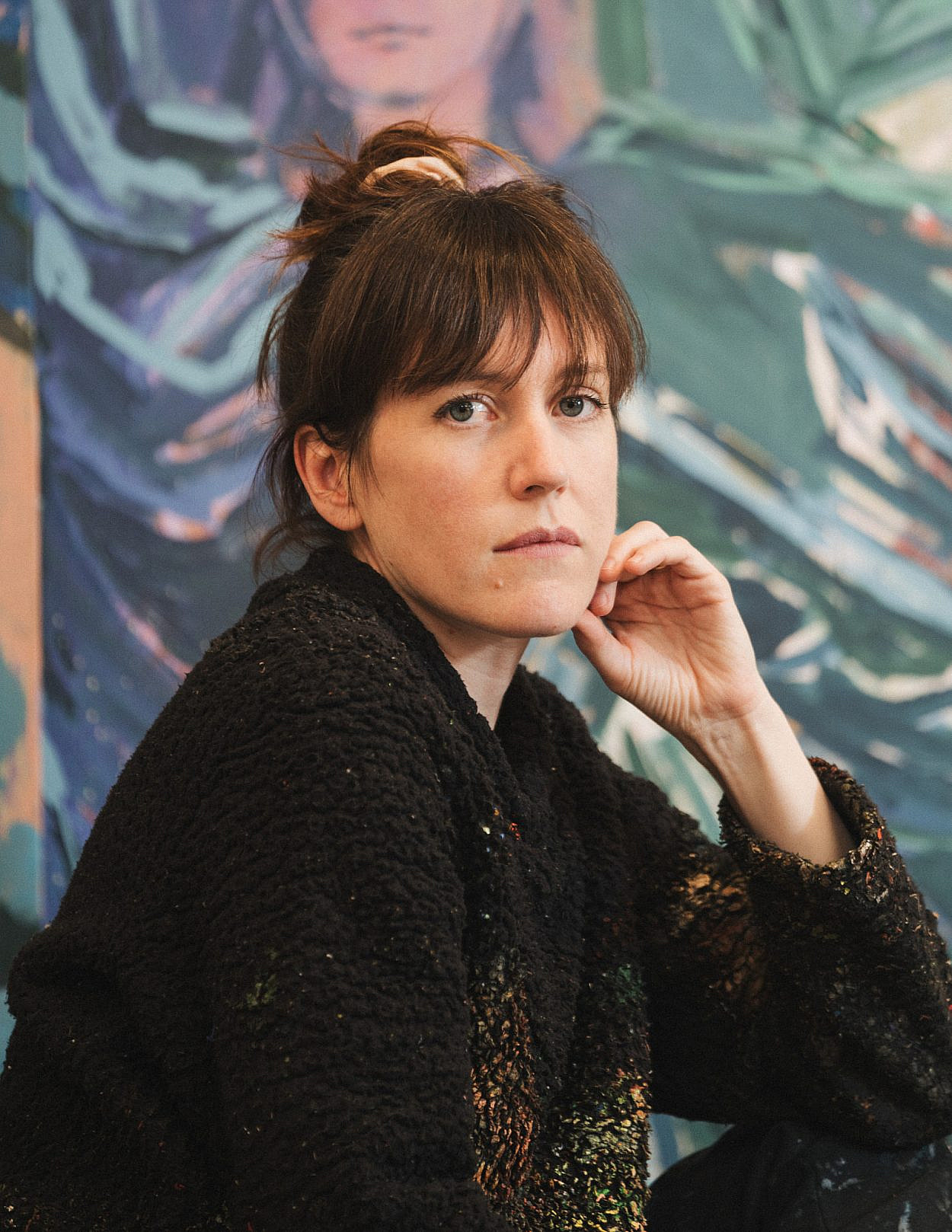
Within this historic and storied space, the artist Claire Tabouret will install her contemporary interpretation of stained glass. The windows are currently being produced by Atelier Simon-Marq in Reims, the same workshop that created Marc Chagall’s stained-glass windows. They will replace the grisaille windows designed by Eugène Viollet-le-Duc by the end of 2026. And for those who wish to see Tabouret’s life-size models for these six windows on the south side of the nave, along with extensive preparatory work, they are currently on view at the Grand Palais in Paris.
However, according to Beaux Arts magazine, this moment of artistic recognition did not come without resistance. Since the project was announced in 2023, Tabouret’s commission has sparked intense debate. A petition initiated by La Tribune de l’Art, which gathered more than 300,000 signatures, called for the preservation of the historic windows, while both the Academy of Fine Arts and the National Heritage Commission voiced their objections. With support confirmed by the Élysée and after the Paris administrative court rejected a legal challenge brought by the association Sites & Monuments in December, the commission now moves forward with full institutional backing.
This tension between tradition and innovation shapes the experience of encountering Tabouret’s work at the Grand Palais. In a world long dominated by male voices and decisions, it is deeply moving to witness a woman from Pertuis, a small town in Provence, who moved to Paris at seventeen and later to Los Angeles in 2015, drawn by the city’s strangeness and the promise of renewal, now exhibiting in a building originally constructed for the Exposition Universelle of 1900 and soon to be installed at Notre-Dame, a cathedral visited by millions of people from around the world each year.
Tabouret has exhibited widely across Europe, the United States, and Asia, with solo exhibitions at the Institute of Contemporary Art in Miami and the Palazzo Cavanis during the Venice Biennale, among many others. In her early thirties, after inviting the renowned collector François Pinault to an exhibition, he acquired most of her work, helping to cement her career. She has also collaborated with artists such as Yoko Ono, further anchoring her practice within an international artistic landscape.
Walking into Gallery 10.2 of the Grand Palais, I was immediately struck by Tabouret’s extraordinary sense of colour, which felt comforting on a grey winter day. The influence of historic stained glass from Notre-Dame is palpable, particularly works such as The Tree of Jesse signed by Édouard Didron in 1864, conceived so that natural light would animate the colours and leave a lasting impression within the cathedral. At the same time, Tabouret’s palette evokes the landscapes of Southern California and the South of France, with yellows, oranges, purples, and reds recalling the sunsets and skies in both of these regions.
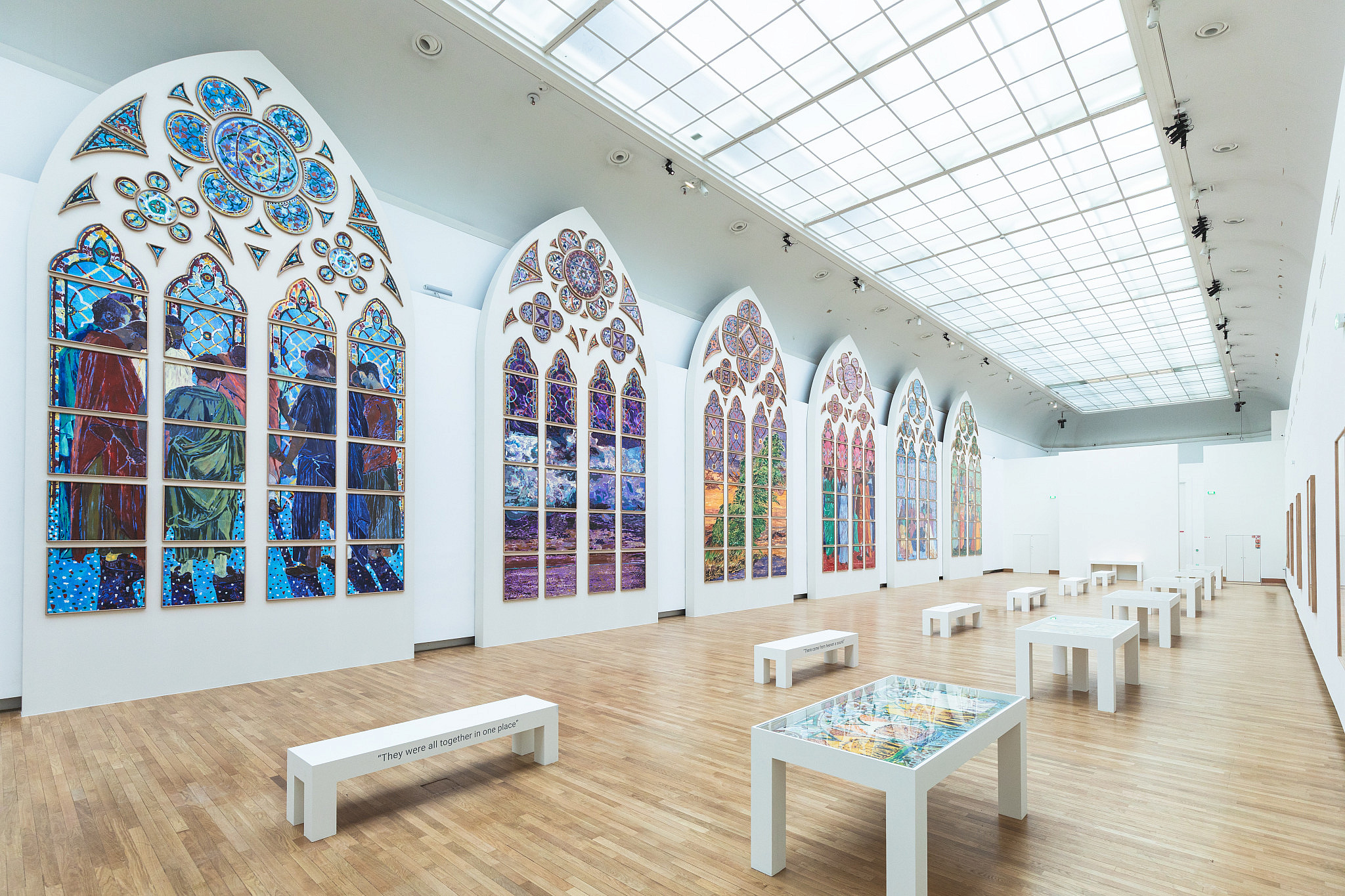
The scale of the work is breathtaking. Each window stands seven meters high, and together they form a visual narrative of Pentecost, the moment fifty days after Easter when the Holy Spirit descended upon the apostles. The story unfolds across six windows, each dedicated to a saint deeply connected to the Church of Paris: Saint Joseph, Sainte Clotilde, Saint Vincent de Paul, Sainte Geneviève, Saint Denys, and Saint Paul Chen.
Across from the monumental windows, benches bear phrases drawn from the Acts of the Apostles. These fragments guide the viewer through the sequence of events: “They were all gathered together in one place,” “A great noise in the sky,” “Like a violent gust of wind,” “Then tongues of fire appeared,” “Their hearts were pierced,” and “They began to speak in other tongues.” Together, the words and images transform scripture into a spatial and emotional experience, allowing the narrative to unfold around the viewer.
Alongside the windows, the exhibition reveals the labour behind their creation. Preparatory works, including sketches, studies, and monotypes that trace the evolution of each composition, are displayed in glass showcase tables and hung on the opposite wall, inviting the viewer to move between the fragility of paper and the ambition of glass.
Each window is composed of monotype prints, manually printed and created in New Mexico. Rather than producing a single image, Tabouret created around fifty individual pieces for each window, corresponding to panels, rosettes, and other elements. Painted in reverse on Plexiglas and printed onto thick paper, the works already hint at how light and image will eventually come together in glass.
The sequence opens with the window dedicated to Saint Joseph, depicting a group of men holding hands in a circle with their heads lowered, accompanied by the phrase “All gathered together in one place.” It continues with the window dedicated to Sainte Clotilde, a largely figureless composition bathed in deep purples reminiscent of skies along the Côte d’Azur, bearing the words “Suddenly a noise came from the sky.” Saint Vincent de Paul follows, set against an orange sky that recalls the wildfires of Los Angeles and inscribed with the phrase “Like a violent gust of wind.”
At the center of the series stands the window dedicated to Sainte Geneviève, rendered in light blue, lime green, red-orange hues, magenta, and soft pinks. She gazes upward with her arms raised toward the sky. Born around 419 and deceased in 512, she is the patron saint of Paris and is remembered for her courage and moral leadership in times of crisis. During Attila the Hun’s invasion in 451, she urged the inhabitants of Paris to remain, pray, and resist panic rather than flee, an act that is credited with helping to preserve the city and protect its population. The Panthéon in Paris was originally built as a church dedicated to her before becoming the resting place of figures such as Voltaire, Rousseau, and Victor Hugo. While Sainte Geneviève does not belong to the biblical narrative of Pentecost, her inclusion functions as a historical and symbolic bridge, linking the descent of the Holy Spirit to the lived spiritual history of Paris and to a legacy of collective courage and care for human life.
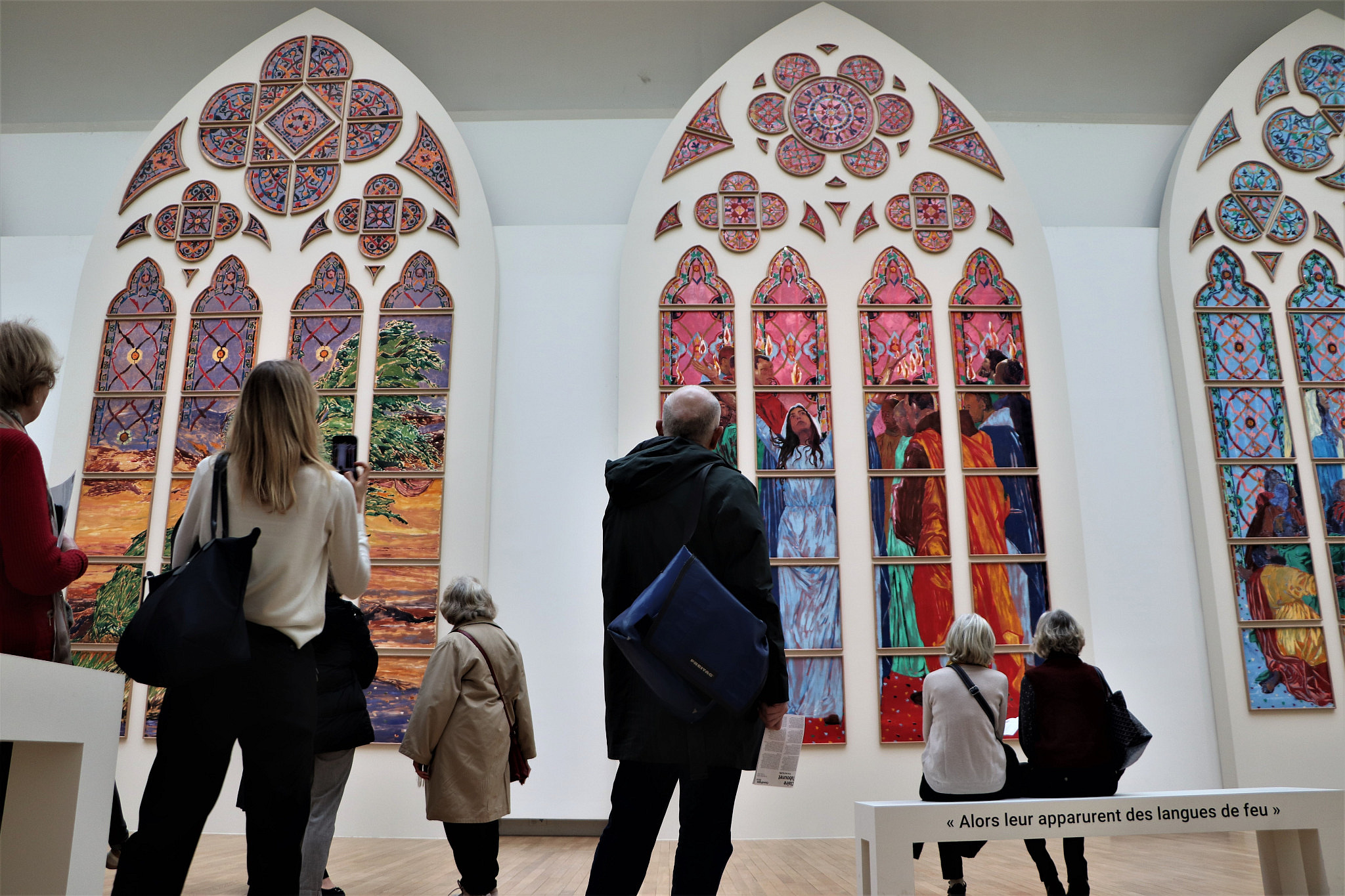
The narrative continues with Saint Denys, accompanied by the phrase “Those who heard it had their hearts pierced,” and concludes with Saint Paul Chen and the words “They began to speak in other tongues, each according to the gift of the Spirit,” a moment that unfolds in Jerusalem, where pilgrims from many regions heard one message in many languages. Together, the six windows convey a vision of unity that does not erase difference, but instead allows it to coexist within a shared space of light.
Although the windows have not yet been installed at Notre-Dame, experiencing the models and preparatory works at the Grand Palais was deeply comforting. The exhibition offered something my soul needed in a world that feels increasingly violent and unpredictable. Perhaps it resonated even more because Tabouret lives in Los Angeles, the city that was my home for more than twenty years, and where I know Night Gallery, which represents her. Standing among these works in progress, surrounded by colour, words, and the traces of an artist’s devotion, I felt held by the idea that harmony, however fragile, remains within reach.
Claire Tabouret, D’un seul souffle
Exhibition
December 10, 2025 – March 15, 2026
Grand Palais, Paris
Eva Jospin, Grottesco · Claire Tabouret, D’un seul souffle | Grand Palais