
"These fragments I have shored against my ruins"
In Spite of Everything: A Tale of Two Jewish Communities in Serbia
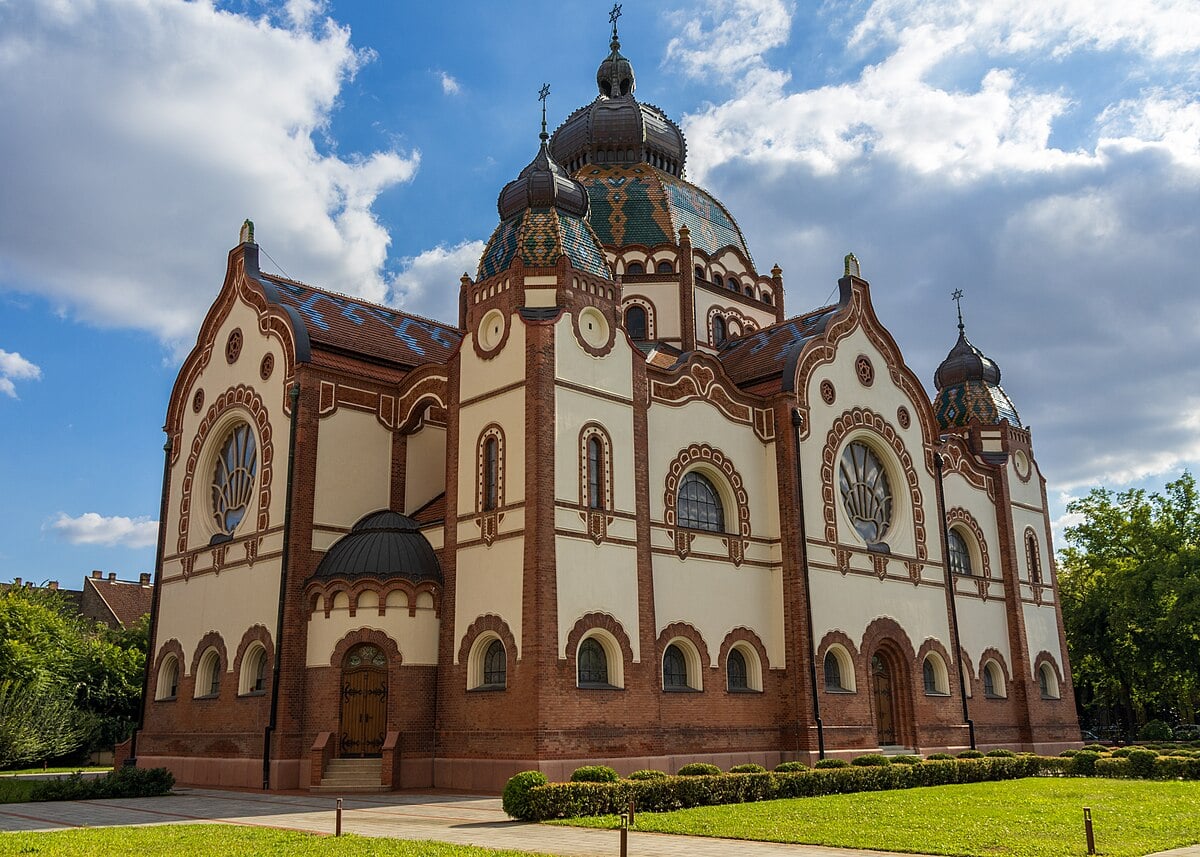
The renovated Synagogue in Subotica. Photo: Cultural Heritage site of Serbia number СК1035.
There are fewer than 3,000 Jews living in Serbia today, and even that number, according to the most generous estimates, includes extended definitions of Jewish identity. Core statistics suggest the figure is closer to 1,500. With only two remaining functioning synagogues, what survives is a fragment of the vibrant communities that once flourished across the region. Yet in visiting Belgrade and Subotica, I realised something quietly heartbreaking: despite their dwindling numbers, the Jewish communities in these two cities remain emotionally and culturally worlds apart.
The first time I stepped into the Synagogue in Subotica, a northern Serbian town that was once part of Greater Hungary, was in 2011. It was in ruins, literally falling apart. Paint peeled like shedding skin, silence echoed off empty walls, and candles flickered in corners, casting shadows that danced across Miksa Róth’s weary glass.
In the ruin, there was reverence, the kind offered by strangers who understand that even abandoned places deserve a heartbeat. That night, I learnt that hospitality doesn’t require restoration; it survives in ritual, in memory, in the soft glow of people who remember how to be kind. In Subotica, I felt at home almost instantly. Hungarian was spoken freely, the architecture sang of Austro-Hungarian grandeur, and even as an odd visitor from Budapest, I was warmly welcomed.
In Belgrade, where I actually lived for two years, the story was different. On my first attempt I could not even make it through the gate and was advised to return another time. While Serbian friends embraced my Hungarian identity with curiosity and kindness, the local Jewish community kept a careful distance. Belgrade’s Jewish world, while vibrant and proud, did not have space for someone whose roots did not quite fit the frame. It was no one’s fault, simply the echo of history, of trauma, of fiercely protected identities. It was not hostility, only silence.
This was not the first time I had ventured far from home, and I had been welcomed in the most unlikely of places before, such as at the US army base in Yongsan, South Korea, or at the freshly opened Chabad branch in Christchurch, New Zealand. Yet in Belgrade, only a four-hour drive from where I was born, I found myself outside the narrative.
The divide between Belgrade and Subotica’s Jewish communities runs deeper than geography. It is the legacy of two empires. Belgrade, once part of the Ottoman world, became a Sephardic stronghold following the 15th-century expulsions from Spain and Portugal. These Jews identified as “Serbs of Mosaic faith”. Even before the war, roughly 80% of Belgrade’s Jews were Sephardic, Ladino-speaking and deeply rooted in Balkan traditions, while only 20% were Ashkenazi, often Yiddish-speaking and more recent arrivals. Subotica, by contrast, flourished under the Austro-Hungarian Empire. Its Jewish population was primarily Ashkenazi, Hungarian-speaking, and deeply woven into local civic life.
Though Sukat Shalom was built by the Ashkenazi community in the 1920s, its transformation into the only functioning Orthodox synagogue in Belgrade, where Sephardic liturgy is practised, was not a matter of choice but of necessity. During the Nazi occupation, the synagogue was desecrated and repurposed as a brothel, a deliberate and grotesque violation of a sacred space. But unlike the others, it survived. After the war, it was reconsecrated not just as a place of worship but as a shelter for a community in ruins.
In theory, it was meant to serve both traditions. In practice, the Sephardic majority, still dominant even after the Holocaust, gradually shaped its liturgy, leadership and communal rhythm. The building’s Ashkenazi architecture remains, but its spiritual life has long since shifted. There is no accusation in this transformation, only sorrow. The Sephardic voice became the prevailing one not through conquest but through continuity. And in that quiet shift, the synagogue became a vessel of survival: a place where memory, not origin determined belonging.
Even today, that divide endures. While Belgrade’s community centres itself around Sukat Shalom, Subotica’s monumental Neolog Art Nouveau synagogue, which highlights the dual Hungarian-Jewish identity of its builders in a multi-ethnic city, and is the fourth largest of its kind in Europe, was restored with Hungarian government support and reconsecrated in 2018, yet it remains far too vast for the few Jewish residents who still gather there. Perhaps that is precisely the point, for its grandeur demands a broader audience, and Hungary’s investment ensures that it remains not merely a relic but a living cultural space, shared with the local Hungarian community, but still sacred.
Languages reflect belonging, and in these two cities, they still delineate boundaries. In Belgrade, Serbian and Hebrew are spoken, and Sephardic traditions are followed during weekly services, attended by small minyans. In Subotica, Hungarian and Hebrew are used; the tradition is Ashkenazi, the minyan is small, often gathering only on major holidays, but cultural events are common and warmly open to the wider public.
In Subotica, Hungarian is not merely spoken, it forms part of the community’s heartbeat. Even the launch of the synagogue’s commemorative book took place both in Subotica and in Budapest’s Miksa Róth Memorial House. Meanwhile, Belgrade’s community, though larger, often feels more insular. The scars of war, the pressures of city life, and a robust Serbian national identity all contribute to this inwardness.
Both cities are members of Serbia’s Federation of Jewish Communities and take part in shared events such as youth programmes, Holocaust commemorations, and women’s gatherings, yet functionally, they live in parallel. Subotica leans towards Hungary for cultural connection and funding; Belgrade turns to Israel, and inwards. Together, yet apart.
It is devastating, really, that continuity lies in fragments. With communities this small, one might hope for unity. Yet deep divides remain: Sephardic and Ashkenazi, Serbian and Hungarian, Orthodox and Neolog, local and outsider. Still, there is resilience, and Jewish life endures.
In Serbia, memory is not always handed down easily; often it is packed into suitcases. The young people who remain do so either by choice or by circumstance. For the Jewish communities, continuity is not guaranteed by birth but chosen and often in defiance of the odds.
And perhaps, by telling this story, we add one more thread to the tapestry, a reminder that even between parallel faiths, there is still space to meet in the middle.
Between borders and bonds, in the Balkan shadows, where memory runs deep and forgiveness is scarce, the weight of history presses against even the most civil of exchanges. Yet peace is not passive. Around cities like Subotica, identity shifts like tectonic plates, sometimes gently, sometimes with seismic force. Serbia’s ambivalence may leave cracks, but Hungary’s quiet cultural interventions have filled some of them with care, with books, with festivals and with soft acts of restoration. These gestures do not erase the past, but they do soften its edges.
Plural identities do not flourish by accident. They survive because someone insists that they matter. Because someone restores a synagogue, writes a memoir, or attends a book launch. Because someone chooses not to turn to bitterness when history says they could, and when history allows.
What I have learnt is that identity is not only claimed, it must be sustained. And sometimes, the most resilient borders are not drawn on maps, but lie instead in the invisible line between choosing resentment and choosing to remain kind.
In Belgrade, the silence was not hostile, it was heavy. Perhaps it stemmed from the burden of centrality, from being the capital’s Jewish voice in a country that often forgets its margins. Or perhaps it was simply weariness. I never found a map to that silence, only came to respect its contours.
In the Subotica Synagogue, sunlight filters through Miksa Róth’s windows, floral, fragile, defiantly luminous. Each petal and feather is a prayer in glass, a testament to what survives when borders shift and silence falls. These windows do not shout; they simply glow in that silence. And in their glow, the Jewish Hungarians of Subotica remain visible, not because history made room for them, but because they made room for beauty.
The Hungarian Jews of Subotica are not merely a community. They are a reminder of what happens when history haemorrhages and the smallest stories risk vanishing. When Yugoslavia fractured, many fled. This community did not. Not because they were unafraid, but because they were not granted a clean escape.
For some, the collapse of Yugoslavia led to raised flags, redrawn borders, a place to claim as home. For the Hungarians of Vojvodina, there was no revolution, only the echo of a homeland across the border, already defined, already elsewhere. Hungary sent no troops, made no claim; it stayed out. And in doing so, it quietly left its kin behind.
Today, the Jews of Subotica are a minority within a minority, stitched into a region that might unravel them at any moment. They have endured through memory, through the quiet gifts of language and ritual. Rooted in a borderland, they are held aloft as much by nostalgia as by care. Their survival is fragile, but it is also deeply intentional.
If Belgrade were to withdraw support, they would remain standing only through the whisper of Hungary’s outreach, if not by policy then by serendipity.
Minority becomes destiny when there is no louder cause. For the Jewish Hungarians of Subotica, it has meant enduring at the edge of attention, weaving memory into ritual and hope into heritage. They did not gain a country. They inherited the patience to remain.
Belgrade’s Jews have endured too, through war, through silence, through the burden of being central in a country that lost its borders. Where identity narrows, it also deepens. What may appear to be distance might in fact be preservation, born of the pressure of being at the centre when the periphery falls away. In a city where everything was once Yugoslavia and must now be Serbia, Jewish identity has perhaps narrowed in order to survive. What feels like exclusion may, in fact, be protection.
Neither story is whole. Neither is complete without the other.
And perhaps that is the true inheritance of Jewish life in Serbia: not unity, but the refusal to vanish. A Sephardic minyan in the capital, a Hungarian-language concert in a provincial town, held together not by geography but by defiance.
Somewhere between them stands Danilo Kiš, born in Subotica, formed in Belgrade, died in Paris. The last Yugoslav writer. A man who never tried to be a bridge but simply stood where the fracture lines ran deepest and insisted on writing from that place. He never demanded reconciliation from the world; only that memory remain plural, that the dead be named, that language not lie.
Uprkos svemu.
Mindennek ellenére.
In spite of everything.
These are not just words of survival. They are a creed for those who live between languages, between cities, between disappearances.
In the flicker of Shabbat candles or the soft glow of Miksa Róth’s windows, Jewish life continues. Not seamlessly, not loudly, but with care. Not as a single voice, but as a stubborn, beautiful polyphony.
And perhaps that is what matters most, not whether the story is shared, but whether we still listen when it is told in another tongue. Perhaps memory does not require a crowd, only a door left ajar, a candle flickering in the dark, and someone — anyone — still willing to listen. To lean into the silence between languages. To gather the scattered syllables of a fading story and hold them with reverence, not as if they were sacred, but because they are: because they bear the weight of ritual, of loss, of survival, and of the quiet insistence that even what endures in fragments still deserves to be heard.
Related Topics
Related Posts