
Founder & Principal, Line of State
India Forged a New Kind of Power and Its Constitution Was the Engine
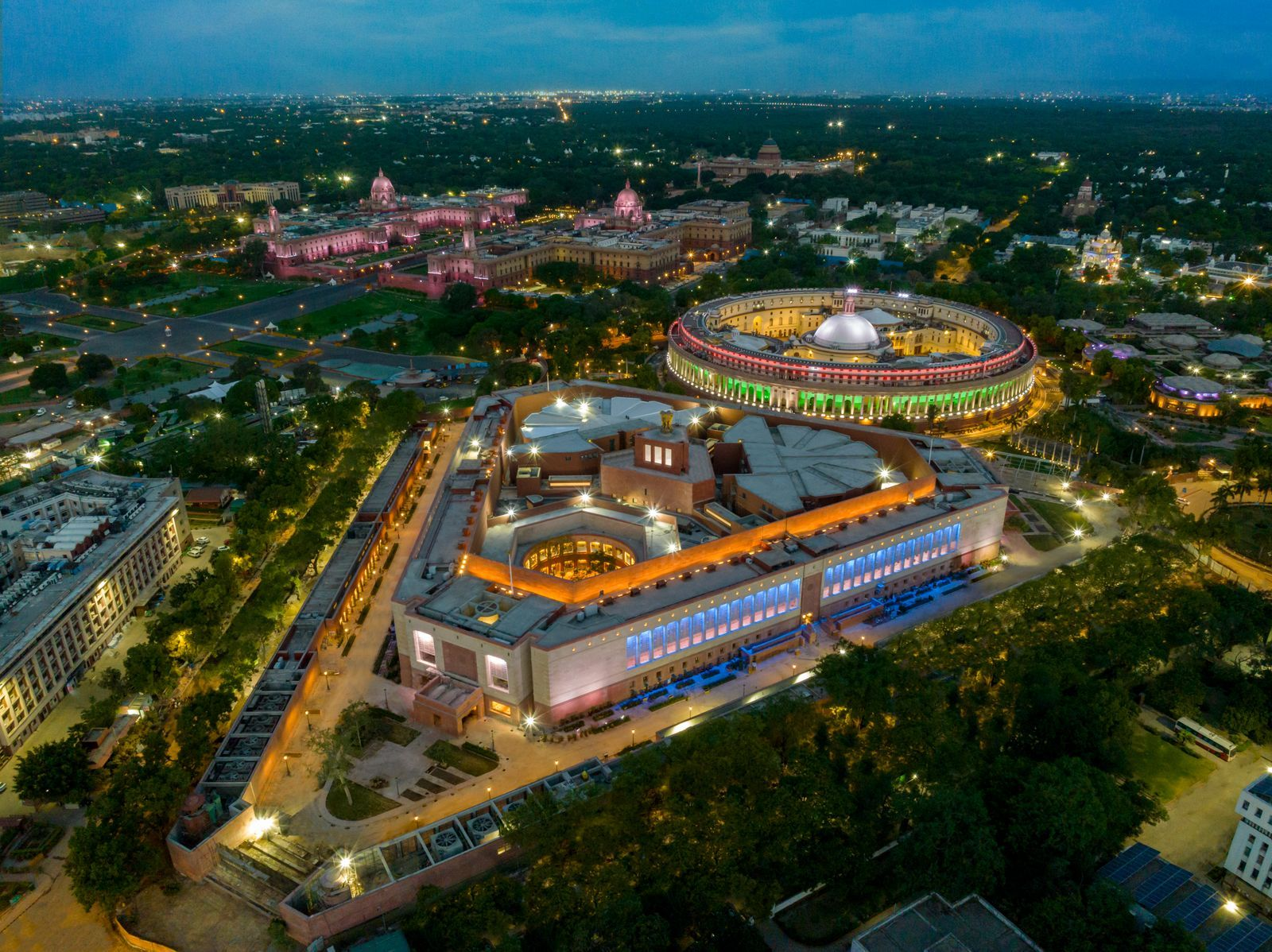
Over the Central Vista, India’s Parliament marks the rise of a Sovereign Edge State - anchored in law, steady under pressure. Photo: Vinay Panjwani, Moving Pixels
On 26 November, when the Preamble is spoken in Samvidhan Sadan and in schools from Kohima to Kochi, India is not recalling an old ceremony. It is reminding a distracted world that in 2025 the most serious conversation on constitutionalism is taking place not in Washington or Brussels, but in a democracy of 1.4 billion that still treats its Constitution as a living promise.
Constitution Day is young. The Constituent Assembly adopted the Constitution on 26 November 1949; it came into force in January 1950 and has been formally honored since 2015. Ambedkar warned it was not a lawyer’s document but a vehicle of life whose spirit must move with the age. Today’s age is one of weaponized supply chains, algorithmic propaganda and routine sanctions, and yet India’s mid-20th-century Samvidhan is proving remarkably fit for this century.
India’s Constitution is the world’s longest: a preamble, hundreds of articles, fundamental rights, Directive Principles and, uniquely, Fundamental Duties. It is federal yet unitary in crisis, parliamentary yet anchored in constitutional supremacy. Above all stands the Basic Structure doctrine, ensuring that no majority can erase democracy, the rule of law, rights or unity. In a region of interrupted republics, India’s armed forces have never ruled for even a single day.
This is more than internal design; it is the grammar of India’s statecraft. When a nation entrenches justice, liberty, equality and fraternity in its supreme law, it shapes a distinctive style of power. Article 32 gives the poorest Indian access to the Supreme Court; Article 51 calls for peaceful relations amongst nations. One looks inward, one outward – together they foreshadow the India that is emerging, a constitutional power whose external behavior echoes its internal commitments.
India’s digital public infrastructure makes this visible. Aadhaar, UPI and the India Stack serve more than a billion people, process over ten billion monthly transactions and already add close to one per cent of GDP. For a street vendor in Varanasi or a migrant worker in Dubai, dignity is the ability to send ten rupees instantly with no hidden fee. That is equality and the right to life expressed as code. India now works with partners across Asia, Africa and Latin America to build similar systems, turning inclusion into a global export.
Climate policy reflects the same logic. The International Solar Alliance, headquartered in India, includes more than a hundred countries. India has reached fifty per cent non-fossil power capacity ahead of schedule and aims for 500 GW by 2030. This is Article 51A’s environmental duty at gigawatt scale, combined with a principled insistence on climate justice.
Humanitarian action completes the picture. Vaccine Maitri sent more than 160 million COVID-19 doses abroad. After major earthquakes in Turkiye and Syria, Operation Dost deployed rescue teams within hours. Operations Ganga, Kaveri and Ajay evacuated tens of thousands – Indians and foreign nationals alike. These missions express a constitutional instinct: citizenship is not suspended in crisis, and fraternity is not confined to India’s borders.
This same discipline shapes India’s response to cross-border terrorism. From the surgical strikes in 2016 to Balakot in 2019 and Operation Sindoor in 2025, India has answered massacres with precise, limited force aimed at terror infrastructure, not civilians. Releasing verified Sindoor footage was constitutional transparency, not theatre: a state acting under law must show that its force is bounded even when confronting enemies who recognize none. In Indian idiom this is dharma-yudh, a just struggle conducted with modern tools and constitutional conscience.
Contrast this with Western inconsistency. States that condemn aggression have allowed Russian-origin fuels to re-enter their markets through third countries whilst lecturing others on ethics. Sanctions scramble to close loopholes they themselves created. India states openly that it will protect its poor from imported inflation whilst accelerating its clean-energy transition. One may debate New Delhi’s choices, but not its coherence.
Another Indian contribution often overlooked in Western discourse is the idea of citizens’ duties. Part IV-A lists duties to respect institutions, protect unity, safeguard the environment, develop a scientific temper and educate one’s children. These are not decorative; courts and legislatures draw on them frequently. On this Constitution Day, Prime Minister Narendra Modi emphasized not only the rights Indians possess but the responsibilities they owe, a rare message in today’s rights-only political culture.
Viewed through this lens, India’s recent diplomacy forms a clear pattern. The 2023 G20 presidency carried the civilizational theme Vasudhaiva Kutumbakam – One Earth, One Family, One Future – from scripture to global governance, and secured full G20 membership for the African Union. The Voice of the Global South Summit brought more than 120 nations into direct conversation. Even the Shanghai Cooperation Organization adopted India’s language in its Tianjin Declaration. These are constitutional ideas – fraternity, sovereign equality – becoming part of the vocabulary of a multipolar era.
In recent years, India has also emerged as a clear Sovereign Edge State – a nation that lives on the line of coercion yet chooses to stabilize the system around it through constitutional discipline rather than expediency. For states living under real security pressure – Israel amongst them – India’s constitutional discipline resonates. What stands out is not similarity but clarity: India shows that constitutional steadiness and strategic resolve can coexist. India neither instructs others nor accepts instruction; it demonstrates that a democracy can remain secure without drifting from its foundations. This steadiness – of law, restraint and purpose – is increasingly noted across regions facing their own tests.
On 26 November 1949, the Constituent Assembly rose to adopt a document intended to hold together a nation many believed ungovernable. On 26 November 2025, its successors rise again – in a Parliament leading the world’s most populous democracy, a clean-energy transition ahead of schedule, a digital infrastructure studied on every continent and a diplomacy respected from Pretoria to Brasilia. The West once exported constitutionalism. Today, on Samvidhan Divas, India quietly returns the favor, not through sermons but by showing that even in a turbulent world a great democracy can still live by the values written in careful handwriting in New Delhi seventy-six years ago.
Related Topics
Related Posts