
Author, America and the Indo-Pacific - Trump and Beyond (Routledge 2021)
India, UK expand tech ties amid US-China rivalry
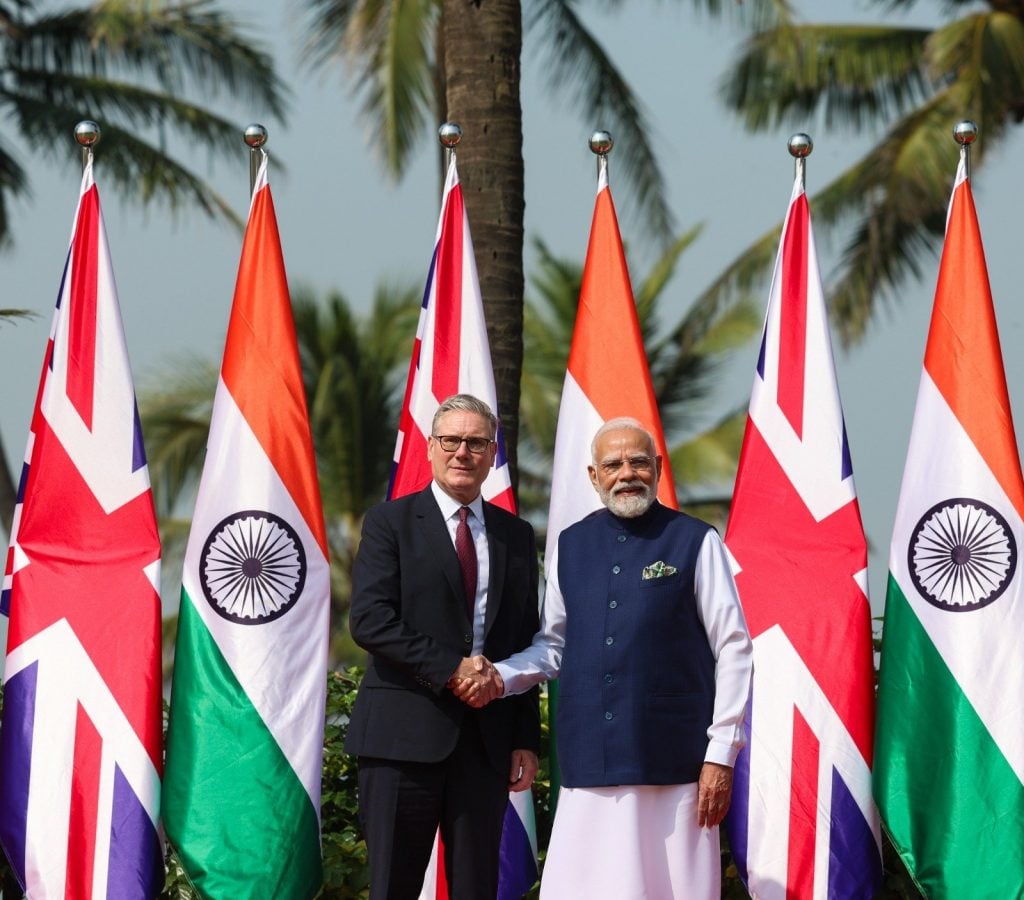
Indian PM Narendra Modi and British PM Keir Starmer took a walk along the seaside lawns of Maharashtra Raj Bhavan ahead of their formal discussions. (Source: Government of India)
New Delhi and London are expanding bilateral tech cooperation, with a first-principles focus on interlinking their innovation and research ecosystems.
KASHISH PARPIANI
This month, UK Prime Minister Keir Starmer visited India, accompanied by a high-level delegation including 125 business leaders, entrepreneurs, university officials and cultural leaders. The visit followed Indian Prime Minister Narendra Modi’s July 2025 visit to the UK, which oversaw the finalization of the India-UK Comprehensive Economic and Trade Agreement (CETA), the India-UK Vision 2035, and the India-UK Defense Industrial Roadmap.
This comprehensive set of outcomes – including the target to double bilateral trade by 2030 (from around USD 56 billion at present) – reflects the momentum underpinning the India-UK strategic partnership.
Another aspect of this upward trajectory of relations between New Delhi and London has been the deepening bilateral tech partnership.
During the UK Prime Minister’s visit to India, the two sides announced some outcomes on bilateral tech cooperation that reflect a first-principles focus on interlinking the two nations’ innovation and research ecosystems.
India-UK tech partnership
The two sides announced the India–UK Connectivity and Innovation Centre, for jointly developing AI native network for 6G, Non-Terrestrial Networks (NTNs), and cyber security for telecoms. The two sides also announced the establishment of the India–UK Joint Centre for AI, for jointly advancing AI propositions across domains like health, climate, fintech, etc.
These initiatives were announced under the ambit of the India-UK Technology Security Initiative (TSI), which was launched in 2024 under the stewardship of the two nations’ National Security Advisors (NSAs), to identify interdependencies and avenues for cooperation on critical and emerging technologies. A year since its establishment, the India-UK TSI has already gathered much momentum on India-UK joint innovation. For instance, in 2024, the TSI launched a flagship GBP 7 million joint research programme to support joint Open RAN and 5G/6G testbed development.
India and the UK have similarly committed to unlocking new financing opportunities for next-gen tech innovation. During UK PM Starmer’s visit to India, the two sides announced a new joint investment in the Climate Technology Startup Fund, an innovation finance initiative for climate technologies, overseen by the UK Government and the State Bank of India (SBI). This effort puts London at the heart of New Delhi’s next-gen infrastructure priorities, such as India’s target of achieving 500 GW of renewable energy capacity by 2030.
India and the UK are also narrowing their focus on the basic building blocks for next-gen technologies and electronics manufacturing. The India-UK TSI has successfully completed the first phase of the India-UK Critical Minerals Supply Chain Observatory, supported by the Institute for Manufacturing (IfM) of the University of Cambridge. During the UK PM’s visit to India, the two sides announced the second phase of the observatory, with a new campus at the Indian Institute of Technology-Indian School of Mines (IIT-ISM), Dhanbad.
These efforts on fostering people-to-people and institutional linkages across Indian and British academic, research, and start-up ecosystems are timely, particularly from the standpoint of the spillover effects of the US-China tech rivalry.
Implications of the US-China tech rivalry
This month’s rupture in US-China relations stemmed from frictions of the US-China tech rivalry, which has seen both sides vying for competitive advantage over next-gen technologies. Beijing’s announcement of sweeping restrictions on exports that contain even small traces of Chinese rare earths, demonstrate China’s willingness to leverage its hold over production, processing and export of critical minerals.
The latest round of restrictions build on China’s April 2025 decision to require licenses for export of rare earth alloys, mixtures, and magnets, and its December 2024 decision on banning export of gallium, germanium and antimony for the US specifically. However, the latest restrictions are significantly broader in scope and risk grave implications for manufacturing operations across the world.
While the move may be to build negotiating leverage ahead of a prospective bilateral between US President Donald Trump and Chinese President Xi Jinping, the US-China tech rivalry has now begun to present global ramifications.
The Trump-Biden-Trump continuity on restricting China’s access to American tech components has raised pressures of compliance. Recently, Malaysia announced permit mandates for export of American semiconductors to clamp down against transshipment of critical tech components to China. Whereas, Singapore has cracked down against reported routing of Nvidia’s chips to China’s DeepSeek. The Trump administration has also reportedly continued the predecessor Biden administration’s aim of leveling the global playing field for US companies, which are complying with existing American restrictions on China’s access to chip-making equipment and maintenance services. This includes seeking greater compliances from Dutch and Japanese companies, despite Tokyo and Amsterdam aligning their respective export mandates with American mandates in early 2025.
Such rising global considerations of regulatory and compliance-related issues of the US-China rivalry have also been apparent in India’s partnership with the UK.
For instance, the India-UK Vision 2035, which was finalized during PM Modi’s July 2025 visit to London, underscored the need for greater cooperation on compliance-related issues.
As the vision document outlined bilateral India-UK aspirations, it also stressed on the need for regular ‘Strategic Export & Technology Cooperation Dialogues’ to “address licensing and export controls issues, unlocking and enabling high-value trade in critical, emerging and other high-end technologies, including in the defence, security and aerospace sectors.”
The way forward for New Delhi and London
Amid rising securitization of tech components and related supply chains, India and the UK are well placed to develop a comprehensive tech partnership, given the two nations’ first-principles focus on interlinking innovation and research ecosystems. This includes the discussed India-UK research partnerships, cross-pollination between innovation ecosystems, and joint development programs, which will foster a collaborative culture of research and development between New Delhi and London.
The importance of such long-term efforts was also evident in the EU’s recent Joint Communication on India, which now recommends setting up of ‘EU-India Innovation Hubs’ and ‘Blue Valleys’, as multi-stakeholder platforms for facilitating investments, aligning standards, and encouraging cross-sectoral collaboration.
In addition, India-UK convergence on critical minerals, including the UK-India Critical Minerals Guild, also opens up opportunities to collaborate with other like-minded partner nations, chiefly in Asia. For instance, this year, the India-Japan Memorandum of Cooperation in the Field of Mineral Resources was also finalised. New Delhi’s focus on this issue has been apparent across its global engagements, with India also endorsing the G7 Critical Minerals Action Plan in June 2025.
Moreover, with collaboration in the education sector, India and the UK are going a step further on their first-principles focus. During the UK PM’s visit to India, the two sides hailed the progress towards the opening of campuses of nine UK universities in India.
There is also immense scope for India and the UK to draw on each other’s unique strengths, such as India’s successful deployment and expansion of Digital Public Infrastructure (DPI) platforms and the broader ‘Digital India’ push (which completes 10 years this year). Amid reports of the UK exploring its own digital ID system, UK PM Starmer recently hailed India’s Aadhaar digital identification programme, which underpins India’s push for greater financial inclusion, secure digital identity-based authentication processes, and transparent digital governance.
Going forward, the recently finalized India-UK Vision 2035 and the India-UK Comprehensive Economic and Trade Agreement (CETA) present much momentum for New Delhi and London to now develop deeper institutional and talent-mobility bridges between their tech ecosystems.
Related Topics
Related Posts