


Indonesia: A New Language in the Middle East
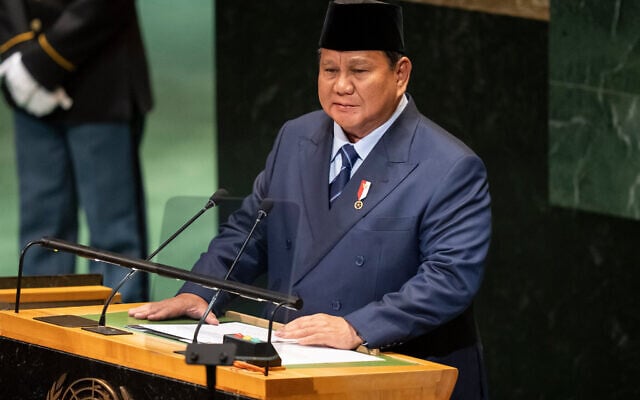
On September 23, 2025, Indonesia’s president told the United Nations General Assembly that “guaranteeing Israel’s security is key to peace.” It was a significant change for the largest Muslim-majority nation in the world, which has long been known for its constant backing of Palestine and refusal to recognize Israel. That is why this new vocabulary — one that highlights Israel’s security concerns — is so significant. It is a rephrasing of the terms of peace, not recognition.
A Pragmatic Turn
Indonesia’s first goal is to be recognized as a developing nation. It presents itself as a credible voice that can present all viewpoints in a world of conflicting discussions. In the UN and elsewhere, Jakarta strengthens its diplomatic position by recognizing Israel’s security requirements.
Second, the economic aspect. Since the Abraham Accords, the Gulf monarchs are closer to Israel, and Indonesia could strengthen its connections with them. Jakarta maintains the Palestinian cause while aligning itself with this regional pragmatism by lowering its rhetoric. the economic dimension.
Finally, Indonesia is sending a message to the West. a sign of moderation — proof that Muslim-majority states are capable of evolving beyond ideological positions.
Is Indonesia preparing to normalize relations with Israel? Not yet. Public opinion at home remains strongly opposed, and any move in that direction would provoke a storm. But the mere fact that Jakarta now acknowledges Israel’s security needs is a first step toward conceptual normalization,
Indonesia’s president may have uttered only a few words, but they could prove consequential. By declaring that Israel’s security is key to peace, Jakarta has redefined its role in the Israeli–Palestinian debate.
Sometimes, history begins not with treaties, but with sentences.