Inside Magen David Adom: AI, Medicycles & The Heroes of October 7th
Magen David Adom’s Uri Shacham on missiles, October 7, an algorithm that knows where emergencies will happen — and the Shabbat dinner that brought him to tears
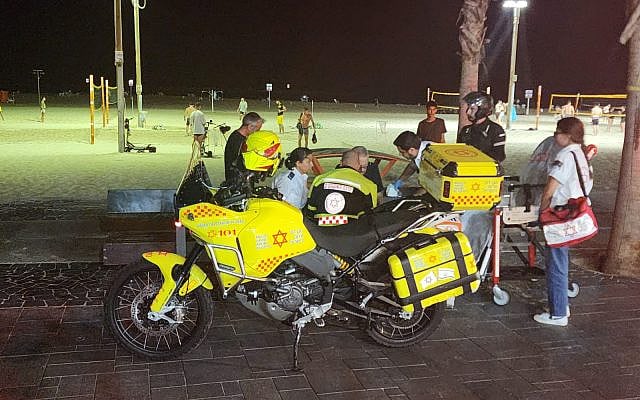
Two years ago, I was on the beach in Tel Aviv when someone went into cardiac arrest. Before I could even process what was happening, motorcycles came racing across the sand — small enough to get where no ambulance could, carrying exactly the equipment that mattered. Then the bigger ambulances rolled in behind them.
I remember standing there thinking: this country has figured something out.
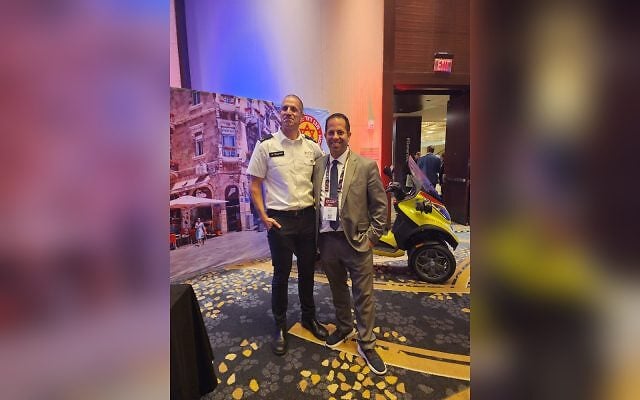
At the Jewish Federations of North America’s General Assembly, you meet incredible people and experience wonderful moments of connection. Hearing the stories of Magen David Adom was one of the most incredible and inspiring of them all.
So when I sat down with Uri Shacham at the GA, deputy director-general and chief of staff of Magen David Adom, I wanted to know what, exactly, Israel figured out. I expected to hear about ambulances and algorithms. I did. But the first thing he told me had nothing to do with either.
“This is also saving lives”
I asked him a simple question: Why do you love saving lives?
“Because I think that saving lives is something that connects everyone together,” he said. “Everyone understands how important it is.”
Then he took the definition somewhere I didn’t expect.
“Sometimes saving lives is getting a boy who heard an Iranian missile hitting the next block. He isn’t injured, but he’s frightened. And having a Magen David Adom volunteer carrying this child in his arms, providing him comfort, letting him know that everything will be okay — this is also saving lives for me.”
Think about that boy for a second. No wound. No chart. Nothing that shows up in a casualty count. And yet someone in a red-and-white vest picked him up and carried him through the worst moment of his young life. That, Shacham insists, counts.
What gets him out of bed? “When I wake up in the morning and I know that 40,000 other Israelis wake up the same morning, and we are all aimed at the same goal — saving lives — this is something that encourages me.”
The lawyer on the motorcycle
Those motorcycles I saw on the beach have a name. MDA calls them “medicycles,” and they’ve been on Israel’s roads for more than 25 years. Here’s the part that floored me: the person riding one might not be a career paramedic at all.
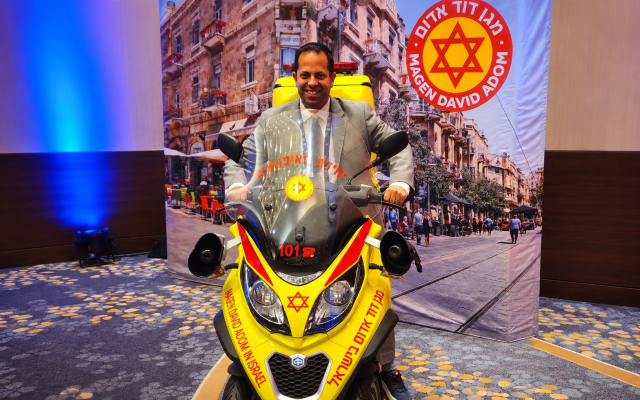
“When there is traffic, an ambulance would get there in many minutes,” Shacham explained. “But a motorcycle with a volunteer that is a lawyer, or a businessman, or someone that sits in his office or her office and gets the call — they will rush to Tel Aviv beach.”
It goes further. MDA has placed automated external defibrillators at lottery stands across Israel. If someone collapses nearby, a bystander can grab one while an MDA call-taker talks them through it from miles away.
“We truly believe that the first line of defense is your neighbor.”
That’s the whole philosophy in nine words. Not the government. Not some faraway agency. Your neighbor — whether that neighbor is driving an ambulance, serving on a local response team, or sitting at a dispatch console using technology to find you, find a defibrillator, and send help before a human even touches the radio.
An algorithm that knows where to wait
Everyone wants to talk about AI right now. MDA is actually using it to keep people alive.
The first layer is dispatch: the system automatically locates the nearest responder — motorcycle, ambulance, whatever is closest — and sends them. “You don’t have to look on the radio who is the nearest to the scene,” Shacham said. “It’s done automatically.”
The second layer sounds like science fiction. A prediction system looks back at the same day and the same hour in past years and flags where a medical emergency is likely to emerge in the coming hour. MDA then pre-positions a small rapid-response vehicle staffed by paramedics in that area.
“We tell them, ‘Listen, be in the vicinity. We don’t know where exactly it will happen, but we know that in a radius of a mile, something will happen. Be there.’ And you know what? It’s more than 93% accurate.”
Then came the war with Iran, and a third layer. When a missile hits, the people who most need help often can’t call — they were caught outside a shelter, or their home has collapsed around them. So MDA built a system to predict the projected impact point of incoming missiles and send ambulances there before a single call comes in.
“It actually saved the lives of hundreds of Israelis.”
Shacham sums it up as three things fused together: “the Jewish spirit of helping your neighbor, the Israeli innovative thinking, and the spirit of Magen David Adom of running to fire when somebody needs you.”
6:29 a.m.
Then I asked him to take me back to October 7th.
“I think that for 99% of Israelis, we all woke up to the sound of a siren at 6:29,” he said. MDA understood quickly that this was not a regular attack, even before anyone knew what it was. Within an hour, all 1,700 ambulances were manned. Call-center shifts were doubled. Two hours in, MDA launched a national blood drive — a decision that proved critical in the days that followed.
Leadership went to the front. MDA’s director-general himself drove to Sderot and later toward the kibbutzim. And what Shacham saw there broke every pattern he knew.
“In Israel, we are used to that 30 minutes after a terror attack, that’s it — the scene is cleared,” he said. “And seeing that the scene is still active, that we were still seeing people lying on the street — this was something that was very shocking for me.”
Then came the moment that changed what the uniform meant.
“The uniform that I so proudly wear always served as a hidden shield. Nobody would harm Magen David Adom people. And that day, as early as 7:00 AM, 30 minutes into the attack, Magen David Adom medic Aharon Chaimov was shot and killed by Hamas terrorists.”
MDA ambulances heading to the kibbutzim were shot at Tzomet Re’im. “We actually became targets,” he said. “It’s one thing when you go to treat somebody that was shot, and another thing when you know that you are in danger.”
Two things kept his teams moving. First, they could see their leaders standing next to them. Second, early that morning MDA sent bulletproof ambulances from Judea and Samaria down to the Gaza border communities. “They were the game changer,” he said — protecting crews and patients alike as they went back and forth, again and again.
They worked, in his words, “on automatic mode.” By midday they knew of dozens of murdered people and held back from going to the media, fearing what that news would do to the country. It wasn’t until around 3:00 a.m. on October 8th that the true scale came into focus.
And then came the question no training manual answers: “Okay, that’s one day. How do you wake up the next morning and keep doing this?”
The answer arrived at dawn. “On the morning of October 8th, everybody showed up,” Shacham said. “There was not one person who said, ‘I’m staying home.’”
MDA launched a resilience program, gathering every responder — dispatchers, ambulance crews, everyone — and simply letting them talk about what they had experienced. Meanwhile, out in the communities, MDA people were already embedded. Some paid the ultimate price; Amit Mann was murdered in Be’eri. But in kibbutz after kibbutz — Rafi Shemet in Kissufim, MDA members in Magen — “they were like a pillar of solid concrete that people would rely on.”
That lesson became policy. MDA launched the Magen program to train communities to respond to disasters themselves. It expanded its bulletproof fleet. It trained to operate with no infrastructure — no electricity, no water.
“Magen David Adom’s response on October 7th was something for people to look up to, to learn from,” he said. “But we are much better than we were back then.”
“Tell my kids I love them”
One of the most beautiful things about MDA is who wears the vest: Jews, Arabs, Bedouins, Christians, Muslims, Druze. I asked whether October 7th had frayed those bonds.
“Some people would think, ‘Listen, maybe October 7th has created tensions among volunteers,’” he said. “And I say, no, the opposite is true.”
“We had Bedouin team members going into the Gaza envelope treating patients, calling their families and saying, ‘Listen, I don’t know if I’ll come back, but tell my kids I love them.’ Thank God everyone came back.”
“When you look at the man next to you,” he continued, “and see that all he cares about is you as a human being, regardless of your ethnicity, of your gender, or whatever — it creates a bond.”
Israelis noticed. MDA had roughly 35,000 volunteers on October 7th. In the three years since, it has added about 5,000 more. “It’s not only secular, not only Orthodox, not only Jews,” Shacham said. “It’s the most Israeli place, and everyone has his or her place in Magen David Adom as long as you are committed to the mission.”
The story he couldn’t finish dry-eyed
I asked him for the one story that stays with him. A man who has seen what he has seen could have picked any trauma call in the country. He didn’t.
“I won’t go to medical things,” he said. “I’ll speak about my own family.”
His wife volunteered with MDA. So do both of his daughters — and he’s careful to say he never pushed them. A few months ago, they asked for something special: “Daddy, we want to have a shift with you. You’ll drive the ambulance and we will ride in the back.”
That shift, they were called to a reservist suffering from PTSD who was going through a family crisis. Not life-threatening. They cared for him and went home.
At Shabbat dinner, his eldest daughter turned to him.
“You know, Daddy, this person didn’t need our professional help in saving his life. But for me to relax him, to speak with him, to put a hand on his shoulder and to make him smile again — I really feel that I saved his life.”
Shacham stopped. “See, I’m all in tears,” he said.
“Many times we wonder, with everything that we do: are we educating our kids the way we want them to act in this world?” he said. “By her saying this sentence to me, it shows me that, yeah, probably my wife and I did a good thing. And I’m so grateful that they had the chance, and that this is my family’s legacy.”
Back to the beach
I think about those motorcycles on the sand differently now. I used to see equipment. Now I see a lawyer who left his desk. A dispatcher reading a map no one else can see yet. A Bedouin medic telling his family he might not come home, then going anyway. A young woman with her hand on a stranger’s shoulder.
At IMPACT, we say fear is loud and joy is louder. Uri Shacham taught me that care is louder too — and that it rarely needs a siren. Sometimes it’s just a neighbor who shows up.
So here’s my question for you, wherever you’re reading this: Who is your neighbor counting on? And when the call comes, will you be the one who runs toward it?