


Mathematics Teaching Professor, Author
Inside Temple Emanu-El, NYC: World’s Largest Synagogue in the Western Hemisphere
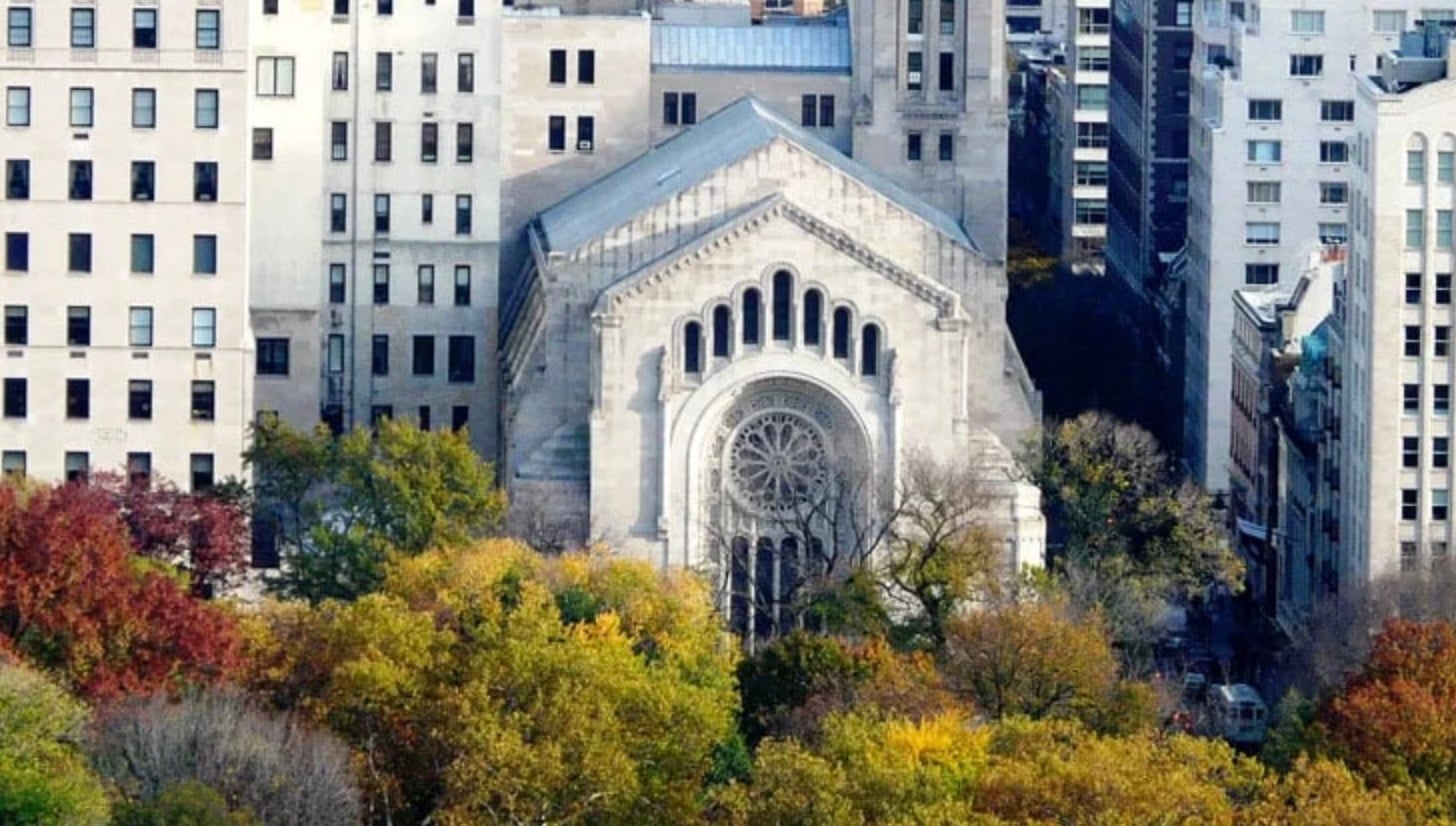
Temple Emanu-El NYC (Source: Temple Emanu-El, NYC)
Rising above Fifth Avenue, Temple Emanu-El is the largest synagogue by size in the western hemisphere and one of New York City’s most iconic houses of worship. More than a landmark, it is a living center of faith, history, and community, where sweeping architecture, rich tradition, and vibrant spiritual life come together in the heart of Manhattan. As one of the most prominent Reform Jewish congregations in the world, it stands at the crossroads of tradition and modernity, defined by soaring stained glass, meaningful ritual life, and a deeply engaged community.
This article is particularly dear to me because in the 1960s, each year for Yom Kippur services, my parents, mostly at my mother’s request, would take my sister Joannie and me to Temple Emanu-El. I would like to thank Bryan Limon Senior Director, Communications of Temple Emanuel and Warren Klein, Curator at Herbert & Eileen Bernard Museum of Judaica, Temple Emanu-El, for their guidance and support of this article.
Synagogue
Located on Fifth Avenue in the heart of New York City, Temple Emanu-El is widely regarded as one of the world’s most beautiful synagogues and an architectural masterpiece. Drawing visitors from around the globe, the synagogue is celebrated for its breathtaking sanctuary, rich symbolism, and welcoming spirit. Completed in 1929 by renowned architects and first used for worship in 1930, the building was constructed using marble, mosaic, stained glass, bronze, and wood sourced from around the world.
Today, Temple Emanu-El is the largest synagogue in the western hemisphere by physical area, encompassing approximately 3,523 square meters (37,922 square feet), or about 0.87 acres, roughly the size of fifteen tennis courts. The majestic building serves New York City’s oldest Reform Jewish congregation and features seating for approximately 2,500 worshippers. While exact figures vary, the congregation is estimated to include more than 5,000 members.
Many of the most influential Jewish families in American history played central roles in the temple’s growth and development. These included the Straus family, owners of Macy’s; the Lehman family, founders of Lehman Brothers; and the Bloomingdale family, founders of the famous Bloomingdale’s department store. The congregation has also attracted notable political and cultural figures, including former New York City mayors Michael Bloomberg and Ed Koch, former New York Governor Eliot Spitzer, celebrated comedian Joan Rivers, whose funeral was held at the temple, renowned journalist Walter Lippmann, and musician Paul McCartney.
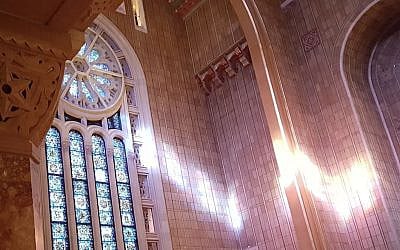
Among the building’s most remarkable features is its soaring, column-free sanctuary, measuring 100 feet wide, 175 feet long, and 103 feet high, with seating for 2,500. It is illuminated by more than sixty stained-glass windows, including the magnificent Wheel Window. The Wheel Window itself incorporates layered symbolism, including the number 36, double chai, the Twelve Tribes of Israel, and themes from Jewish mysticism, making it one of the synagogue’s most treasured artistic features.
The grand Ark, designed to resemble an open Torah scroll, houses seven sacred Torah scrolls. Visitors are also drawn to the hand-painted ceiling and the towering eight-story mosaic arch over the bimah, created by artist Hildreth Meière, which blends Jewish imagery with early Art Deco design.
Lastly, I would be remiss not to mention one more architectural highlight, the Temple is home to one of the world’s largest synagogue organs, containing more than 10,000 pipes and recently restored to its original splendor.
Livestream
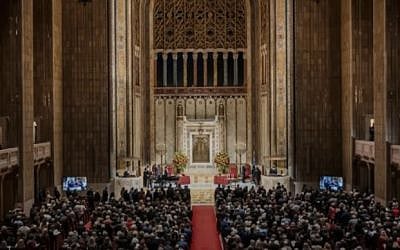
Temple Emanu-El extends its reach far beyond New York City through its robust livestream program, which enables more than 2.2 million people each year to participate in worship services from around the world. Livestreaming is made possible through the Schwarzhaupt-Levite Video Fund, established by Elsie L. Adler in loving memory of her grandparents, whose generosity funded the purchase and installation of the temple’s video and production equipment. Through these broadcasts, Temple Emanu-El continues its mission of making meaningful Jewish worship, learning, and community accessible to people wherever they may be.
Culture and Religious Life
At the heart of Temple Emanu-El is a commitment to being a dynamic spiritual home for all who seek connection, meaning, and community. Whether Jewish by birth, by choice, or simply curious about Jewish life, individuals and families are welcomed to worship, and celebrate both in person and online. The congregation embraces the values of community, inclusion, and belonging, affirming the dignity and worth of every person. Temple Emanu-El welcomes people of every race, ethnicity, sexual orientation, gender identity, age, ability, and background, as well as families of all structures and traditions.
Through worship, education, volunteer opportunities, cultural programs, and social gatherings, the temple seeks to make Judaism relevant to contemporary life while fostering meaningful relationships among congregants, clergy, and staff.
Temple Emanu-El strives to inspire spiritual growth, mutual care, and social responsibility. The congregation celebrates life’s milestones together, provides support during times of illness and loss, and promotes a culture of compassion and respect. Guided by the principles of Klal Yisrael (Jewish unity), Tikkun Olam (repairing the world), and Tzedakah (charitable giving), the temple maintains strong connections with Jewish communities worldwide and supports efforts to create a more just and caring society.
As New York City’s first Reform Jewish congregation, Temple Emanu-El continues a legacy of leadership while looking toward the future. The congregation remains active year-round, offering daily evening services, Shabbat worship, observances for all major Jewish holidays, and a full range of lifecycle events, providing members and visitors with meaningful opportunities for spiritual engagement and communal connection.
Streicker Cultural Center
Beyond its role as a house of worship, the temple serves as a major center for Jewish learning, culture, and community engagement through The Temple Emanu-El Streicker Cultural Center. Recognized as one of New York City’s leading cultural institutions, the Streicker Center provides diverse opportunities to explore Jewish history, culture and traditions through lectures, classes, concerts, discussions, and partnerships with prominent organizations. Its innovative programming reaches more than 60,000 in-person participants annually, while an additional 460,000 people engage through its virtual offerings.
Music
Music is also an integral part of Temple Emanu-El’s identity and worship experience. The temple is home to distinguished cantors and musicians whose performances enrich both religious services and concert programs.
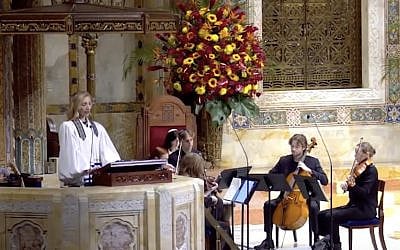
Among them is Cantor Mo Glazman, an internationally acclaimed vocalist who has appeared in concert venues across North America, Europe, and Israel. The Temple also hosted Cantor Sara Anderson, a Tisch-Star Fellow recognized for her exceptional musical talent and leadership. Together with the temple’s renowned choir and one of the world’s largest synagogue organs, these artists contribute to a rich musical tradition that inspires congregants and visitors alike.
Learning
Adult engagement at Temple Emanu-El is vibrant and multifaceted, offering opportunities for connection, learning, and service. Young professionals participate in social and cultural programs, while volunteer initiatives and Tikkun Olam activities encourage meaningful community involvement. Longstanding groups such as Women of Emanu-El and the Men’s Club foster friendship, leadership, and civic engagement, while Gather, the temple’s small-group program, brings congregants together to build relationships, learn, and deepen their sense of community.
Temple Emanu-El offers a wide range of programs for children, teens, and families. Its Nursery School provides a play-based foundation for learning and social development, while the Religious School helps students explore Jewish values, traditions, and spirituality. Young families can participate in programs for babies, toddlers, and caregivers, while tweens and teens engage in leadership, educational, and social opportunities that prepare them for the future. Additional initiatives, including Emanu-El Downtown and College Connection, help families and students stay connected to Jewish life at every stage.
Historical Background
In 1654, what is now the United States was made up of scattered European colonies and Indigenous nations, with only about 50,000 to 60,000 people living in all the English colonies combined. Travel was slow and difficult, relying on dirt paths, horseback, or sailboats, and New Amsterdam, later New York City, was a small Dutch trading post with just a few hundred residents.
That year, 1654, is the year Jews first arrived in what is now New York City. A group of 23 Jewish refugees fled Portuguese persecution in Brazil after the Portuguese recaptured the Dutch colony of Recife. They arrived in New Amsterdam, the Dutch settlement that later became New York City, marking the beginning of Jewish settlement in the city.
Although Governor Peter Stuyvesant initially tried to expel the Jewish refugees who arrived in New Amsterdam in 1654, they were allowed to remain after intervention by leaders of the Dutch West India Company. This small group helped lay the foundation for New York’s growing Jewish community.
Jewish life in New York expanded steadily through the 18th and 19th centuries, beginning with the establishment of Congregation Shearith Israel in 1730, the city’s first synagogue. Growth accelerated dramatically in the 19th century as large waves of Jewish immigrants arrived from Germany and later Eastern Europe, bringing new languages, traditions, and forms of worship. These communities built synagogues, mutual aid societies, and cultural institutions that helped shape Jewish life in the city.
It was in 1845 that 37 German Jewish immigrants founded Congregation Emanu-El on Manhattan’s Lower East Side, which later became the first Reform Jewish congregation in New York City. The congregation worshiped both in Hebrew and in German in their services and later transitioned to English. In 1848, it installed a large organ, introducing instrumental music into worship, an innovation that distinguished Reform practice from Orthodox tradition.
By 1868, New York City had become the largest Jewish city outside Europe and the Middle East, setting the stage for institutions like Temple Emanu-El. The congregation had grown and prospered enough to build a landmark synagogue at Fifth Avenue and East 43rd Street, signaling its rising prominence.
During the 1920s, as New York City expanded northward, the congregation moved uptown and in 1927 merged with Temple Beth-El to open its current home at Fifth Avenue and 65th Street. Temple Emanu-El was intentionally built on Fifth Avenue across from Central Park, providing a prominent and accessible location between Manhattan’s East and West Sides. Construction began in 1927 and was completed in 1929. It was sometimes referred to as the “Skyscraper Temple” because it incorporated modern structural steel, allowing for faster construction compared to traditional brick methods. The main sanctuary rises nearly seven stories high, reflecting both its monumental scale and the innovative building techniques of its era.
Temple Emanu-El endures as both a sacred space and a symbol of Jewish life in America—rooted in nearly two centuries of history yet continually evolving to meet the needs of a modern congregation. From its origins in 19th-century immigrant New York to its present role as a global center of worship, learning, and culture, the temple reflects a legacy of resilience, innovation, and inclusion. Today, it remains not only an architectural masterpiece on Fifth Avenue, but also a vibrant spiritual home for generations past, present, and future.
Contact Information:
Temple Emanu-El, One E 65th Street, New York, NY 10065
Phone: 212-744-1400
Email: temple@emanuelnyc.org
Website: https://emanuelnyc.org/