
Russian-American-Israeli Palestinian. Palestine is Israel.
Investing in Hypocrisy: The BDS Index Fund
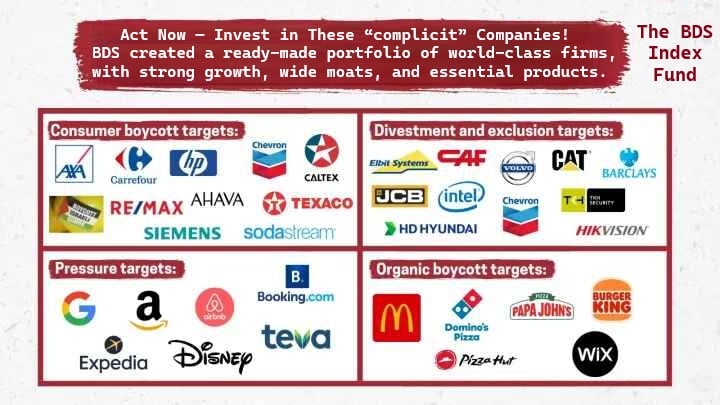
Act now—invest in these “complicit” companies! BDS has ironically created a ready-made portfolio of world-class firms, with strong growth, wide moats, and essential products. Their boycott lists perfectly overlap with the engines of global economic success.
How a BDS Index Fund Could Expose and Disarm the Boycott Movement
The Boycott, Divestment, and Sanctions (BDS) movement has spent years publishing lists of companies it wants the world to avoid. These companies are accused of “complicity” with Israel—though curiously, they always happen to be the same companies BDS activists rely on daily. Their smartphones, laptops, social media accounts, cloud services, credit cards, and medicines all trace back to firms on BDS “blacklists.”
Rather than treat these lists as weapons, perhaps it’s time to flip them into opportunity. The most powerful way to expose the futility of BDS isn’t another debate, but the creation of an investment vehicle that transforms their boycotts into profits: the BDS Index Fund.
What Is an Index Fund?
An index fund is a basket of stocks designed to track the performance of a defined list of companies. Instead of trying to “beat the market,” the fund simply mirrors a set of companies—say, the S&P 500 or Nasdaq 100. Investors buy shares of the fund, gaining exposure to all companies inside it, with lower costs and steadier long-term performance.
Index funds have become the backbone of modern investing, precisely because they reflect broad economic growth rather than the risky bets of individual stock-pickers.
How a BDS Index Fund Would Work
A BDS Index Fund would simply track the companies targeted by the BDS movement. The BDS lists, updated regularly by activists, would serve as the “index.” Fund managers wouldn’t need to pass judgment on politics; they’d just follow the movement’s own blacklists.
Investment firms could then issue ETFs (exchange-traded funds) or mutual funds that mirror the index. These funds would attract both:
- Ideological investors who want to support Israel and thumb their nose at BDS.
- Rational investors who recognize that BDS has conveniently selected some of the world’s best-performing corporations—Microsoft, Google, Intel, Amazon, HP, and beyond.
Ironically, by trying to “punish” Israel, BDS has produced a ready-made portfolio of world-class companies with strong growth, wide moats, and essential products.
Fund Variations: Turning Boycotts Into Portfolios
Beyond the basic index, managers could offer several spinoffs:
- BDS Dividend Fund – holding the BDS-listed companies that pay high dividends, appealing to income-focused investors.
- BDS Large Cap, Mid Cap, Small Cap Funds – slicing the list by company size.
- BDS Sector Funds – technology, finance, consumer goods, healthcare.
- Extended Market BDS Funds – the inverse product, tracking the “market minus BDS.” Perfect for those who want to measure exactly how much return they’re throwing away in the name of “ethics.”
Just as “sin funds” exist—holding alcohol, tobacco, and gambling companies because people will always consume them—so too would BDS funds thrive. Investors don’t have to smoke, drink, or gamble to profit from human behavior. Likewise, you don’t need to be a BDS hypocrite to recognize that people will never give up Microsoft, Google, or Teva Pharmaceuticals.
The Hypocrisy of “Ethics Councils”
Some national funds and university endowments have already dabbled in symbolic BDS gestures. Norway’s $2 trillion sovereign wealth fund, the largest in the world, recently divested from several Israeli banks and Caterpillar because bulldozers are used in Judea, Samaria, and Gaza.
But the hypocrisy is glaring. If they truly followed BDS demands, they would also have to dump Microsoft, Intel, Amazon, HP, and hundreds more. That would cripple performance—and betray their fiduciary duty to citizens and retirees. So they make a symbolic cut, pretending to take a moral stand while continuing to profit from the very companies they denounce.
A BDS Index Fund would expose this duplicity in the most quantitative way possible: by showing, in real time, that BDS lists overlap almost perfectly with the engines of global economic growth.
Why This Would End the Movement
Money speaks louder than slogans. If BDS-inspired funds consistently outperform the broader market—as they almost certainly would—then the boycott collapses into absurdity. Investors, pension funds, and asset managers will have hard data proving that “complicity” equals profitability.
BDS activists themselves, ever reliant on the very companies they claim to boycott, will be reduced to the ultimate irony: watching capital flow into the firms they denounce, and realizing they’ve become unwitting promoters of an elite stock portfolio.
A Final Consideration: What Happens When BDS Dies Out?
Funds need long-term strategies. If BDS collapses—and this index could hasten its collapse—what then? Fund prospectuses could plan for a merger with broader index funds, or a shift into “post-BDS portfolios” that simply continue tracking the companies BDS once targeted. Investors wouldn’t face sudden tax burdens; the transition would be handled just as with any rebalanced fund.
In other words, the risk is manageable. The reward is immense: a financial innovation that not only humiliates BDS, but also strengthens Israel’s defenders and enriches rational investors.
Conclusion
The best way to confront BDS is not only to debate it, but to monetize its hypocrisy. A BDS Index Fund would reveal that the movement’s blacklist is actually a golden ticket to some of the most innovative, profitable companies on earth.
By transforming boycotts into portfolios, investors can both profit and prove the futility of the movement. And in the end, that may be the most effective form of disarmament: letting the market show that BDS is not just wrong, but worthless.
See Also
Boycotters Without a Cause: The Circus of Hypocritical Activism
Related Topics
Related Posts