
Middle East Analyst
Iran Deal: Has the Time Come for a Real Abraham Accords?
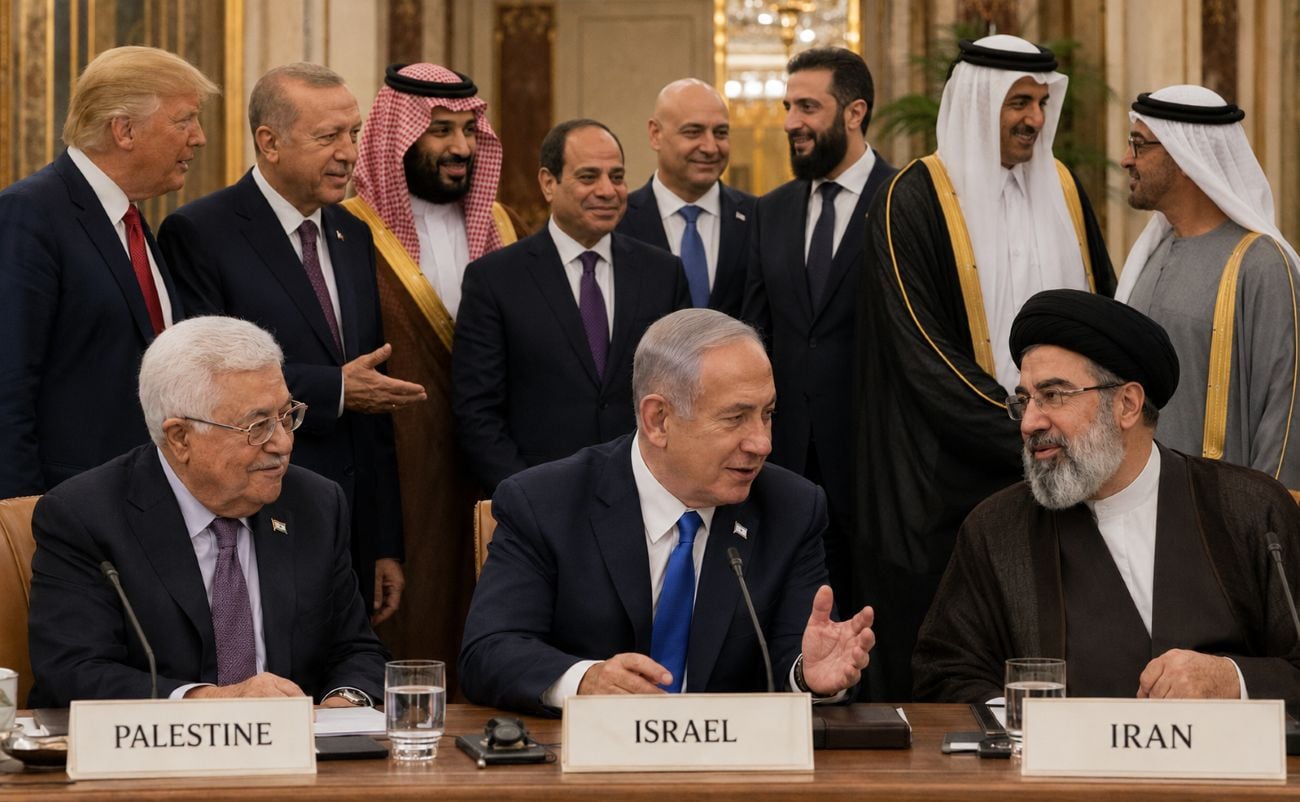
By author (AI)
The fourteen-point memorandum of understanding signed between Washington and Tehran on June 17 commits the United States and its regional partners to a $300 billion reconstruction package for Iran, financed through a performance-gated structure rather than a sovereign payout. Critics have flagged its sequencing — sanctions relief begins immediately while disposition of Iran’s enriched stockpile waits sixty days. That debate matters, but this essay treats the MOU as something larger: the opening move in a Middle East economic integration project aimed at making Iran’s recognition of Israel, and Israel’s recognition of Palestine, more valuable than withholding either.
Where the Current Abraham Accords Fall Short
The 2020 Accords were a genuine achievement, but a bounded one. The UAE, Bahrain, Morocco, and Sudan normalized with Israel without movement on Palestine — proof limited normalization no longer needed to wait on Israeli-Palestinian peace. But the actors with the weight to turn bilateral deals into a regional order — Saudi Arabia, Turkey, and Iran — stayed out, each for a different reason.
Riyadh has tied normalization to a credible Palestinian track, both for Crown Prince Mohammed bin Salman’s own legitimacy and because Saudi leadership of the Muslim world carries an expectation of defending Palestinian statehood. Erdogan has cultivated ties with Hamas for similar reasons of regional standing. Iran’s absence is more fundamental: since 1979, the Islamic Republic has built its claim to regional leadership around championing the Palestinian cause. Anti-Zionism is legitimacy infrastructure load-bearing on that cause, which means Iran’s willingness to recognize Israel is substantially hostage to the Palestinian file rather than a separate question. A “real” Abraham Accords — one that reorganizes the region’s architecture rather than adding names to the original photo — has to solve this harder problem.
What Economic Integration Could Actually Build
The obstacles are real, but so is the prize. Iran sits on some of the world’s largest oil and gas reserves with degraded but existing infrastructure; Israel has world-leading capacity in desalination, agriculture, and energy technology built from scarcity Iran badly needs addressed; and the Gulf states have trillions in sovereign capital seeking infrastructure returns and a stable eastern neighbor. A reconnected region could plausibly support an energy corridor from Iranian gas fields to Gulf export terminals through a secured Hormuz, Gulf capital underwriting Iranian grid and port modernization, Israeli technology licensed into regional markets, and a de-risked Hormuz that removes a standing premium from global energy markets. None of this is fanciful — the capacity and capital already exist. The question is what has to happen politically before they can move, because the economics, on their own terms, are not the hard part.
Why the Economics Alone Cannot Carry It
This has already been tried in isolation nearby, and it has stalled. The Board of Peace, created to administer Gaza’s reconstruction with a UN Security Council mandate, has moved almost no money since member states pledged $17 billion against a cost the UN and World Bank put closer to $70 billion. The reason is governance: the Board’s charter gives its chairman, President Trump, personal, largely unchecked control of membership, agenda, and spending, with no fixed term — exactly the structure that keeps institutional capital sidelined regardless of the mission’s merits. This is the precise inverse of the Iran track’s weakness: real economic logic and a workable financing structure, but no political resolution of the conflict driving the need for reconstruction. Economic architecture and political legitimacy are not substitutes for each other — each track has one and is missing the other, and any design assuming money will eventually paper over an unresolved political conflict is repeating a failure already visible in Gaza.
Why Gaza Is the Keystone, Not a Mirror
It would be a mistake to treat Palestinian political standing and Iranian recognition of Israel as co-equal items, completed independently and matched up after the fact. Gaza is the region’s center of gravity — the issue whose unresolved status drains legitimacy from nearly every other initiative around it, from Saudi normalization to a US-Iran settlement. This isn’t a claim about whose fear matters more; Israelis facing Iran’s missile and proxy network have a legitimate fear too. It is an empirical claim about what has and hasn’t moved in three years of crisis: Saudi-Israel normalization stalled the moment Gaza exploded in October 2023 and hasn’t advanced since; the Board of Peace can’t function without Palestinian buy-in it hasn’t secured; and Iran’s domestic legitimacy depends on the Palestinian cause in a way no other issue touches. This changes how the recognition problem should be modeled. Iranian recognition of Israel is not a parallel track but substantially downstream of the Palestinian one, because Tehran’s legitimacy claim is staked on a cause it cannot abandon without something credible to point to in return. Get Gaza wrong, or leave it unaddressed, and no financing package is large enough to make Tehran’s reversal politically sellable at home.
The Non-Negotiable Precondition
This is the center of the argument: there is no durable Abraham Accords without a credible resolution of Gaza’s status, paired with Iran’s conditional recognition of Israel and Israel’s conditional recognition of Palestinian political existence — not separable concessions on parallel tracks, but one interlocking step where movement on Gaza makes Iran’s deradicalization survivable. The logic is structural, not moral: an agreement asking one party to make a costly, irreversible concession for a step the other side’s domestic politics can credibly withhold has no rational basis for compliance, since the conceding side has no reason to believe the deal will be honored once its concession is banked. Gaza has already shown this — a disarmament demand made for a “pathway” the other side’s leadership said would not be honored regardless of compliance produced exactly the non-compliance any analyst should have expected. The same trap operates if Iranian recognition is extracted in isolation: hardliners get to call it a naked capitulation that abandoned the regime’s central cause, and the regime has every incentive to agree. The sequencing that survives this logic has credible Palestinian progress coming first or in close lockstep, with both recognition tracks then moving together, each contingent on the other.
This is why the precondition is non-negotiable rather than aspirational, and why financing alone cannot satisfy it. If Gaza’s status goes unresolved, the rest of the architecture — the $300 billion fund, the energy corridor, the Gulf capital — is largely irrelevant, since none of it touches the legitimacy problem that has scuttled every prior integration attempt. Riyadh will not extend full normalization without Palestinian progress, however attractive Iranian markets become. Tehran is not likely to abandon its central ideological cause for money alone, since “we were paid to” is not a defensible domestic story while Gaza remains unresolved. Jerusalem will not extend meaningful political standing to Palestinians as unilateral goodwill detached from its own security calculus. Each side’s movement depends on the other’s, with Gaza as the fulcrum.
What Would Actually Make This Rational
None of this requires good faith from Tehran, Jerusalem, Washington, or Gulf investors. It requires specifying conditions under which compliance becomes rational even for unreliable actors. Three elements do that work: independent, milestone-based verification rather than unilateral certification by any single government, closer to the World Bank’s role as fiduciary trustee than to a vehicle controlled by one political patron — the exact defect that has frozen the Gaza effort; automatic reversal, where sanctions relief and the reconstruction architecture revert on a defined trigger if commitments lapse, rather than requiring a fresh political decision the next election cycle can capture; and staged reciprocity, with the Iran-Israel and Israel-Palestine recognition tracks moving on linked, mutually verified timelines rather than as separate negotiations that can each stall without consequence to the other. These are the standard tools of credible international commitment, and their absence — not the unreliability of the actors — is the actual design flaw in everything on offer.
Bottom Line
The maximalist war aims pursued over recent months — regime collapse, elimination of Iran’s proxy network, surrender rather than settlement — did not succeed, and Washington, Jerusalem, and Tehran all absorbed real costs proving it. That failure doesn’t guarantee anyone will choose differently; leaders facing a failed strategy sometimes recalibrate and sometimes double down. But it creates an opening that didn’t exist a year ago: the alternative to a flawed architecture is no longer abstract, it is the war just fought, with global energy markets still absorbing the damage. A real Abraham Accords could become the vehicle for genuine regional order rather than a set of bilateral deals with its central unresolved conflict still standing outside it. Whether Washington, Tehran, and Jerusalem find the will to build it is a question only they can answer.
Related Topics
Related Posts