
Analysing Risks, Assumptions and What Comes Next
Iran Gets More Room in BRICS. Should Israel Worry?
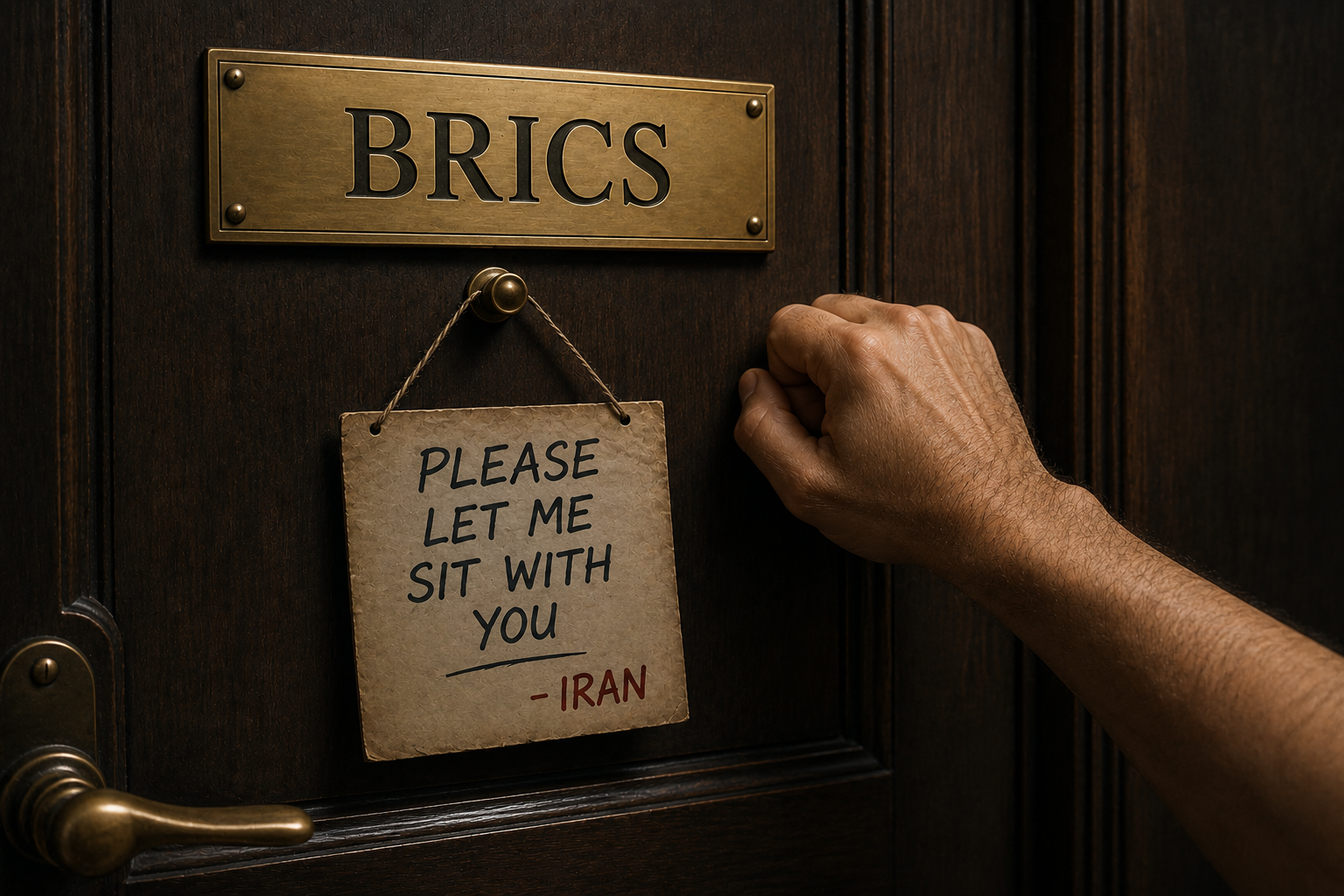
The BRICS meeting in Jaipur on August 12 saw Iranian Central Bank Governor Abdolnaser Hemmati push for Iran’s entry into the New Development Bank, greater use of national currencies and closer payment-system links among members. The NDB is nowhere near large enough to replace the IMF or Western capital markets. That is not the point. Iran is looking for a seat in a cohort.
Iran joined BRICS in 2024. Now its central bank governor is talking about the financial plumbing that could make membership more useful.
Should Israel worry? Yes, but not because BRICS is about to hand Iran a financial red carpet.
The BRICS countries have their own interests, their own exposure to sanctions and their own security concerns. India in particular understands the difference between giving Iran a diplomatic and economic channel and giving Tehran unrestricted access. Hemmati’s announcement itself still requires the NDB’s formal process, the bank has not independently confirmed that Iran’s membership is final. So the immediate concern is manageable.
India knows particularly well the difference between maintaining a relationship with Iran and assuming Iranian risk on its behalf.
Israel has more to manage than The United States, The United States can treat much of this as a question of sanctions, intelligence and enforcement from outside the immediate regional environment. Israel cannot. Israel has to manage the consequences inside the region, including the networks and actors operating between state and non-state space. That creates a different burden.
The US can designate an Iranian financial network operating through a third country. Israel has to consider what that network may eventually mean for the security environment around it. Distance is a luxury the US has while distinguishing between the Iranian state and an affiliated organization. Israel has to make that distinction while deciding how to respond.
The harder Iranian behavior becomes to attribute, the harder deterrence becomes to calibrate.
That does not mean every action by Hezbollah or the Houthis should be treated as a direct Iranian order. In fact, assuming that would make the analysis worse. The difficulty is precisely that Iran can benefit from relationships whose actors retain their own incentives. That is where the Iranian technocratic story becomes relevant again.
Hemmati is talking about payment systems. Other parts of the Iranian state have spent years developing relationships that function when conventional systems do not. These are not the same thing. But they exist within the same state.
Calling out the fox, which in this case is not BRICS, The fox is the assumption that legitimate integration and grey-zone behavior are mutually exclusive. They are not. Iran does not need BRICS to replace the West. It needs enough alternatives that exclusion from Western systems does not leave it without diplomatic, financial or commercial company.
Iran wants a camp out of desperation. The institutional value may ultimately matter more than the financial one. Iran is not looking at BRICS only as a source of capital, it is looking for evidence that it still has a place within an international grouping of states willing to engage with it.
There is also a domestic dimension. For a government facing economic pressure and diplomatic isolation, being accepted by a major international grouping offers something beyond practical access. It allows the state to project that it still has a camp.Whether that camp is as cohesive as Tehran would like is another question.
The NDB cannot give Iran much of a financial lifeline today. Its significance is institutional. Iran is trying to secure a place in the room before it needs the room.
BRICS members have different interests, and none is likely to assume Iran’s geopolitical risks for it. India, China, Russia and the other members will continue to calculate their own interests.
But Iran does not necessarily need a unified bloc, or even one that can offer substantial practical support. It may simply need enough institutional company to avoid looking alone to reassure its own population that isolation has limits, and to signal to its less predictable partners that Tehran still has states willing to engage with it.
Related Topics