
PhD | Sr. Change Leadership and Crisis Management Expert
Iran Has a Leader: Canadians Calling for Engagement with Prince Reza Pahlavi
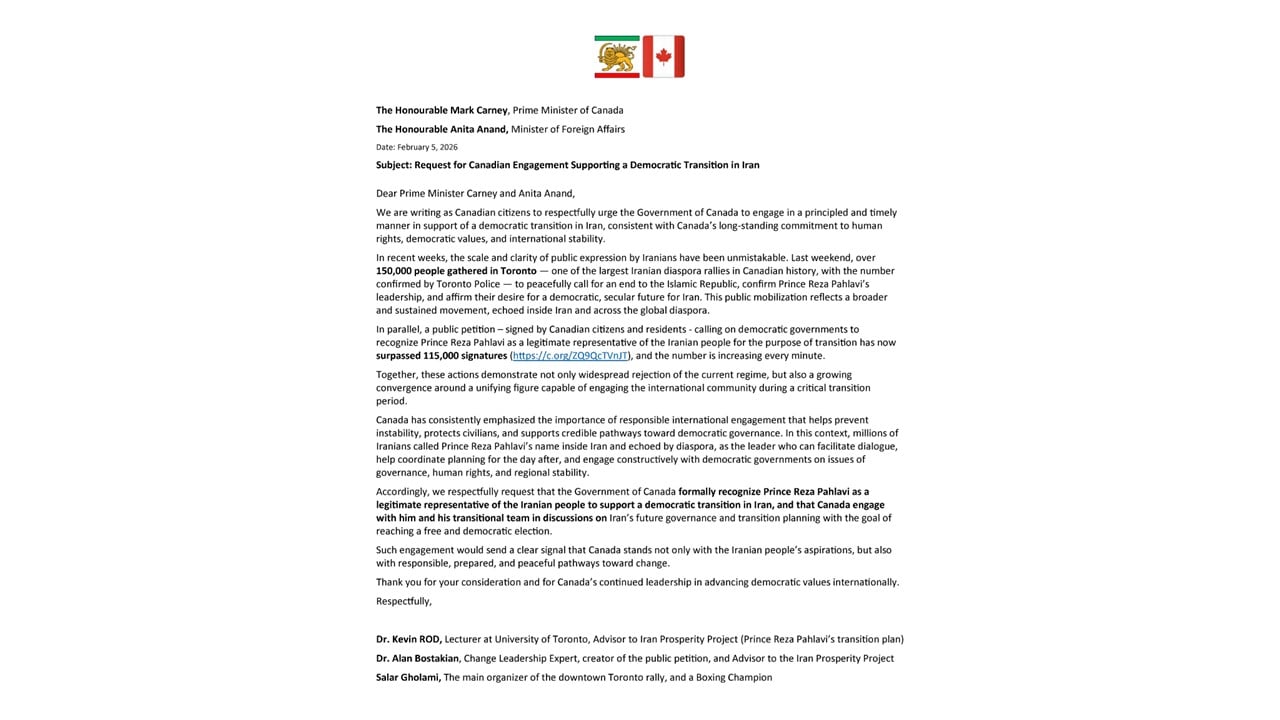
The Letter
How Canada’s Citizens Are Setting a Global Standard by Calling for Engagement with Prince Reza Pahlavi
Moments of historic change rarely arrive with clear instructions. They emerge gradually, unevenly, and often faster than governments expect. Iran is now at such a moment. While the precise timing of change cannot be predicted, its direction and leadership are no longer in question. One reality has become increasingly clear: millions of Iranians, inside the country and across the diaspora, have identified Prince Reza Pahlavi as a unifying national leader for a democratic transition.
The question facing democratic governments is no longer whether this reality exists, but how they should engage with it.
In Canada, citizens and residents have responded to this moment through a deliberate and escalating civic sequence: public mobilization, documented support, and direct engagement with government.
In recent weeks, more than 150,000 people gathered peacefully in Toronto for one of the largest Iranian diaspora rallies in Canadian history, publicly calling for the end of the Islamic Republic and affirming Prince Reza Pahlavi as the leader of a democratic transition. That public expression was followed by a formal petition calling on democratic governments to recognize and engage with him as a legitimate transitional representative. The petition has since surpassed well over 123,000 signatures and continues to grow.
Building on that public mandate, a team of Canadian citizens sent a formal letter to Prime Minister Mark Carney and Foreign Minister Anita Anand, calling on the Government of Canada to engage responsibly and proactively with Prince Reza Pahlavi to support a democratic transition in Iran.
This action sets a civic standard for how citizens can engage democratic governments responsibly and early.
From Mobilization to Mandate to Engagement
Public demonstrations and petitions are often treated as symbolic expressions. In this case, they served a more precise function:
- The rally demonstrated scale and urgency.
- The petition translated that urgency into documented public consent.
- The letter converted legitimacy into a clear, disciplined call for governmental engagement.
Together, they formed a coherent civic model: One that moves beyond protest alone and toward preparedness.
This sequence matters because governments typically hesitate less when citizens do not simply express anger or hope but present a structured case grounded in public legitimacy and democratic values.
Why This Can Be a Standard
The Canadian action has been realistic and not framed as a demand for immediate recognition. It did not ask governments to intervene, impose solutions, or endorse a future political system. Instead, it called for engagement. An engagement with a widely recognized transitional leader who can facilitate dialogue, coordination, and movement toward free and democratic elections.
By doing so, citizens lowered the political and strategic barriers that often cause democratic governments to delay action until crises force rushed decisions.
Why Prince Reza Pahlavi, and Why Engagement Now
Calling for engagement with Prince Reza Pahlavi reflects an existing political reality. Millions of Iranians have publicly named him as the figure they trust to guide the transition toward democratic elections. That legitimacy has been demonstrated repeatedly, in the streets inside Iran, through petitions, and across the global diaspora.
Acknowledging that reality does not lock governments into outcomes. It allows them to prepare responsibly. Engagement does not mean endorsement of future structures; it means recognizing where public legitimacy currently resides and being ready to act constructively when circumstances demand it.
A Global Model, Not a Country-Specific Appeal
Although this article appears on a platform widely read in Israel, it is not directed at Israel’s government, nor does it seek to pressure allies or partners. Israel is part of a broader democratic readership that understands the value of planned transitions.
The same Rally–Petition–Letter model can be applied in Europe, North America, and other democratic societies. Iran’s transition will affect regional security, migration, energy markets, and global stability, and make the regime change by a trusted leader a shared democratic interest.
What Citizens Elsewhere Can Learn
The Canadian example shows that effective civic engagement does not rely on volume alone (which is essential). It also depends on sequence, discipline, and legitimacy.
Citizens elsewhere can adapt this model by:
- mobilizing publicly to demonstrate scale
- documenting support through petitions or formal endorsements
- engaging governments directly with clear, responsible demands
This is not about forcing recognition. It is about calling on governments to be ready.
The Responsibility of the Moment
Iran’s future will not wait. Change will arrive whether governments have prepared for it or not. When that moment comes, democratic leaders will either act with clarity or react under pressure.
We acknowledge that sometimes citizens cannot dictate foreign policy. But they can (and should) set expectations for responsible governance. Canada’s citizens have shown how public mobilization, democratic consent, and respectful demand can be aligned into a single, adequate civic standard.
The model is now visible, and the mandate has been demonstrated.
Related Topics
Related Posts