
Middle East Analyst
Iran War Day 101: Mother of All Catch 22s
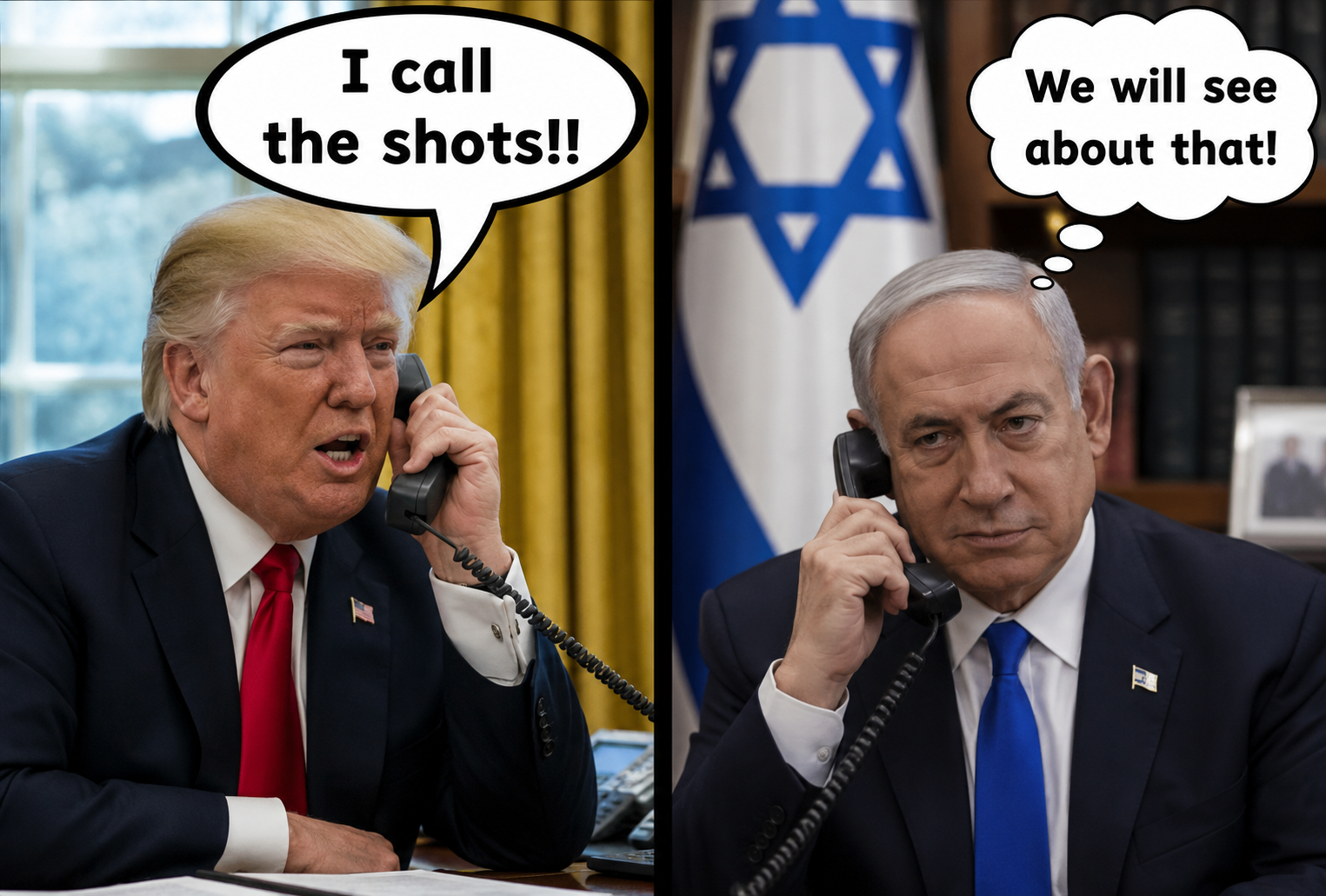
by author (AI)
The crisis unfolding between Washington, Jerusalem, and Tehran has entered a phase that feels less like strategy and more like a trap. It is a trap built from misread capabilities, mismatched incentives, and the brittle architecture of a patron–client relationship under wartime stress. It is also a trap that Donald Trump, in his overconfidence and impatience, helped construct. And now that the walls are closing in, the consequences are not limited to the man who set the conditions. They fall on all of us.
One hundred and one days ago, the United States and Israel entered the war with a shared purpose: to degrade Iran’s nuclear and missile capabilities, to weaken Hezbollah and Hamas, and possibly to create the conditions for a post-revolutionary Iran. That partnership has now reached a crisis point. The crisis did not come from a single event but from a sequence of misaligned decisions, each one widening the gap between the superpower and the regional power it sought to guide.
At the center of this crisis is a simple but devastating contradiction. Trump believed he could choreograph the war like a controlled demonstration of American power — swift, decisive, and strategically profitable. He believed Iran would behave like Venezuela, folding under pressure, allowing the United States to dictate terms and dismantle its nuclear program. But Iran is not Venezuela, and the Middle East is not a stage for quick victories. It is a region where adversaries adapt, allies improvise, and the ground shifts faster than any single actor can control.
The Patron Who Thought He Controlled the Chessboard
Trump’s confidence in his ability to manage the conflict is captured in his own words. “I call the shots. I call all the shots,” he told the Financial Times on Sunday. This was not just bravado. It was a declaration of hierarchy — and a response to a growing domestic narrative that Israel, not Washington, was directing the war. In Trump’s mind, the United States was the patron, Israel the client, and Iran the adversary whose behavior could be shaped through pressure and inducement.
But the war has not conformed to this model. That became even more clear after Hezbollah recently intensified rocket attacks into the north of Israel. Israel responded by striking a Hezbollah command center in Beirut — a move that Iran had expressly warned would trigger direct retaliation, and one that Trump had reportedly urged Netanyahu not to make. Whether Washington received advance notice of the Beirut strike or was bypassed entirely remains unclear; what is not unclear is that the strike served Israeli strategic and domestic interests at the direct expense of the American diplomatic track. After Iran predictably retaliated, Trump again urged Netanyahu not to retaliate. Again, Netanyahu retaliated with strikes in Iran.
Trump’s response to previous breaks in the ceasefire was to double down on the belief that a deal with Iran was imminent. He has been saying as much for weeks — that an agreement was within days that the terms were largely finalized, that the end of the war was at hand. Each declaration has been followed by renewed exchanges of fire, stalled negotiations, or Israeli actions that reset the clock. Trump’s priority is not total victory but stability — specifically, the reopening of the Strait of Hormuz and the easing of the global energy crisis that Iran has skillfully engineered. In this sense, Trump is not wrong. The world’s oil markets are under severe stress, and the global economy cannot absorb another shock.
But in pursuing this deal, Trump placed himself in a position where he needed Israel to show restraint at the exact moment Israel felt it could least afford to.
The Client Who Knocks Over the Table
Netanyahu’s dilemma is laid out with brutal clarity. If he obeys Trump’s demand not to retaliate, he risks destroying Israel’s deterrent credibility and appearing weak to both adversaries and his own public. If he defies Trump, he risks dragging Israel into a wider confrontation without guaranteed American backing — a scenario that could leave Israel dangerously exposed.
This is the Catch-22 at the heart of the crisis. Netanyahu cannot obey without losing legitimacy. He cannot defy without risking catastrophe. And Trump, in insisting that Israel “had better not hit back,” placed Netanyahu in a position where any choice is a losing one.
Netanyahu’s political instincts are well known. When constrained, he creates crises. When pressured, he escalates. When told to wait, he acts. He is not a chess player moving pieces within a system of rules. He is the actor who kicks the leg of the table when the rules no longer serve him. And in this moment, with his domestic standing fragile and his strategic environment deteriorating, he is more likely than ever to assert autonomy.
In doing so, however, he feeds the very narrative Trump was trying to suppress. Trump can make bold public declarations about calling all the shots, but when Israel strikes Beirut over American objections and Iran responds with ballistic missiles, Trump’s claim to control is exposed as aspiration rather than fact. Americans will be asking why their tax dollars finance an ally who continually acts against stated American policy and makes the president look like a passenger in his own war.
The Adversaries Who Shake the Other Leg
Iran and Hezbollah are not passive observers in this drama. They are active destabilizers, exploiting the widening gap between Washington and Jerusalem with considerable sophistication. Iran’s position is in fact the most structurally advantageous of the three: it simultaneously needs Trump to be able to deliver Israeli restraint as a condition of any workable deal — because an agreement that Netanyahu can blow up at will is worthless to Tehran — while actively exploiting every visible sign that he cannot.
Iran is negotiating with the patron while undermining the patron’s authority over the client. That is a remarkably leveraged position for the ostensible loser of the military campaign. Their missile attacks are calibrated to this purpose — enough to provoke Israel and expose the alliance fracture, not enough to force the United States into abandoning the diplomatic track entirely. The ten missiles fired Sunday were intercepted without casualties. That is likely more of a message than a misfire.
The Trap That May Yet Be a Door
Before concluding that the trap is fully closed, one variable demands acknowledgment. All three actors are performing for domestic audiences under conditions that may require visible toughness before any of them can accept the compromises a deal will demand. Netanyahu needs to demonstrate he was not leashed. Iran needs to demonstrate it was not defeated. Trump needs to demonstrate he extracted something real. The chest-pounding may be a ritual prelude to agreements that have already been substantially accepted in private.
That possibility cannot be dismissed. The pattern of this conflict — repeated imminent-deal declarations, calibrated escalations, and back-channel continuity even during exchanges of fire — is consistent with a negotiation nearing its close rather than one breaking down. The economic pressure on both Iran and the United States is severe and growing, and it functions as the one forcing mechanism none of the three actors fully controls and none can publicly acknowledge as their primary motivation. Which is itself another layer of the Catch-22: the real driver of resolution is the factor all parties have the strongest incentive to conceal.
The Trap That Belongs to All of Us
Trump’s critics will enjoy the spectacle of a president who pompously claimed to call all the shots discovering that he does not. They will enjoy the image of Netanyahu defying him, of Iran outmaneuvering him, of the deal slipping away. But this enjoyment is shortsighted. Trump is the only president the United States has. His miscalculations do not stay contained. They spill outward into markets, alliances, and the global energy and food supplies.
If Trump succeeds in forcing a deal, he becomes more convinced of his own infallibility — more autocratic in style, more dismissive of institutional constraints. If he fails, the United States pays the price in oil shocks, inflation, strategic overextension, and a weakened global position. And if the deal comes, as deals in this region often do, on the far side of one final round of violence, the structural problems this war has exposed do not disappear with the signing. The divergence between Israeli and American strategic requirements, the limits of patron-client control under democratic pressures, and the precedents set by a hundred days of war will outlast whatever memorandum of understanding is eventually reached.
The trap is of Trump’s own making. But it has become the world’s trap as well.
Related Topics
Related Posts