
Middle East Analyst
Iran War: The CIA-ODNI Turf War That Wasn’t
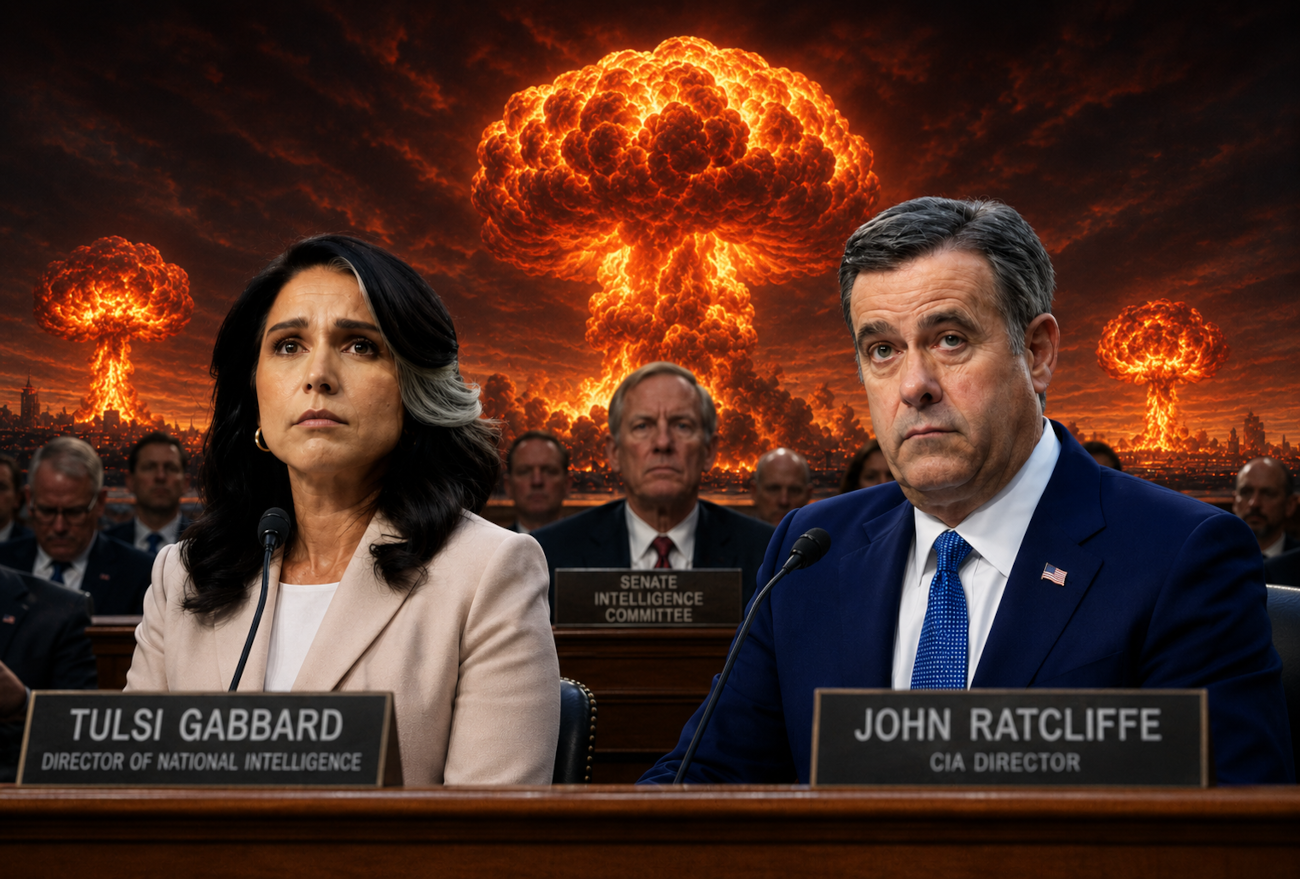
by author (AI)
Why Tuslsi Gabbard Had to Go
Recent reporting on Tulsi Gabbard’s departure from the Office of the Director of National Intelligence has focused on a familiar Washington storyline: an institutional feud between ODNI and the CIA, competing intelligence assessments about Iran, and bureaucratic infighting masquerading as policy disagreement. It is a plausible explanation because parts of it are likely true. Gabbard’s ODNI and John Ratcliffe’s CIA were reportedly at odds on several fronts. Her congressional testimony on the Iran nuclear threat diverged from elements of Ratcliffe’s testimony and the administration’s public case for war. The disconnect was visible. Yet the turf-war explanation appears insufficient on its own. It explains some of what happened after the administration moved toward military action against Iran, but it does not adequately explain signals that emerged beforehand. Most notably, it does not explain why the Director of National Intelligence was absent from one of the most consequential national security discussions of the Trump presidency.
When Benjamin Netanyahu presented his case for joint military action against Iran at the White House Situation Room on February 11, Gabbard was reportedly not invited. At that point she had not publicly contradicted administration policy. She had not testified to anything politically inconvenient. She had not become the focus of a public controversy. Yet she was apparently excluded from a discussion that would shape one of the administration’s most significant national security decisions. strong>The Worldview Problem
To understand that problem, it is worth recalling why Trump selected Gabbard in the first place.
That same credential likely became a liability once the administration began moving toward war. Gabbard’s position was never that Iran posed no threat. Her public statements suggest something more nuanced. She appeared to view Iran as a genuine challenge while simultaneously believing that military confrontation carried potentially catastrophic escalation risks. Her widely discussed Hiroshima video, repeated warnings about the dangers of major-power conflict, and reluctance to publicly celebrate military action all point toward a worldview in which the dangers of escalation often outweigh the perceived benefits of intervention. That is not a fringe position. It is a judgment shared by many serious strategists. But it is a difficult position to reconcile with a decision to launch military operations. Once the administration crossed that threshold, Gabbard’s room for maneuver appears to have narrowed dramatically.
The Ratcliffe Contrast
The contrast with Ratcliffe is revealing. According to reporting on the February Situation Room discussions, Ratcliffe reportedly dismissed Netanyahu’s regime-change scenarios as unrealistic. Marco Rubio was similarly skeptical. JD Vance reportedly expressed even stronger reservations. By the logic of the current media narrative, several senior officials disagreed with aspects of Netanyahu’s proposal. Yet only Gabbard ultimately departed.
The difference appears to be the nature of the disagreement. Ratcliffe, Rubio, and Vance were skeptical of Netanyahu’s most ambitious assumptions. They questioned scenarios involving regime collapse, internal uprisings, or other highly optimistic theories of victory. But skepticism toward those objectives remained compatible with a more limited military operation aimed at degrading Iran’s nuclear infrastructure. Once Trump chose that course, each retained a viable political lane. Ratcliffe publicly defended the threat assessment. Rubio supported the strikes. Vance aligned himself with administration policy. Their reservations concerned the scope of the plan rather than the underlying decision to use force.
Gabbard appears to have occupied a different position. Her concerns seem to have centered less on whether Netanyahu’s objectives were realistic and more on whether military confrontation itself risked triggering a broader regional conflict. If that assessment is correct, then the administration’s eventual decision left her with far fewer options than it left the others. Her congressional testimony reflected that dilemma. Rather than endorsing claims of an imminent Iranian threat, she reportedly deferred to the president’s authority to make such determinations. The answer was careful and politically disciplined. It may also have highlighted the growing gap between her worldview and the administration’s chosen course. Trump would later publicly acknowledge that Gabbard’s approach to Iran was softer than his own.
The Question Many Will Ask
There is another dimension that cannot be entirely ignored.
Gabbard was the fourth female cabinet-level official to leave the administration. By itself, that fact proves nothing. Small numbers do not establish causation, and there are numerous possible explanations for each individual departure. Nevertheless, the pattern is likely to attract attention, particularly given Trump’s long and well-documented history of contentious relationships with women in positions of authority.
The pattern does not displace the ideological and institutional explanations outlined above. Those explanations remain more persuasive and better supported by the available evidence. Yet it would be equally incomplete to pretend the pattern does not exist. A reasonable observer might ask whether a male official possessing the same worldview and public profile would have encountered the same trajectory. That question cannot be answered with confidence from the outside, but it is unlikely to disappear from discussions of her departure.
What the Main Story Actually Is
The most persuasive explanation for Gabbard’s departure is not a simple intelligence turf war. The bureaucratic conflict was real, but it was probably a symptom rather than the root cause. A broader incompatibility appears to have emerged between the reason Gabbard was brought into the administration and the direction the administration ultimately chose. Trump recruited a prominent anti-interventionist voice at a moment when that voice carried political value. Once the administration committed itself to military action against Iran, the very qualities that had made Gabbard useful may have become a source of tension.
The February 11 briefing exclusion points in that direction. Long before congressional testimony became a controversy and long before reports of internal feuding dominated headlines, there were already signs that Gabbard’s perspective was no longer central to the administration’s most important national security deliberations. Viewed through that lens, her departure looks less like the outcome of a bureaucratic battle and more like the culmination of a growing strategic mismatch. The intelligence dispute mattered. The personalities mattered. The bureaucratic politics mattered. But the available indicators suggest they were all operating within a larger reality: an administration moving toward war and a Director of National Intelligence whose political identity had been built around warning against exactly that path.
Trump’s Choice for Acting Director May Be the Real Clue
Trump has chosen Bill Pulte, a housing-finance regulator and political ally with no intelligence-community experience, to serve as Acting Director of National Intelligence. The move likely intends to narrow ODNI’s role and influence rather than strengthen it. If so, Gabbard’s departure could prove to be part of a broader shift in how this White House uses the intelligence apparatus. In any case, given Trump’s long-standing tendency to discount intelligence assessments that conflict with his political instincts or policy detours it may not matter greatly whether the Director of National Intelligence is fully qualified. Few observers believed Gabbard was selected because she was qualified. Pulte’s appointment reinforces the impression that such credentials are not central to the president’s priorities.
Related Topics