A Veteran Diplomatic Advisor Specializing in Interfaith Dialogue
Iran’s Awakening: The Fall of Clerical Rule
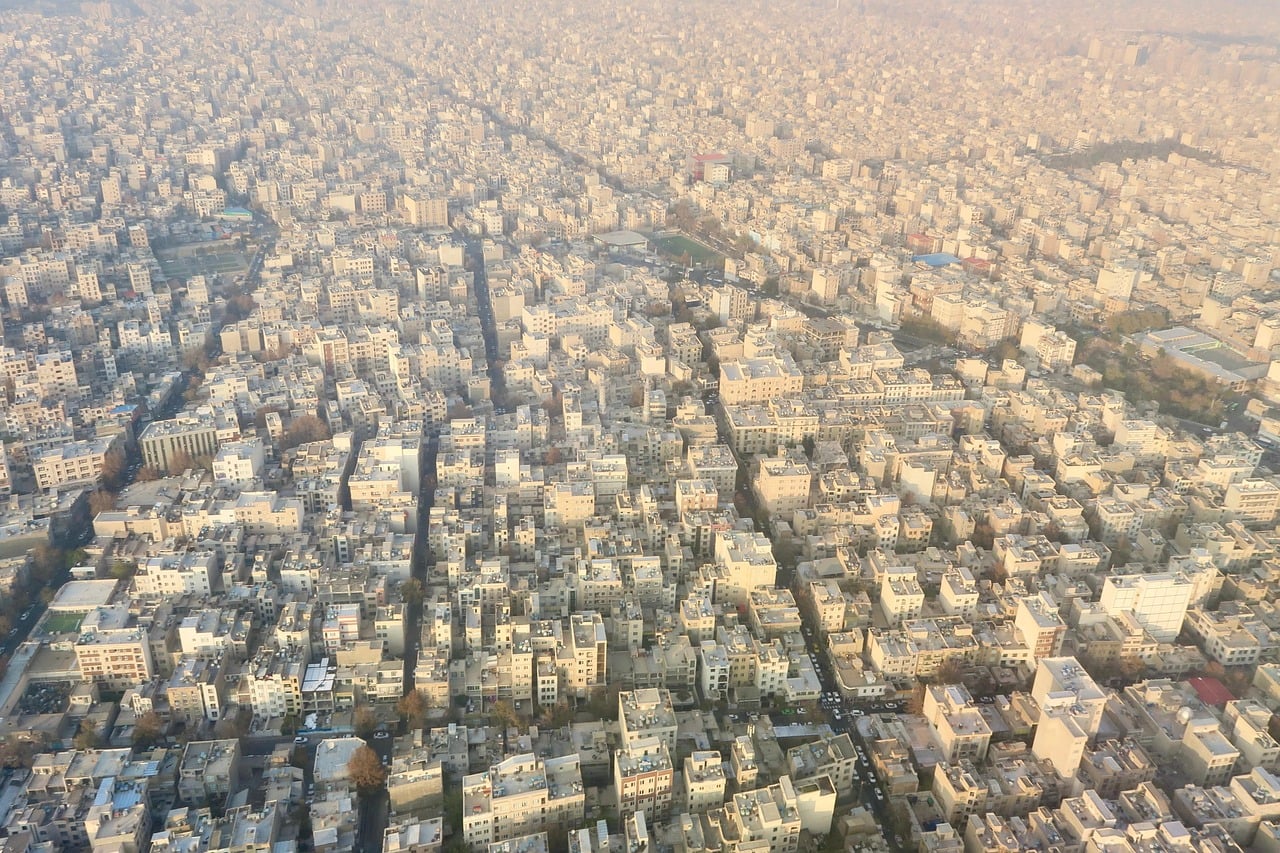
Tehran, Iran. Source: Pixabay. Free for Commercial Use. https://pixabay.com/photos/tehran-iran-city-houses-buildings-7450241/
For more than four decades, the Islamic Republic of Iran has weaponized religion –distorting Shia Islam into an instrument of repression at home and coercion abroad. What began in 1979 as a revolution claiming moral legitimacy has hardened into a theocratic system sustained by fear, economic predation, and violence. Today, that system faces its gravest challenge yet: a nationwide uprising that fuses material collapse with spiritual defiance and demands not reform, but an end to clerical rule itself.
Since late December 2025, protests ignited by economic freefall have swept nearly every Iranian province. By early January 2026, calls for accountability evolved into explicit demands for regime overthrow. The state’s response was unprecedented in scale and brutality. Security forces deployed mass live fire, sniper units, and shoot-to-kill orders, turning streets into killing fields – particularly on January 8 and 9. Human rights networks, drawing on eyewitness testimony, hospital data, and morgue records, estimate casualties ranging from more than 6,000 confirmed deaths to figures exceeding 30,000, including children and bystanders. A near-total internet blackout concealed much of this carnage, but mounting evidence of mass burials, disappearances, and overwhelmed medical facilities points to crimes against humanity on a scale unmatched in the Islamic Republic’s 46-year history.
This upheaval is not an isolated spasm of unrest, but the latest in a long sequence of Iranian resistance: the Constitutional and student movements of the early twentieth century; the Green Movement of 2009; the economic protests of 2017-2018; Bloody November 2019; and the Women, Life, Freedom uprising beginning in 2022. History offers parallels – from Eastern Europe to the Balkans in the 1990s – when authoritarian systems collapsed under the combined weight of economic failure and moral exhaustion. When the Islamic Republic falls, whether suddenly or through sustained erosion, the consequences will reverberate far beyond Iran: refugee flows toward Europe, the weakening or fragmentation of proxy militias from Lebanon to Yemen, and a profound redefinition of Shia Islam after decades of capture by the state.
At the heart of this moment lies a deeper struggle over faith itself. The regime has long insisted that obedience to God requires submission to clerical authority. That claim is now unraveling. In Iran’s streets, women lead protests that reject not belief, but its coercion. Young Iranians invoke Hafez and Rumi not as cultural ornaments, but as living sources of dignity and resistance. Ethnic minorities, Sufis, Yarsanis, Zoroastrians, and other suppressed traditions are reclaiming spiritual lineages that predate 1979, predate forced Islamification, and transcend the regime’s ideology. This is not secular nihilism; it is a revolt of conscience against the monopolization of the sacred.
What is emerging – inside Iran and across its global diaspora – is the possibility of a renewed Shia voice: one rooted in ethics, introspection, and pluralism rather than domination. Traditions such as Bektashism and Ismailism demonstrate that Shia Islam has always contained currents emphasizing reason, poetry, inner enlightenment, and coexistence. These paths reject sectarian supremacy and stand in direct opposition to antisemitism, Islamophobia, and hostility toward Christianity – pathologies that flourish when religion is militarized and reduced to ideology.
This moment is not about conversion, nor about replacing one orthodoxy with another. It is about reopening a spiritual space – an open door through which Muslims, Zoroastrians, Christians, Jews, and those who have drifted away from faith altogether can rediscover tolerance, moral meaning, and curiosity about the sacred. In an era marked by alienation, extremism, and cultural exhaustion, such traditions remind us that religion, at its best, humanizes rather than radicalizes. They invite reflection rather than submission, compassion rather than exclusion.
Europe has lived this lesson before. In parts of the Balkans, centuries of coexistence among Muslims, Christians, and Jews produced societies where religious identity reinforced civic harmony rather than undermined it. Many democratic societies across Europe and the broader free world continue to embody this principle. These experiences matter now, as Iran stands on the brink of transformation and the Middle East searches for alternatives to the endless export of ideological violence beyond its borders.
American leadership will help shape what follows. President Donald Trump brought a degree of moral clarity to Iran policy absent in prior administrations. By withdrawing from the deeply flawed nuclear agreement and reimposing sustained pressure on the regime, he signaled that aggression and repression would no longer be rewarded – while affirming solidarity with the Iranian people rather than their rulers. The Abraham Accords demonstrated that rejecting extremism can unlock realignment and peace. Extending that logic – by supporting individual and communal spiritual sovereignty, and pluralism over clerical coercion – offers a path toward a more stable Middle East aligned with the interests and values of democratic societies.
Europe, too, must prepare with foresight rather than improvisation. The continent will feel the effects of Iran’s transition directly, from refugee flows to energy markets to security challenges. Early coordination among NATO, the European Union, and other democratic partners; support for independent media and civil society; and engagement with non-state religious and cultural actors will be essential to prevent chaos and contain malign external interference.
Democratic governments should resist the temptation to anoint exiled figures – though they may play constructive roles in a future constitutional monarchy or republic – as singular successors. Durable change can only emerge from within Iran itself, through broad coalitions of women’s movements, labor organizations, students, ethnic minorities, and independent religious voices. What the West can do – quietly but decisively – is provide the tools for resilience: secure communications, educational exchange, cultural preservation, and platforms for authentic Iranian voices long silenced.
To the Iranian people: you are heirs to architects, engineers, artists, poets, astronomers, philosophers, and spiritual innovators who shaped civilization – not to secret police and self-appointed, dogmatic guardians of God. The 2021 Epic Iran exhibition at London’s Victoria and Albert Museum offered the world a rare, sweeping portrait of Iran’s 5,000-year cultural legacy – revealing a civilization defined by creativity, plurality, and global influence far richer than the narrow ideology imposed since 1979. This uprising is a reclamation of that inheritance. You are not alone.
Sustained by the perseverance of the Iranian people and principled international support – privileging spiritual renewal over coercion – Iran’s next chapter need not be one of chaos, but of rebirth: serving its people, stabilizing its region, and reaffirming the enduring cause of human freedom. Noor and Aram – wisdom and peace – must and will prevail for Iran.