
Iran’s Doom Protocol: How Tehran Turns Western Disorder Into a Weapon
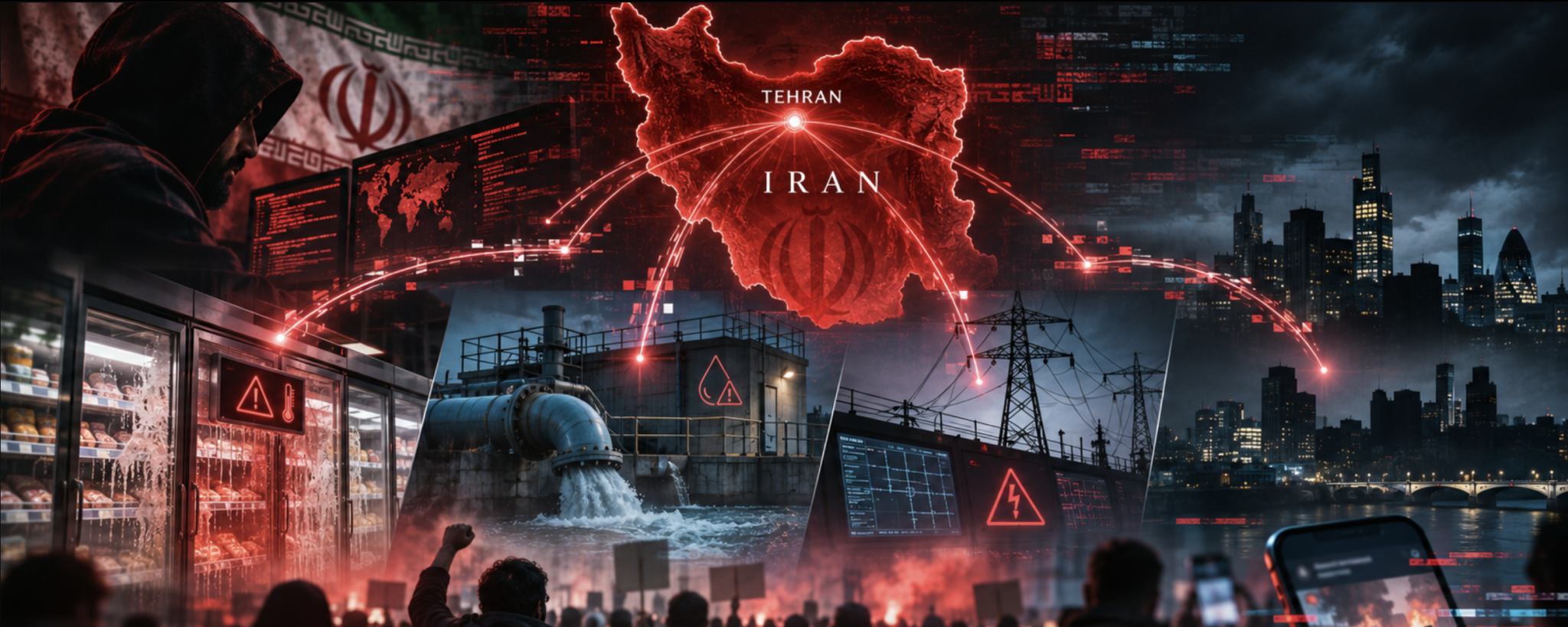
There is something particularly sinister about sabotage that begins in a supermarket freezer. No declaration of war. No missiles streaking across the sky. No general congratulating himself before a bank of microphones. The refrigeration units simply begin to heat. Food spoils, businesses incur losses, and ordinary people discover that the conveniences of modern life have become instruments of their vulnerability.
On November 9, French authorities attributed a cyberattack against refrigeration systems at approximately 700 retail locations to Shahid Kaveh, a unit linked to Iran’s Islamic Revolutionary Guard Corps. The October attack manipulated equipment settings to produce dangerously high temperatures, causing extensive merchandise losses and at least 15 outbreaks of fire.
Among the affected businesses were Carrefour, Leclerc, Casino, and Intermarché. Small butcher shops and food-processing facilities were also targeted, alongside attempted intrusions into hydroelectric installations.
The choice of targets deserves consideration. Refrigeration units and electricity controllers hardly rank among the traditional trophies of military conquest. Yet an economy that cannot refrigerate its food, distribute fuel, maintain electricity, or guarantee clean water will soon discover the limits of its sophistication.
The Islamic Republic has understood this vulnerability for some time.
I have come to describe the strategic logic behind such operations as Iran’s “doom protocol.” The term is my own analytical formulation, rather than the name of an authenticated Iranian directive. It captures a dangerous proposition: that a regime unable to defeat its adversaries militarily may nevertheless possess the means to make their societies increasingly difficult to govern.
There is little need to defeat a Western army if you can make its civilian population question whether the government can keep the lights on.
The evidence has been accumulating.
In 2022, Iranian state-sponsored hackers penetrated Albania’s government networks and deployed destructive malware, crippling public services. According to the FBI, the attackers had established access approximately 14 months before executing the operation.
In June 2025, American cybersecurity agencies warned that Iranian actors could exploit vulnerable networks and industrial control systems. By August 2026, research published by the Center for Strategic and International Studies documented attacks against American water infrastructure across at least 12 states. An IRGC-linked group claimed responsibility, although Washington had not publicly attributed the wider campaign.
In Georgia, attackers shut down a pumping station, reducing water pressure and prompting a precautionary boil-water advisory. No related illnesses were reported. The physical damage remained limited, but the vulnerability was unmistakable.
A foreign adversary can interfere with drinking water supplies to American households without dispatching a single saboteur.
Britain has acknowledged the danger. In its 2026 annual review, the National Cyber Security Centre warned that Iran-linked groups had demonstrated the capacity to cause indiscriminate disruption at scale.
And therein lies cyberwarfare’s attraction to Tehran. The attacker remains thousands of miles away while the victim confronts the inconvenience, financial damage, and political consequences.
The real dividend comes afterward.
A supermarket may reopen, but its stock must be replaced. A water utility may restore pressure, but customers must be persuaded that the water is safe. A computer network may be repaired while the business depending upon it continues to hemorrhage money.
I call this the recovery gap: the interval between restoring a service and restoring confidence in it.
Then comes the more poisonous element of Tehran’s campaign. The manipulation of public anger.
Here was an American intelligence chief acknowledging that a hostile foreign government was manipulating domestic tensions. The operation exploited genuine grievances. There was no need to manufacture controversy when existing divisions could be aggravated and directed toward destructive ends.
The French investigation published this November disclosed another revealing operation. It attributed cyberattacks against Charlie Hebdo to an IRGC-linked unit, Shahid Shoostari, and documented a 2024 attempt to hijack digital advertising displays during the Paris Olympics. The intended content attacked the participation of Israeli athletes.
A sporting event intended to bring nations together offered an opportunity to inject hostile propaganda into public spaces and inflame political passions.
The target was the public mood.
Tehran need not invent hostility between communities. Antisemitism, sectarian prejudice, political extremism, and distrust of institutions already provide ample material. Its operatives can exploit an outrage, amplify inflammatory claims, impersonate activists, or help turn a local grievance into an international confrontation.
A society consumed by suspicion becomes difficult to govern. Its citizens begin to see enemies in their neighbors, betrayal in their institutions, and conspiracy in every misfortune.
For Jewish communities, the danger is particularly acute. The Islamic Republic has spent decades placing Israel’s destruction at the center of its ideological project. Exploiting hostility toward Israel to encourage wider antagonism against Jewish communities would serve that project. Yet treating legitimate protesters or Muslim communities as inherently suspect would deepen precisely the fractures Tehran benefits from.
We must also resist attributing every riot, technical failure, or act of vandalism to an Iranian command center. Intelligence requires evidence. Unsupported accusations allow Tehran to dismiss legitimate warnings as paranoia.
The greater danger is that Western governments continue examining each incident in isolation.
Cybersecurity specialists investigate network intrusions. Police examine street disorder. Intelligence agencies monitor foreign influence. Politicians discuss social cohesion. Each addresses a portion of the problem while the possibility of a common strategic purpose receives insufficient attention.
What emerges is a method of coercion designed to make resistance to Tehran increasingly costly. The regime need not occupy London, Paris, or Washington. It needs only to persuade their governments that confronting it will invite disruption at home.
The response begins with protecting civilian infrastructure, exposing foreign influence operations before they acquire momentum, and ensuring that consequences reach those directing the attacks.
Western governments must also recover the confidence to distinguish peaceful dissent from deliberate subversion and communal disagreement from orchestrated incitement. A democracy incapable of making these distinctions invites manipulation. One that suppresses legitimate disagreement in the name of security merely assists the provocateur.
For years, the West has imagined that the threat posed by the Islamic Republic would announce itself through a missile, a terrorist attack, or some unmistakable act of aggression.
Perhaps we have been looking for the wrong warning.
A failing water pump. A ruined food supply. A fabricated message circulating through an angry crowd. An entire community persuaded that its neighbors wish it harm.
None need be decisive on its own.
Their cumulative effect is what ought to concern us.
Tehran’s method exploits the conditions that make civilized life possible: trust, interdependence, tolerance, and the expectation that tomorrow will resemble today.
Destroy those expectations, and you can begin dismantling a society long before defeating its army.
That is the danger I mean by Iran’s doom protocol.
The troubling question is whether Western governments will recognize the campaign before their citizens begin to experience its consequences as the ordinary condition of life.