
Iran’s Easier Nuclear Target Is Washington, Not Jerusalem
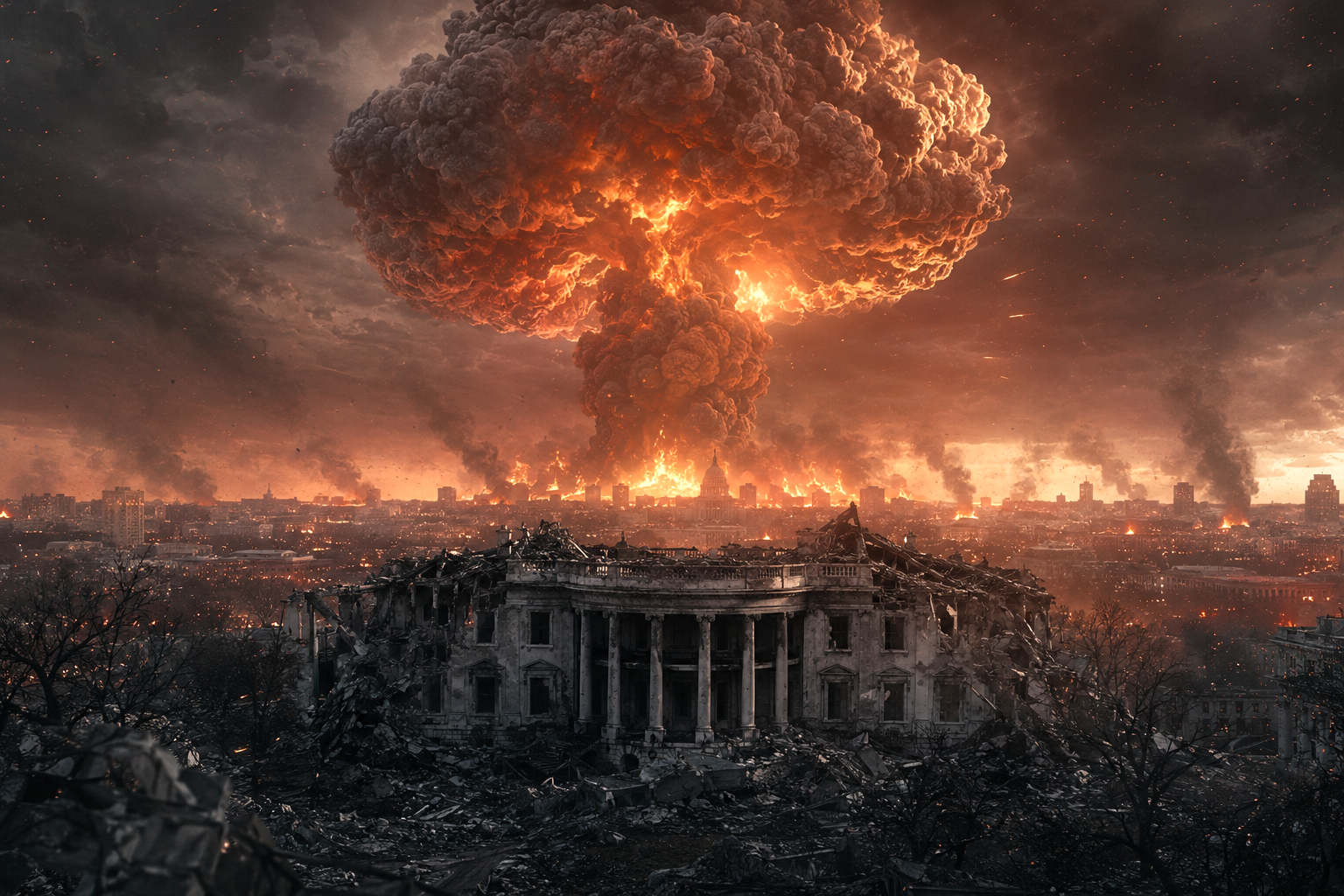
On November 5, 1979, Ruhollah Khomeini gave the United States a name that has outlived him: the Great Satan. Israel he called the Little Satan, a lesser devil chained to the greater one. For more than four decades the Islamic Republic has spoken of the two as one enemy, a single body with two heads, both marked for the same end.
The pairing has lasted forty-five years. It never had to survive contact with a target. A warhead forces the distinction the slogans erased.
A weapon capable of erasing one of these two capitals would destroy the very thing Iran claims to want. The other sits ten thousand kilometers away, past the reach of anything Tehran has ever flown. What follows is an analytical exercise, not a forecast. It predicts nothing about what Iran will choose. It asks a narrower question: if Iran ever held a nuclear device, which of the two targets would cost it less to strike?
The answer runs against instinct.
None of this stands on speculation. Iran has spent decades, and sums no one has fully counted, climbing toward a threshold most governments never reach. Beside its declared and safeguarded plants it ran a second track, the one the world learned about late: Fordow before its exposure, the experiments at Parchin, the archive Israeli agents carried out of Tehran in 2018. By the last measurement inspectors managed before the June 2025 strikes shut them out, Iran had gathered close to four hundred forty kilograms of uranium enriched to sixty percent. That figure is not weapons-grade. It is worse than it sounds. Sixty percent is the steep part of the climb, and the stretch from there to ninety is counted in weeks.
So the record is plain. Iran meant it.
A warhead threatens no one if it cannot arrive, and on delivery Iran has outrun its own promises. For years Tehran swore its missiles stopped at two thousand kilometers, a limit Khamenei set out himself. The claim lasted until it didn’t. When Iran reached for the American base at Diego Garcia, far out in the Indian Ocean, it sent a Khorramshahr across something nearer four thousand kilometers. The declared ceiling had been a courtesy, not a wall. Much of Europe now sits inside the arc.
Then came the boast. In the summer of 2025 Iranian state media described a new missile, the Khorramshahr-5, with a claimed reach of twelve thousand kilometers, enough to touch any point in the continental United States. The claim earns suspicion, not belief. It surfaced through unofficial channels rather than the Defense Ministry. No independent body has confirmed it. One supposed test showed none of the reentry behavior that separates an intercontinental missile from a rocket that simply flies a long way, and the range figure falls apart once a heavy warhead sits on top, since distance and payload trade against each other.
The direction is the point, not the number. Iran’s space program says the same thing in a lower voice. The Simorgh and Qased launchers, defended for years as civilian science, burn the same physics as an intercontinental missile. Lift a satellite into orbit and most of the problem of dropping a warhead across an ocean is already solved. What remains is engineering and decision, not discovery.
There is a reason to treat Iran’s planning as serious, and it sits under a mountain. Tehran grasped, well before this summer, that its enrichment sites might one day be split open by American bunker busters. That is precisely what came. And Iran had made ready for it. Deep inside Kuh-e Kolang Gaz La, the ridge Western analysts named Pickaxe Mountain, it had been carving a facility beneath rock too deep for the heaviest penetrating bomb, a place to carry the program onward whatever the surface lost.
This is not a government that improvises everything. On the questions that reach its survival it looks years ahead and builds to match. That is the shrewdness worth naming, and only that. Not omniscience, and not the competence of a state that this month scrapped a fuel-pricing scheme the same afternoon it announced one. Where its existence is in play, Iran plans with cold care.
Which carries the argument to the two cities, and to why they are not one target. Take Jerusalem first. A bomb over Israel would not land on Israelis alone. The Old City holds Al-Aqsa, the third holiest site in Islam, sixty kilometers from Tel Aviv. Two million Arab citizens live inside the blast geography, the West Bank lies minutes nearer, and the fallout in that corridor drifts east, toward Najaf and Karbala. The cause that justifies Iran’s whole outward machine, the Quds Force, Hezbollah, the entire grammar of liberation, dies in the same flash.
A Persian, Shia state has one credential in an Arab, Sunni street, and that credential is Palestine. To burn it away by Iran’s own hand is a contradiction no theology walks back. Rafsanjani, no dove, said the blunt calculation aloud in 2001: a nuclear exchange would finish Israel while costing the Islamic world only damage it could absorb. Even that arithmetic never solved the problem of the shrine and the two million.
Detonating a device over Washington would be easier than over Jerusalem. Washington holds nothing Iran wants to keep.
No shrine. No entangled people it claims to shield. No ash carried toward its own holy cities. Striking the Great Satan contradicts nothing Iran has said since 1979. It confirms it. The moral brake that makes Jerusalem unthinkable is simply absent for the American target.
None of this says Iran would never strike Israel. It says the inner argument would run longer, the hesitation deeper. And a state that had already crossed into the nuclear club, backed into a fight it reads as terminal, would watch those hesitations thin. When survival is the wager, the theology of restraint moves to the back of the room. The claim is not that one city is safe and the other doomed. It is that the debate before the order would be shorter over Washington, as pure analysis, since this piece forecasts nothing.
That asymmetry is what Washington ought to read with care. A nuclear Iran menaces its region first, through rhetoric and conduct, a movement that greets global upheaval as a promising sign rather than a disaster to head off. The menace does not stop at the region. The day Iran’s ballistic program closes the last of the distance to American soil, the calculation above stops being theoretical. The barrier that guards the United States is not moral. It is only range, and range is the one protection that time erodes.
There is a mercy folded into the physics. An intercontinental missile can no more hide than a nuclear test can. Reentry has to be proven in flight, and those flights show themselves for years before they work. Washington would watch the barrier weaken long before it broke.
So the counsel is uncomfortable and narrow. The United States has to keep Iran militarily contained without a pause, and it has to do so aware that the same pressure, driven to the edge where the regime believes it is already finished, is exactly what dissolves the restraint that keeps the weapon in its silo. Contain, without cornering.
Jerusalem is the harder target, and it always will be. Washington is the easier one, and only distance has kept it from being true yet. What happens the year the distance runs out?