The views expressed herein are solely mine.
Iran’s Hormuz Tollbooth Empowers Rogue States
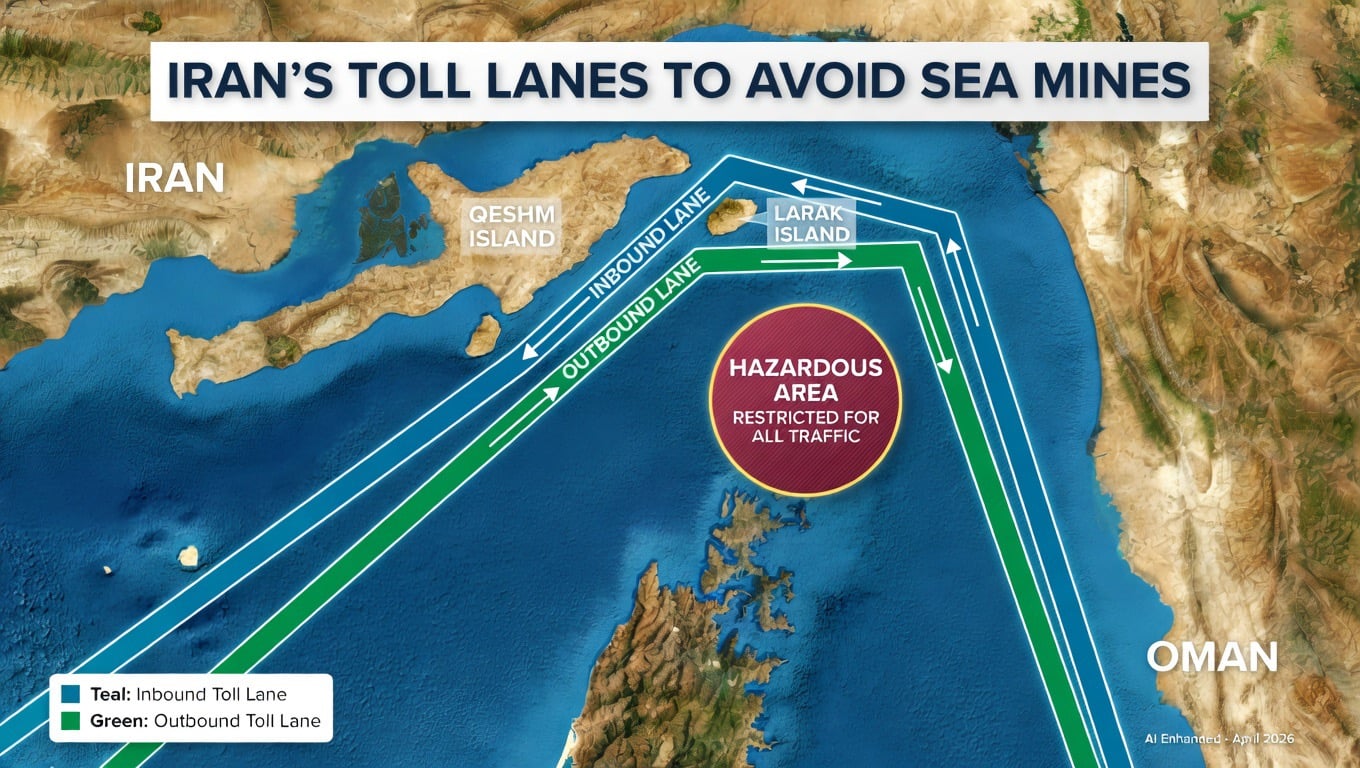
Credits: AI-Generated.
Iran has turned the Strait of Hormuz -the world’s most vital energy chokepoint- into a brazen state-run tollbooth. Around 20.9 million barrels of crude oil, condensate, and refined products surge through the Strait every single day. That volume equals 25% of global seaborne oil trade and 20% of worldwide petroleum consumption.
Since the Pakistan-brokered ceasefire between the United States and Iran took effect, Tehran has imposed a functioning toll system. Commercial vessels must now email cargo manifests to Iranian authorities and submit to vetting for “hostile connections.” They are forced to divert around minefields via corridors patrolled by the Islamic Revolutionary Guard Corps and pay fees that routinely hit $2 million per supertanker. Payments arrive in Chinese yuan, stablecoins, or bitcoin. Compliance brings an armed escort. Refusal strands ships in the Persian Gulf or forces a $15 million detour around Africa, adding three weeks to every voyage.
This is a state-run tollbooth, upgraded from the Iran-backed Houthis protection racket that extracted $180 million a month in Red Sea safe-passage fees. Ship owners there quickly learned that paying beat the risks of missiles or the long reroute around the Cape of Good Hope. Iran has now scaled the model to the planet’s most critical energy artery.
The Islamic Revolutionary Guard Corps keeps coastal missile batteries on alert and minefields intact while selling navigation through the hazards as a commercial service. Global insurers and charterers, fixated on quarterly results, have already wired hundreds of millions into accounts linked to Iranian cutouts.
The ceasefire supplied the legal loophole. Its vague clauses on coordinated safe passage and war-cost recovery let Iranian forces treat the mines as permanent defensive assets and bill shippers for safe rerouting.
The United Nations Convention on the Law of the Sea designates the Strait of Hormuz as an international strait where coastal states may regulate traffic separation and pollution but cannot impose prior authorization, discriminatory inspections, or levies. Iran never ratified the convention; however, it now claims a new sovereign regime justified by recent hostilities.
Western governments, desperate for de-escalation after weeks of fighting, refused to enforce freedom of navigation with naval power. That choice has, in practice, ratified the tollbooth.
Geostrategically, the precedent is spreading with alarming speed. Russia operates the world’s largest shadow fleet, with estimates ranging from 1,100 to 1,392 tankers moving sanctioned crude. The United Kingdom has sanctioned 544 of those vessels. On March 25, 2026, Prime Minister Keir Starmer authorized the Royal Navy to board and seize any sanctioned Russian tanker in British waters. Yet maritime tracking data show that at least 25 such vessels continued passing through British waters and the English Channel at the pre-announcement rate. No interceptions occurred.
Russian officials immediately declared their linked ships would enjoy preferential treatment inside the new Hormuz tollbooth. North Korea, running its own covert maritime networks, has appealed to the same loophole. Both regimes watched Tehran convert battlefield risk into daily revenue and sustained diplomatic leverage. The message is brutally simple: when Western forces will not clear mines or board vessels in their own backyard, they will not discover the will elsewhere.
The contagion now threatens every strategic chokepoint. Turkey already regulates the Bosporus under the Montreux Convention. China observes the Malacca Strait and South China Sea with intense interest. Coastal states with revisionist ambitions now possess a proven playbook: seed a waterway with hazards, monetize safe passage, demand payment in untraceable currencies, and dare the West to respond.
Every tolerated tollbooth operation erodes the norm of unobstructed transit passage that has anchored global commerce since the end of the Second World War. Lloyd’s of London recorded a 300% surge in insurance premiums for Hormuz transits since the ceasefire, while European and Asian buyers have absorbed rerouting costs that pushed delivered oil prices up 4% in the past three weeks alone.
Before the conflict, Iran could manage only sporadic harassment. Today the fusion of persistent minefields, coastal missile concentrations, and bureaucratic vetting grants Tehran continuous coercive power over 20.9 million barrels of daily oil flow. Every compliant tanker pads Iranian coffers and normalizes the tollbooth as routine business. Russia and North Korea see the identical opening in their own theaters. The ceasefire did not restore freedom of navigation. It converted open warfare into institutionalized, state-sponsored extortion.
Western governments have now signaled that geography and raw audacity can override legal principle whenever political will collapses. The strategic price will arrive in higher energy costs, shattered credibility, and a maritime order that no longer reliably punishes those who exploit its weaknesses. Those 20.9 million barrels keep flowing past Iranian guns and tollbooth collectors every day because no one has shown the resolve to shut it down.
The world’s revisionist powers are watching closely. They will copy the model wherever their coasts command the sea lanes that feed the global economy — unless the West finally shows the resolve to shut this tollbooth down.
Related Topics
- Africa
- Benjamin Netanyahu
- China
- Donald Trump
- Europe
- Gaza
- Great Britain
- Hamas
- Hezbollah
- IDF
- Iran
- Iran Nuclear Deal
- Islam
- Israel At War
- Israel-Iran Conflict
- Israel-US Relations
- Lebanon
- Middle East
- Natural Gas
- Pakistan
- Palestinians
- Russia
- Terrorism
- Trump Peace Plan
- Turkey
- United Kingdom
- United Nations
- US Politics
- Weapons
- World War II
Related Posts