


Iran’s Last Gasp and Algeria’s Rising Shadow
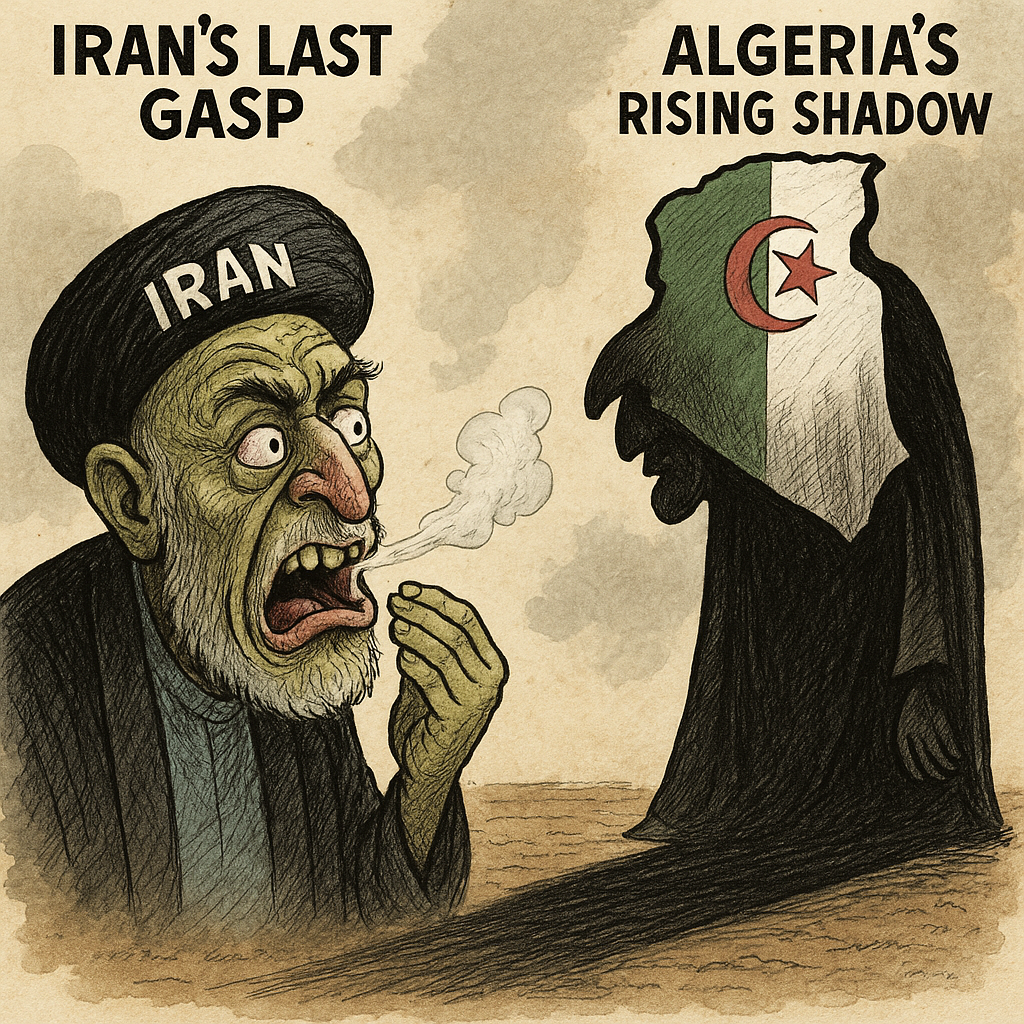
It is an image both tragic and unnerving: the Islamic Republic of Iran, once strutting across the Middle East with all the hauteur of a revolutionary colossus, now limping like a wounded beast, desperate for a new lair. Its economy is ravaged, its people are defiant, and its ideological grip at home is withering. But the mullahs have not surrendered; rather, like all creatures driven to survive, they have turned outward — and found in Algeria a partner of peculiar convenience.
It is tempting to think of Iran as cornered, trapped by sanctions and battered by protests, but this is a regime that thrives on crisis. When its own house burns, Tehran looks for fresh ground from which to project its peculiar cocktail of theocratic authoritarianism and geopolitical ambition. As the Institute of New Europe recently observed, Iran is “actively seeking new ideological and strategic bases to offset its waning influence in traditional strongholds such as Iraq, Syria, and Lebanon.” Algeria, with its history of anti-colonial defiance and its deep connections to Europe through migration, is proving to be that base.
Tehran’s interest in Algeria is not accidental. Algeria is the gateway to both Africa and Europe, sitting like a pivot between the Sahel and the Mediterranean. For the mullahs, this is fertile ground — not just geographically, but ideologically. In Algiers, Iran sees not only a sympathetic political partner, but a channel through which it can extend its soft power into European capitals, particularly Paris and Brussels, where Algeria’s sizeable diaspora already holds sway.
Mohamed Mliless, writing in Geostrategic Pulse, describes Algeria as Iran’s “fifth gate,” an emerging outpost through which Tehran can export its revolutionary ideology while simultaneously undermining Western influence. It is an alignment built not on shared faith — Algeria is Sunni and proudly nationalist, while Iran clings to its Shi’a theocracy — but on shared antagonism toward the West and a shared appetite for influence.
Iran’s modus operandi since 1979 has been the exportation of revolution. The Islamic Revolutionary Guard Corps (IRGC) maintains an entire infrastructure dedicated to spreading Khomeinist ideology, from funding cultural centres and religious schools to training clerics who can carry Tehran’s message abroad. But with unrest gnawing at its foundations and resistance stiffening in Iraq and Lebanon, Tehran needs new theatres. Algeria offers precisely that.
Algeria, for its part, has its own brand of exportation — not of ideology, but of demographics. Migration has long been a political lever, particularly in its fractious relationship with France. The steady flow of Algerian migrants into Europe provides a form of soft power that Algiers can wield when diplomatic tensions rise. Pair this with Tehran’s ideological machinery, and you have a potent hybrid threat: migration corridors carrying not just people but, increasingly, ideas.
In the Jerusalem Post we recently warned that Iran’s IRGC is using North Africa as a staging ground for influence operations, with Algeria emerging as a key node. “Iran is turning Algeria into an IRGC outpost”, writes Meir Masri in IFMAT. “This is not simply a regional alliance,” he adds, “but a deliberate effort to shift ideological fault lines into Europe’s heart.”
And what do we hear from Europe’s great capitals? Muted disquiet at best, polite avoidance at worst. The EU is far too busy agonising over energy contracts and border policies to take a hard look at how these currents of influence are shaping the future. France, in particular, has seemed paralysed — unable to confront Algiers’ political manoeuvring for fear of inflaming domestic tensions.
But silence is complicity. Tehran thrives in the spaces where the West looks away, using culture, religion, and propaganda to plant seeds that germinate quietly in migrant communities and academic institutions. Algeria, knowingly or otherwise, provides fertile soil.
This is not a war of armies, but of ideas — and ideas are harder to defend against. Iran’s theocratic model is not just about governance; it is a worldview, one that positions the West as decadent and weak, ripe for moral collapse. Algeria’s migration dynamics add another layer, serving as the physical channel through which these ideas can travel, often cloaked in the rhetoric of cultural identity or resistance against colonial legacies.
It is, in short, a form of hybrid warfare — less visible than missiles or tanks, but no less effective. As Brahim Oumansour of IRIS observes, Algeria sits “at the heart of migration flows extending from the Sahel to Europe,” shaping the dynamics of migration and security in ways that Europe is still struggling to address. While Oumansour’s remarks focus primarily on Algeria’s migration policies, they underscore the broader challenge of how external actors, including Iran, may leverage Algeria’s strategic position to exert ideological and geopolitical influence across the Mediterranean.
What, then, is to be done? Europe must first shed its delusions. Iran is not simply a distant Middle Eastern power; it is actively seeking footholds in Europe’s backyard. Algeria is not merely a partner in energy or trade; it is increasingly aligned with actors who see Western liberalism as something to be undermined, not emulated.
Second, policymakers must begin treating ideological infiltration as seriously as physical security threats. This means auditing cultural and religious networks funded by Tehran, engaging more robustly with Algeria on migration flows, and refusing to shy away from the uncomfortable conversation about how demographic politics intersect with radicalisation.
We must stop pretending that these are isolated issues — they are part of a broader design, one that Tehran, even in its weakened state, is pursuing with a grim determination. A regime on its knees is not a regime without claws. In Algeria, Iran has found a partner and a proxy; in Europe’s apathy, it has found opportunity.
The question is whether we will name the wolves at the door, or continue, as ever, to hope that polite silence will make them go away.
Written in collaboration with Aurele Tobelem – Director of Research Forum for Foreign Relations