


Professor of Political Science | Strategic Affairs Analyst | Senior Fellow, Defence Research and Studies
Iran’s Pause May Be Tactical, Not Strategic
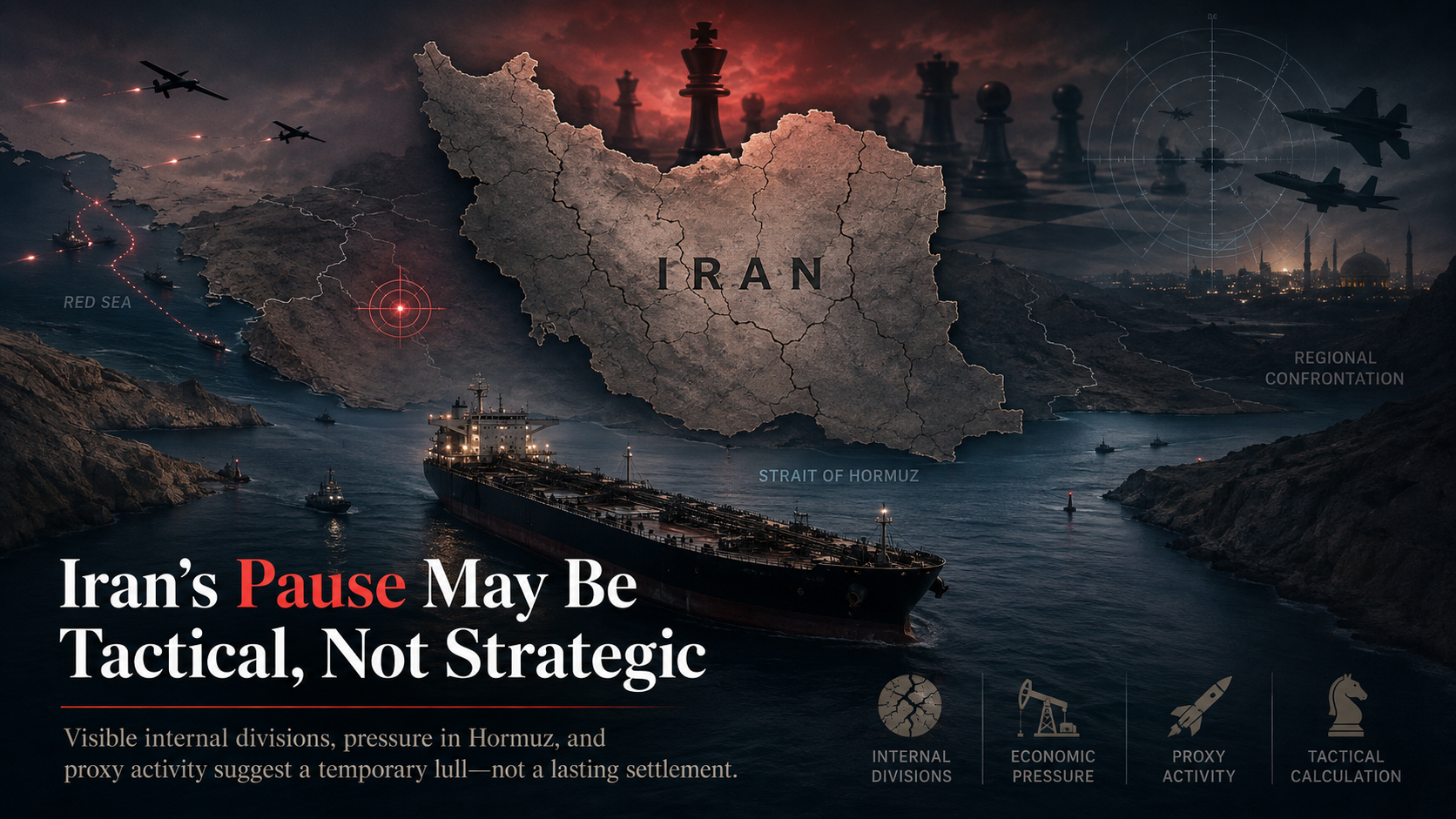
Iran’s Internal Power Struggle: Are Pragmatists Becoming More Assertive?
Iran’s latest message on the Strait of Hormuz is revealing. The Head of Iran’s National Security Council Mohsen Rezaei, former commander of Iran’s Islamic Revolutionary Guard Corps, who was named on August 9, 2026, as the secretary of Iran’s Supreme National Security Council stated that Tehran will not reopen Hormuz even if an Iran – Oman arrangement is finalised suggests that the internal debate inside Iran is becoming more visible. It also indicates that the present period of calm should not be mistaken for a settlement.
The Iranian political system appears to be entering a more complicated phase. Different centres of power are beginning to speak with greater confidence. The political establishment and the harder-line factions may still share the same broad objective of resisting American and Israeli pressure. However, they may increasingly disagree on tactics, negotiations, economic costs, and the acceptable level of confrontation. Therefore, recent statements from Iranian leaders deserve close attention.
To recall, the Iranian President Masoud Pezeshkian earlier and recent claim that he had met Ayatollah Mojtaba Khamenei, a nearly seven-hour meeting and discussed the economy, sanctions, employment, housing, the market, national unity, and Iran’s response to the conflict. Mr. President also said that Khamenei emphasised preserving “unity and cohesion.” It means that unity is shaken. The seven hour meeting with a seriously injured person is also doubtful. There was already uncertainty about the Supreme Leader’s physical condition and his ability to exercise normal political authority. The President’s statement therefore had a political purpose beyond simply confirming a meeting.
The statement of Mr Mohsen Rezaei creates a different impression. It suggests that Iran’s internal political divisions are becoming more open. The political establishment, particularly its less radical sections, appears more assertive than it was earlier particularly after first phase of MOU. This does not mean that the radicals have lost control. They remain powerful. They still influence the security system, the ideological establishment, and Iran’s regional strategy. But the balance inside the system may be shifting.
Iran has already faced military damage, leadership losses, economic pressure, and weakening regional allies. A section of the government engaged in indirect takls with the U.S. may, therefore, prefer tactical compromise in order to protect the State. The radicals are obviously resist such an approach. They are continued with demand of compensation for military damage. They are also demanding a withdrawal of American pressure and a reversal of U.S. policies towards Iran. These conditions are unlikely to be accepted by Washington.
That creates a deadlock. Iran radicals may believe that they are winning and may put more pressure on the U.S. while President Trump still believes that economic pressure will work. The U.S. has already weakened Iran enough to demand greater concessions. If both sides hold these positions, diplomacy could eventually reach its limit.
The next stage would then become more dangerous. The renewed activity of the Houthis in the Red Sea also raises questions. Their attacks, including pressure on shipping linked to Saudi interests, require careful interpretation.
The first question is obvious. Why were the Houthis relatively restrained during the period when Iran itself was facing direct American and Israeli attacks? If they form an important part of Iran’s regional network, their limited activity during Iran’s most difficult period is striking. Their renewed attacks now may, therefore, have a different purpose.
One possibility is that Iran’s weakness has increased the strategic importance of the Houthis. Tehran may now need its regional partners to generate pressure in theatres particularly after Hezbollah knock down.
Another possibility is that the Houthis are helping to keep the wider conflict alive during a temporary thaw. This would fit a broader pattern. The direct war may have paused, but the regional confrontation has not disappeared. Pressure can continue through proxies, maritime disruption, intelligence operations, economic restrictions, and political threats. The Red Sea can, therefore, remain active even when Iran and Israel avoid direct attacks. But, the query remains open that why Iran proxies simultaneously did not activated at the time of combined U.S.- Israel attacks.
Lebanon provides another important indication of the changing regional balance. This produces an unusual strategic convergence. Hezbollah is common enemy of the Lebanese Army and the Israel Defence Forces. Hezbollah was once viewed as one of Iran’s strongest instruments of deterrence against Israel. Its weakening reduces Tehran’s ability to threaten Israel through Lebanon. It also limits Iran’s regional room for manoeuvre.
The same pattern can be seen in the absence of major Iranian and Hezbollah attacks against Israel. At present, Iran is not launching major direct attacks on Israel. Hezbollah is also relatively confined. Israel, for its part, is not carrying out attacks on Iran.
It is better understood as strategic restraint. Each side has reasons to avoid immediate escalation. Israel is approaching elections in October 2026. Domestic politics will influence security calculations. The Israeli leadership may prefer to avoid another large-scale confrontation before the election and would not like to take blame of sabotaging negotiation game of the U.S.
Iran has its own reasons for restraint. It has already suffered significant damage. It has lost important military and political figures. Its security system is still believed exposed for Israeli intelligence penetration. Israel has already demonstrated that it can reach deeply into Iran’s military and security structure. Former Mossad director Yossi Cohen has revealed that Israeli operatives have toured Iran’s Fordo uranium enrichment facility several times in the past.This capability remains a serious source of pressure on Tehran. Iranian leaders know that further escalation could produce another round of leadership losses. For this reason, Iran may prefer to use the current pause to rebuild, reorganise, and reassess.
Thus, the Israeli election becomes an important factor. A new Israeli government, or a renewed mandate for the existing political leadership, could create the conditions for another phase of action against Iran.
The United States mid term election is equally important. President Donald Trump appears to believe that sustained economic pressure can succeed where military action is the last option open. The basic assumption is that economic hardship will eventually force Iran to moderate its position or create cracks among them.
Iranian radicals may see the issue differently. They may be more willing to tolerate economic pain. Economic hardship can be explained domestically as the cost of resistance. Sanctions can be blamed on the United States. Economic decline can be presented as part of a national struggle.
The Iranian radicals fear military pressure more than economic pressure. Washington may believe that economic pressure will eventually produce political moderation. Iranian radicals may believe that they can survive sanctions as long as the regime’s security structure remains intact. If both sides continue to operate under these different assumptions, the chances of miscalculation will remain high.
The approaching mid term elections in American politics will also influence the next phase. President Trump is naturally thinking about the 2026 midterm elections. If he concludes that restraint towards Iran is politically damaging, his calculations could change.
The timing would depend not only on developments in Iran but also on political calculations in Washington. One conclusion, however, seems increasingly clear. Iranian radicals are unlikely to bow down without a fight. This remains true even if Iran is economically weaker and militarily damaged.
The resistance is more suitable for ideology of radicals which are supposedly suicidal. Therefore, the economic pressure alone may not achieve the result expected by Washington. It may deepen Iran’s internal political divisions. It may strengthen the argument of the non-radical political establishment in favour of negotiations. But it could also reinforce the radicals’ belief that the United States ultimately seeks political submission rather than negotiation.
Now, it is clear that the economic cost of the confrontation will make this debate more intense. American blockade will continue to put pressure on Iran. The population will feel the impact. Under these conditions, political differences inside Iran are likely to become more visible. It means that decision-making may become more contested.