


Iran’s Unrest and the Middle East Balance
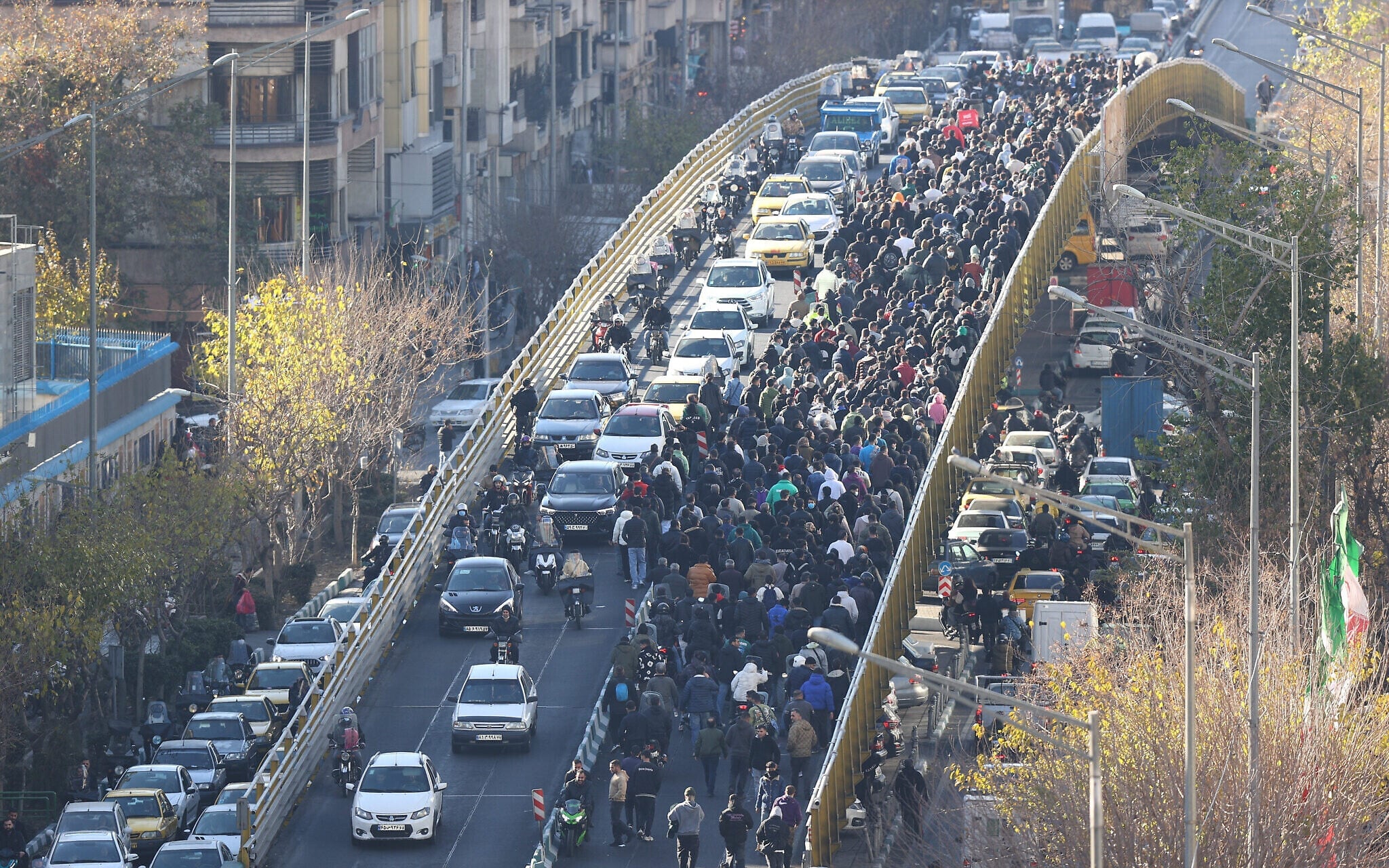
The demonstrations seen in Tehran since December 28, whether they take the form of spontaneous gatherings, business closures, or protests related to the cost of living, recall a reality often overlooked by official Iranian rhetoric: the Islamic Republic is today crossed by a deep inner fragility. This fragility does not mean the imminent collapse of the regime, but it already affects its strategic choices and, by extension, on regional balance.
For several years, the protest in Iran has no longer been just political or ideological. It has become economic and social. Persistent inflation, depreciation of the rial, and supply difficulties, among a young and urban population, have weakened the implicit contract between power and society. The closures of the bazaar, a historical symbol of stability and loyalty to the regime, are in this regard a VERY strong political signal. They indicate that the malaise goes beyond traditional activist circles and touches the economic heart of the country.
Faced with this internal pressure, the classic reflex of an authoritarian regime would be to seek an external outlet, even a confrontation intended to gather the nation around a common enemy. However, in the Iranian case, this scenario is still far from clear . The regime of the mullahs has demonstrated, on several occasions, that it was ideologically rigid but strategically rational. Its absolute priority remains the survival of the system, and not the military headlong rush.
A direct war against Israel would today represent an existential risk. It would immediately aggravate the economic crisis, expose Iranian territory to strikes, and could transform a latent social protest into massive political rejection. The idea that a war would mechanically unify the population no longer fits current Iranian sociology. A growing part of society no longer recognizes itself in revolutionary rhetoric, much less in the human and material cost of a major conflict.
For the region, this internal weakness does not indicate an end, but rather a change in Iranian behavior. A constrained Iran will seek to demonstrate that it remains a central actor, without crossing the thresholds likely to provoke an uncontrollable response. This posture favors an already well-established strategy: indirect action. Asymmetric pressures, activations of allied networks, calibrated military signals, or symbolic demonstrations of force allow Tehran to assert its resistance posture at the least political cost.
It is this logic that could worry regional actors. Israel, first of all, observes the Iranian instability with calculated caution. A weakened Iranian regime is potentially more unpredictable, but not necessarily bolder on the frontal plane. Offering Tehran a direct war could provide it with an internal legitimacy that is lacking today. The Israeli strategy therefore prioritizes deterrence, targeted pressure, and the limitation of Iran’s regional relays, while avoiding the escalation that would transform an internal Iranian crisis into a national issue.
The Gulf monarchies share this uncertainty. A “weakened” Iran reduces strategic pressure on their borders. But an Iran under tension can also compensate for its weakness through indirect actions, particularly in maritime or energy areas. For these states, the main risk is not total war, but the accumulation of incidents, disturbances, and coercive signals that undermine regional security without ever justifying a decisive response.
On the American side, Washington could fear less the survival of the Iranian regime than its brutal collapse. A disorderly fall of power in Tehran could open up scenarios of chaos, internal conflicts, and uncertainty on sensitive sites, particularly nuclear ones. In this perspective, the management of Iranian fragility takes precedence over its exploitation. The goal of economic and diplomatic pressure is to weaken the regime, not to push it into a military headlong rush.
Ultimately, Iran’s internal fragility does not automatically foreshadow collapse or immediate war. It could signal a region where Tehran seeks to survive by minimizing existential risks while maximizing asymmetric leverage. This is not a scenario for peace; it is a scenario of sustained tension—the most modern form of instability.