


Critiquing Ireland's "anti-Zionist" mindset
Ireland and Antisemitism
screenshot from American Jewish Committee online article 2025 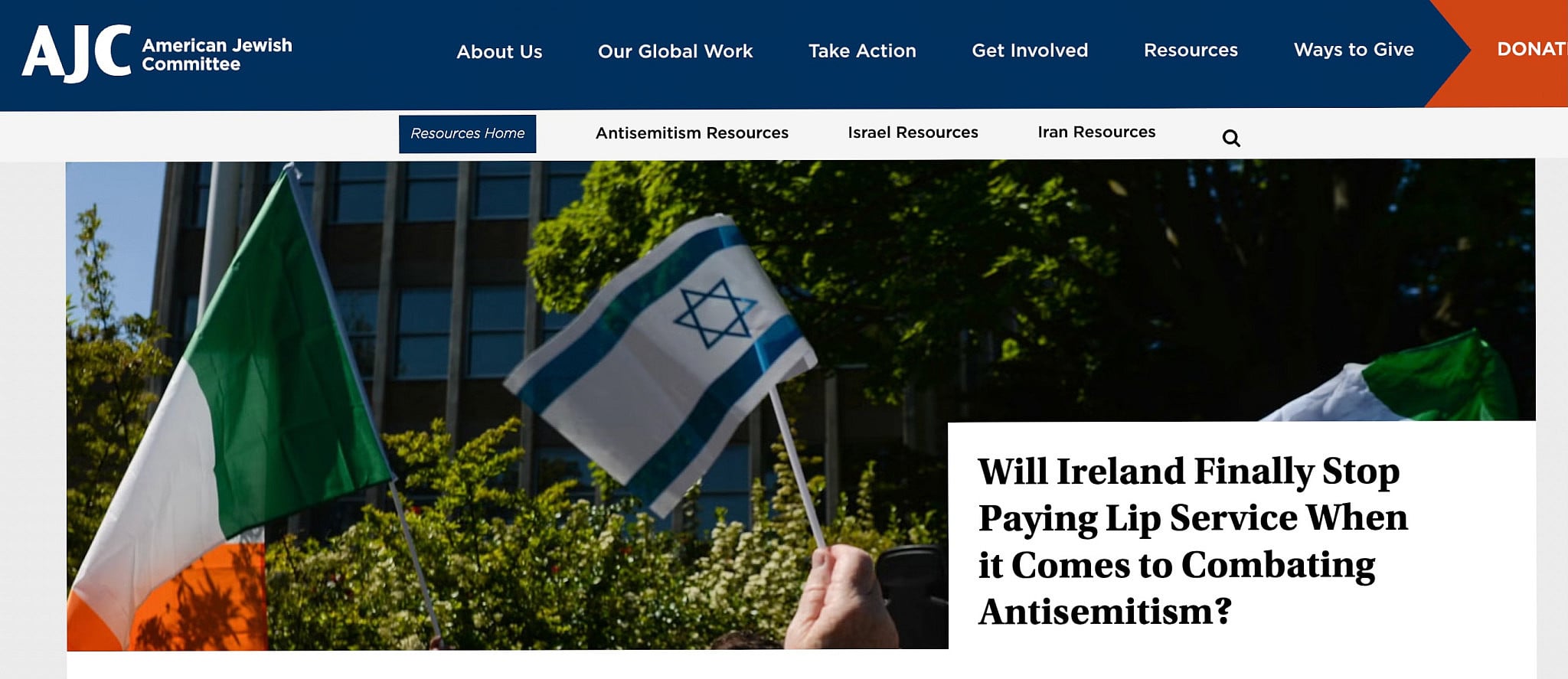
1. Historical Context: Jewish Life in Ireland
The Jewish presence in Ireland dates back centuries but remained small, concentrated mostly in Dublin, Belfast, and a few other urban centers. By the 1940s, the Jewish population was around 5,500, modest but vibrant, participating in commerce, the arts, and civic life. Over the decades, that number declined to just over 2,100 by 2022, primarily due to emigration, assimilation, and the pull of larger Jewish communities abroad.
Much referred to in the narrative between Ireland and Israel is Chaim Herzog’s connections. He was born in Belfast, Northern Ireland (UK) and raised primarily in Dublin (Republic of Ireland). Chaim was son of Ireland’s Chief Rabbi Yitzhak HaLevi Herzog. He migrated to Mandate Palestine in 1935, serving in the Haganah paramilitary group during the Arab Revolt.
The Jewish population of Ireland was 5,500 in the 1940s, but according to the 2022 Census had declined to 2,193 (-14.2%) mainly due to assimilation and emigration. There are only two synagogues in Dublin, one Orthodox, one Reform – and one synagogue in Belfast. A tiny tribe indeed – but why?
The Limerick Pogrom (1904–1906)
The Limerick Pogrom, also called the Limerick Boycott, represents one of the darkest chapters in Ireland’s treatment of Jews. Spearheaded by the Redemptorist priest Fr. John Creagh, his sermons incited economic and social exclusion of Jews in the city. Businesses were boycotted, and families were intimidated into leaving.
Though it lasted only about two years, the event demonstrated that sectarian and religious prejudice in Ireland was not merely rhetorical—it had tangible, life-altering consequences. It also exposed the fragility of minority communities in a country grappling with its own political and religious identity.
World War II and Ireland’s ‘Neutrality’.
Ireland’s neutrality during WWII is often framed as a moral or political stance, but in practice it led to significant indifference to Jewish suffering. Only a handful of Jewish refugees were permitted entry, often contingent on wealth or business skills. Figures like Charles Bewley, Ireland’s ambassador to Germany, actively obstructed Jewish escape, reflecting both personal prejudice and broader governmental passivity.
The Irish anti-Jewish sentiment during World War II, was expressed in a speech to the Dáil in 1943, when newly elected independent politician TD Oliver J. Flanagan advocated “routing the Jews out of the country”. Added to that ugly attitude, only five Jews were permitted entry into Ireland during WW2, and they were allowed allowed entry by bringing cash and / or business skills.
Yet, there were exceptions of courage. Hubert Butler, an Irish Protestant writer and diplomat, helped save around 100 Jews in Vienna. His actions stand out precisely because they went against the prevailing tide of political indifference. These stories remind us that even in periods of systemic prejudice, individual acts of conscience can have life-saving impact.
Ireland-Israel Relations and Historical Ties
Ireland once maintained a proud connection to Israel, a relationship symbolized by figures like Chaim Herzog. Born in Belfast and raised primarily in Dublin, Herzog moved to Mandate Palestine in 1935, joining the Haganah during the Arab Revolt. Later, he became the President of Israel, illustrating the potential global impact of Irish-born Jews.
Today, however, that relationship is more complex and politically fraught. Criticism of Israel—often framed as opposition to specific policies—has sometimes merged with anti-Semitic rhetoric, particularly within segments of Ireland’s left-wing and socialist movements. Politicians and media voices have promoted BDS campaigns, aligned with pro-Palestinian protests, and occasionally adopted simplistic moral narratives that cast Israel as inherently “bad” or “undemocratic.”
Jewish Contributions to Irish Society
Despite their small numbers, Jews have left a lasting mark on Ireland. Several were elected to political office, including Alan Shatter, Ben Briscoe, and Mervyn Taylor, and notable mayors included Robert and Ben Briscoe.
Estella Solomons (1882–1968) was one of Ireland’s most significant early-20th-century artists and an important figure in both Irish cultural life and the revolutionary period. She was part of Dublin’s well-known Jewish community and made lasting contributions to the arts.
David Marcus: Founded Irish Writing and edited New Irish Writing, fostering dozens of literary careers.
Louis Lentin: Playwright, theatre director, and film-maker.
Ronit Lentin: Sociologist and author. Produced influential works on race, identity
Harry Kernoff: Chronicler of everyday Dublin street life, working-class neighborhoods, and literary figures. His paintings are central to Irish cultural heritage.
Geraldine Finnegan (née Weiss): A Jewish-Irish opera soprano known for international performances.
These accomplishments illustrate that integration and contribution were possible even in a society that had, at times, been hostile.
Irish Anti-Semitism Today
While Ireland is now seemingly more diverse and inclusive—with immigrants making up roughly 20% of the population—there is a resurgence of anti-Semitic sentiment, often intertwined with left-wing politics and media narratives. Some pro-Palestinian activism, though motivated by human rights concerns, has unfortunately slipped into anti-Jewish tropes, fueling hostility in both political and social spheres.
Ireland’s Contribution to UNRWA Funding
Ireland’s 2023 contribution of €18 million to UNRWA raises questions about auditing, oversight, and the content of educational materials. Reports of anti-Semitic indoctrination in UNRWA schools, combined with allegations of staff involvement in violent attacks, underscore the moral and practical risks of unmonitored foreign aid.
The Irish government faces a delicate balancing act: supporting humanitarian aid while ensuring that funds are not misused to propagate hatred.
Moral Reflections
De Valera’s condolences to Hitler’s ambassador encapsulates a broader moral critique: Ireland’s past political leadership often prioritized formalities or neutrality over moral responsibility. De Valera’s decision to express sympathy to the German government, while technically diplomatic, symbolized indifference to the suffering of millions of Jews, including those with Irish ties.
This historical moment resonates today. Modern debates about Israel, BDS, and Jewish life in Ireland echo past tensions: how to balance moral clarity with political strategy, humanitarian concern with political ideology.
Concluding Thoughts.
Historical lessons: Ireland’s treatment of Jews reflects a spectrum from exclusion and indifference to courageous advocacy and integration.
-
Contemporary challenges: Rising anti-Semitism in political discourse, social media, and activism, coupled with unexamined funding of foreign agencies, requires vigilance.
-
Future implications: As Ireland becomes more diverse and globalized, reconciling pluralism, humanitarian values, and historical accountability will be essential.
Ireland’s story with its Jewish population is a reminder that awareness, education, and principled leadership are crucial if history is not to repeat itself.
____________________________________
Taoiseach De Valera called on the German Minister, Eduard Hempel,‘to offer condolences’ on Hitler’s death. He apparently made a mental distinction between Hitler and the German people as a whole.
https://en.wikipedia.org/wiki/History_of_the_Jews_in_Ireland#cite_note-42
https://en.wikipedia.org/wiki/Ireland%E2%80%93Israel_relations