
Iron Beam and the end of cheap war
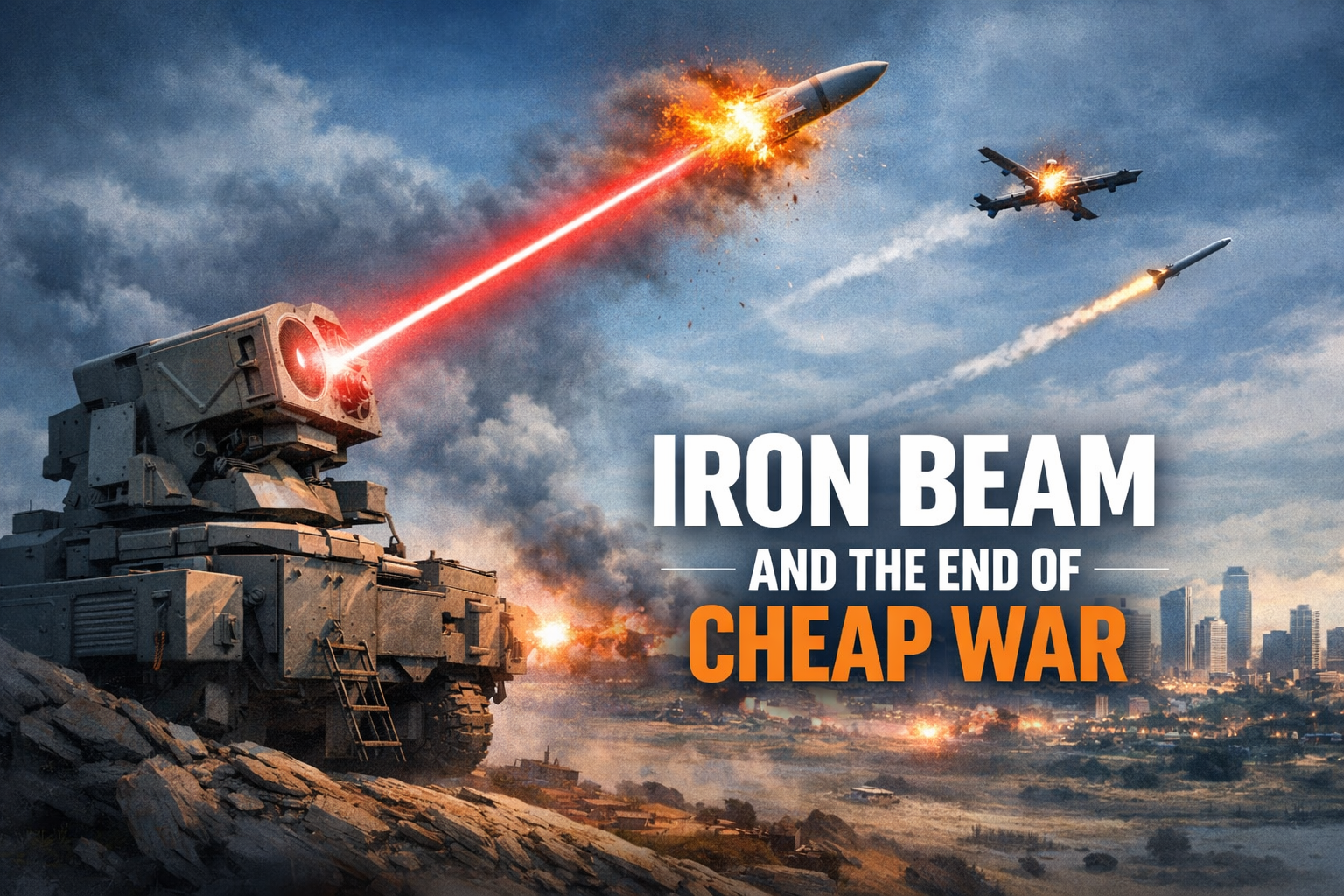
Israel’s operational deployment of Iron Beam is often described as another layer in the country’s air-defense architecture. That framing misses the significance. Iron Beam is not simply a new interceptor; it marks a fundamental shift in the economics and logic of modern warfare.
For decades, Israel and other democracies faced a punishing asymmetry. Non-state actors could fire inexpensive rockets, mortars, and drones in volume, forcing defenders to respond with interceptors costing orders of magnitude more. The strategy was not accuracy but attrition: fire enough, and eventually the defender exhausts their magazine.
Iron Beam inverts that equation.
A laser interceptor replaces missiles with electricity. The limiting factor is no longer stockpiles, but power and cooling. Prolonged rocket and drone campaigns—the backbone of Hamas, Hezbollah, the Houthis, and other Iranian proxy strategies—become economically and operationally unsustainable.
Integrated with Iron Dome, David’s Sling, and Arrow 3, Iron Beam reshapes layered defense. Lasers absorb short-range rockets, mortars, and drones; kinetic interceptors are preserved for complex or long-range threats. Defense now scales faster than offense.
Speed compounds the shift. Lasers engage at the speed of light, compressing decision timelines and degrading swarm tactics. From the perspective of command and control, this is decisive: when engagement cycles outpace human decision-making, volume ceases to confer advantage and instead becomes a liability.
Iron Beam also rebalances power between states and non-state actors. High-energy laser defense favors those with infrastructure—power generation, integrated sensors, and airspace control. One of the most effective asymmetric tools of irregular warfare loses its leverage, forcing adversaries toward costlier, riskier alternatives.
This is not a silver bullet. Adversaries will probe weather effects, obscurants, maneuvering projectiles, and multi-domain attacks. But each countermeasure adds complexity, cost, and detectability. The strategic burden shifts back to the attacker.
Some technologies do not end war; they permanently change how it is fought. Radar, precision-guided munitions, and stealth all did exactly that. Iron Beam belongs in this lineage. It signals the beginning of the end for cheap saturation warfare and the return of economic discipline to the battlefield.
The age of rockets and drones is not over, but the era in which quantity alone can decide outcomes is coming to a close.
–
Author’s note: I write this not only as an analyst, but as an Advanced Incident Command Instructor for the Center for Domestic Preparedness, where the compression of decision cycles and the disruption of command-and-control are taught as central determinants of success in complex, high-tempo crises—on the battlefield and beyond.