


Iron Beam Changes the Cost Curve—But Not the War
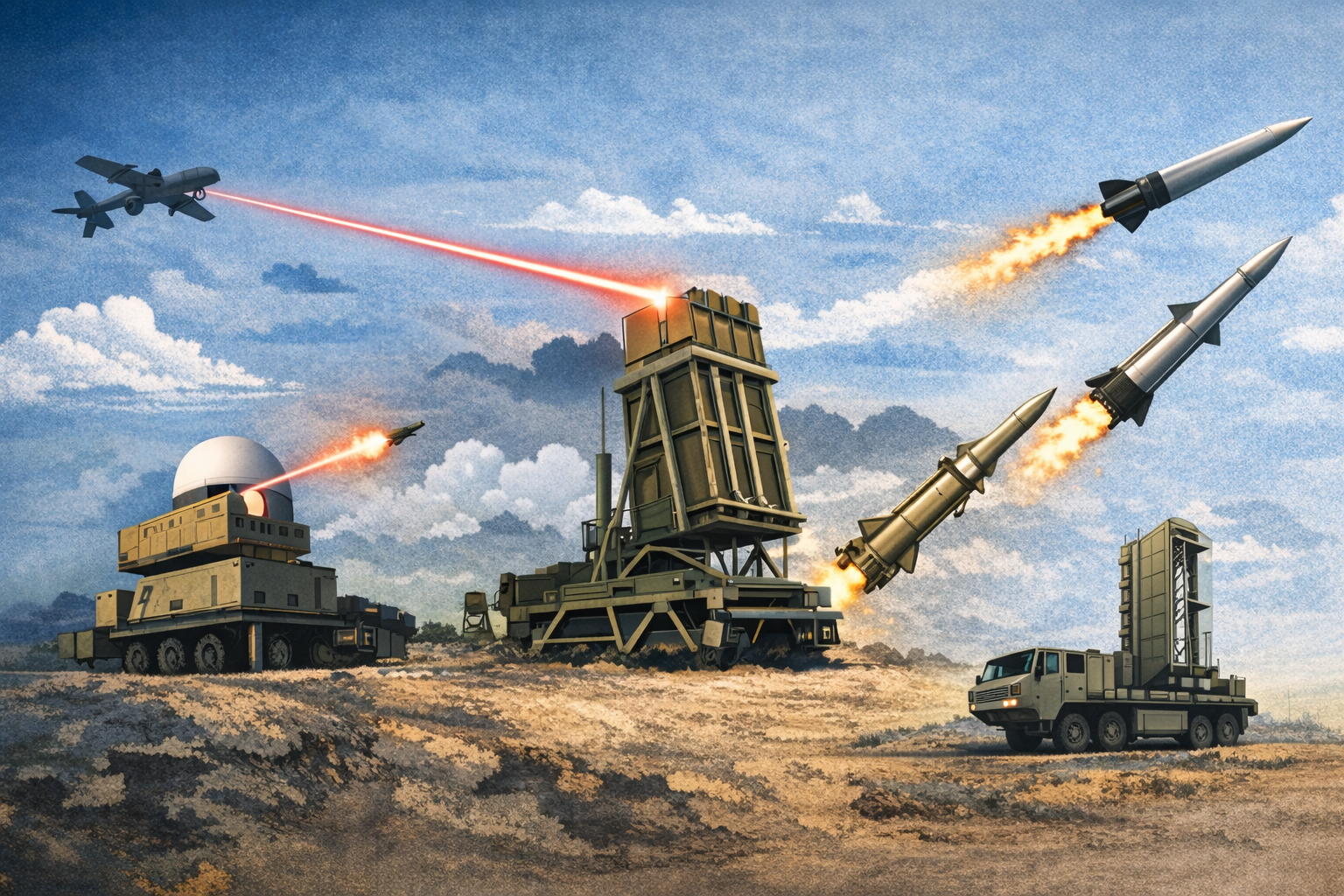
Iron Beam is not simply another interceptor layered onto Israel’s air-defense stack. It is a structural correction to the economics of modern warfare. By converting electricity into interceptions, Israel has begun to neutralize Iran’s most effective asymmetric strategy: flooding defenses with cheap rockets, drones, and saturation attacks designed to exhaust far more expensive interceptors.¹
This matters enormously. Iron Beam preserves high-end interceptors for threats that genuinely require them and restores cost discipline to Israel’s defensive posture.
But clarity is essential: Iron Beam solves a tactical and operational problem—not the strategic one.
A laser that defeats rockets tonight does not prevent the next shipment tomorrow.
What a Robust Layered Defense Actually Requires
Israel’s defense challenge is no longer one of geography but of concurrency, endurance, and economics. Iran and its proxies do not need to defeat Israel’s defenses; they need only to force depletion faster than replenishment.²
A planning-grade, open-source force structure consistent with sustained multi-front conflict would require approximately:
Iron Beam (High-Energy Laser)
- Role: High-volume interception of rockets, mortars, and UAVs
- Planning inventory: 30–60 installations
- Unit cost (order of magnitude): $20–40 million³
- 10-year acquisition cost: $3–5 billion
- Per-intercept cost: Electricity-scale (single-digit dollars)⁴
Iron Beam’s value lies not in perfect coverage, but in absorbing the volume layer of attacks that would otherwise drain interceptor magazines.
Iron Dome (Short-Range Kinetic)
- Role: Rockets, UAVs, short-range cruise threats
- Planning inventory: 18–26 batteries
- Unit cost: $50–100 million per battery⁵
- 10-year acquisition cost: $6–10 billion
- Interceptor cost (Tamir): ~$40,000–$50,000⁶
Iron Dome remains the backbone of Israel’s population defense, but without Iron Beam it remains vulnerable to unfavorable cost-exchange dynamics.
David’s Sling (Mid-Tier)
- Role: Heavy rockets, cruise missiles, maneuvering threats
- Planning inventory: 6–10 batteries
- Unit cost: ~$120–200 million per battery⁷
- 10-year acquisition cost: $2–4 billion
- Interceptor cost (Stunner): ~$1 million⁸
David’s Sling fills the critical gap between Iron Dome and Arrow, preventing unnecessary escalation to strategic interceptors.
Arrow-3 / Arrow-2 (Strategic Ballistic Defense)
- Role: Long-range and exo-atmospheric ballistic missiles
- Planning inventory: 4–6 batteries
- Unit cost: ~$300–500 million per battery⁹
- 10-year acquisition cost: $4–6 billion
- Interceptor cost: ~$3 million per missile (order of magnitude)¹⁰
Arrow systems are indispensable—but inherently magazine-limited and economically unsuited for routine use against mass attacks.
Total Defensive Investment (10-Year Horizon)
Approximately $15–25 billion, including acquisition, integration, and sustainment.¹¹
This is comparable to a single major aircraft program—yet directly protects Israel’s population, infrastructure, and continuity of government.
Why Allied Production Is Essential
Israel cannot—and should not—bear this cost alone.
Joint production with the United States and selected NATO partners enables:
- 20–35% unit-cost reductions through scale¹²
- Deeper stockpiles and surge capacity
- Strategic normalization of laser-based air defense
Iron Beam and Iron Dome are increasingly viewed as strategic infrastructure, not niche Israeli systems.¹³
The Hard Truth: Defense Does Not Stop Rearmament
Missile defense saves lives. It preserves national resilience.
As long as the current Iranian regime remains in power, its ideological and strategic commitment to Israel’s destruction remains unchanged.¹⁴ The question is not if another campaign will come, but when.
That capacity to regenerate forces rests overwhelmingly on Iran’s petrochemical revenues.
Iran’s Financial Center of Gravity
Iran possesses the capacity to generate $150–200 billion in petrochemical export revenue over a decade, depending on sanctions enforcement and global prices.¹⁵ The overwhelming majority of Iran’s crude oil exports transit a single chokepoint: Kharg Island.
Open-source assessments consistently estimate that approximately 80% of Iran’s oil exports pass through Kharg Island.¹⁶
These revenues underpin missile and drone production, proxy financing, and Iran’s ability to regenerate combat power faster than Israel can intercept it.¹⁷
Strategic Conclusion
Iron Beam marks the beginning of a new era in defensive warfare. It allows Israel to refuse the economic attrition strategy imposed by rockets and drones.
But defense alone is a holding action.
If Israel recognizes that the current Iranian regime defines its national mission in opposition to Israel’s existence, the strategic logic is unavoidable:
- Defend the population relentlessly.
- Scale defenses with allies to ensure endurance.
- And degrade the financial foundations that make perpetual war possible.
Without constraining Iran’s petrochemical revenue—without addressing the centrality of Kharg Island and the export network that sustains it—no number of lasers or interceptors will deliver lasting security.
Iron Beam changes the battlefield.
Only economic denial changes the war.
Author’s Note
Mordechai Levin is an Associate Fellow of the American Institute of Aeronautics and Astronautics (AIAA) and an Advanced Incident Command Instructor for the U.S. Department of Homeland Security’s Center for Domestic Preparedness. His work focuses on defense systems, resilience, and the intersection of technology, economics, and national security.
Sourcing Rigor and Methodology
This analysis relies exclusively on open-source, non-classified material from government agencies, major defense manufacturers, congressional research bodies, international energy institutions, and globally recognized analytical organizations. Where precise figures are not publicly available, order-of-magnitude ranges are used and clearly labeled. No operational locations, deployment patterns, or sensitive vulnerabilities are discussed.
The intent is not to reveal capabilities, but to illuminate economic and strategic dynamics already visible to adversaries and allies alike.
Footnotes
- Reuters, “Israel to deploy Iron Beam laser air defense,” 2023–2025
https://www.reuters.com/world/middle-east/israel-deploy-iron-beam-laser-air-defence-2023-10-15/ - International Institute for Strategic Studies, The Military Balance
https://www.iiss.org/publications/the-military-balance - Defense News, reporting on Iron Beam procurement estimates
https://www.defensenews.com/industry/2023/10/15/israels-iron-beam-laser-cost/ - Israeli Ministry of Defense, Iron Beam program statements
https://www.mod.gov.il/Defence-and-Security/IronBeam - Congressional Research Service, Israel’s Iron Dome
https://crsreports.congress.gov/product/pdf/IF/IF10218 - U.S. Army budget justification documents (Tamir cost references)
https://www.asafm.army.mil/Budget-Materials/ - Raytheon–Rafael David’s Sling program overview
https://www.raytheon.com/capabilities/products/davids-sling - Defense News, Stunner interceptor cost estimates
https://www.defensenews.com/land/2021/06/10/davids-sling-interceptor-cost/ - Missile Defense Agency, Arrow-3 overview
https://www.mda.mil/system/arrow_3.html - CSIS Missile Defense Project, Arrow-3
https://missilethreat.csis.org/system/arrow-3/ - Author synthesis based on CRS, IISS, MDA, and MOD data
- NATO, Smart Defence and pooled procurement studies
https://www.nato.int/cps/en/natohq/topics_84268.htm - German Ministry of Defence, Arrow-3 procurement announcement
https://www.bmvg.de/en/arrow-3-air-defence-system-5659476 - MEMRI, Iranian regime doctrine and leadership statements
https://www.memri.org/iran - U.S. Energy Information Administration, Iran country analysis
https://www.eia.gov/international/analysis/country/IRN - EIA and Lloyd’s List analyses of Kharg Island export flows
https://www.eia.gov/todayinenergy/detail.php?id=53339 - U.S. Treasury, Iran sanctions and revenue assessments
https://home.treasury.gov/policy-issues/financial-sanctions/sanctions-programs-and-country-information/iran-sanctions