Is AI Good for the Jews?
Is AI Good for the Jews?
I began this blog in the weeks after October 7 to think in public about Jewish life, our safety, memory, identity, and politics. I posted unevenly, sometimes wide, sometimes narrowly, but the center of gravity has been consistent.
The world is entering an era in which artificial intelligence will not merely sit on top of society like another app. It will become part of the infrastructure of reality, how information is ranked, how narratives spread, how reputations are made and broken, how threats organize, and how communities defend themselves. Going forward, this blog will be laser-focused on AI and the Jewish future.
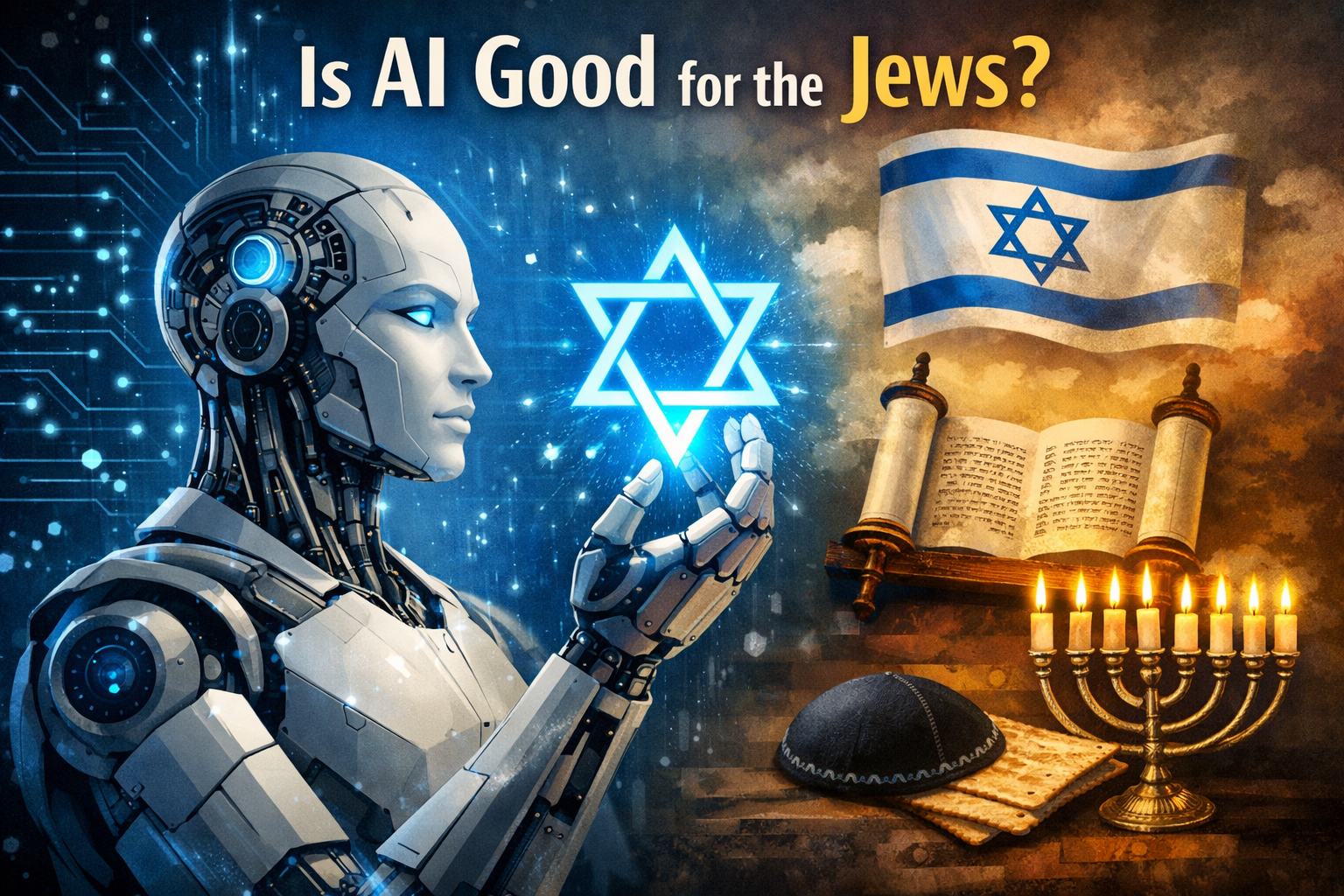
And that brings me to the question I’ve been wrestling with for the last eighteen months, the one that sounds like a punchline until you sit with it long enough to feel the seriousness beneath the grin. It’s the title of my book and the organizing question of this project: Is AI Good for the Jews?
Why Jews Ask the Hard Question First
Jews have a cultural habit of asking the most anxious question in the room and asking it early. Is this good for the Jews? becomes a kind of folk risk-assessment framework, a Shabbat dinner version of scenario planning.
This habit isn’t paranoia so much as historical pattern recognition. When you’ve lived through centuries where rumors harden into laws, where scapegoating becomes policy, and safety can evaporate between one decade and the next, you develop instincts that resemble comedy on the surface and survival underneath.
Jews are also a civilization trained in interpretation and debate, the people of the book. AI, meanwhile, is helping transform us into the people of the cloud, uploading memory and identity onto platforms that store everything and forget nothing. AI, in this view, isn’t simply another tool, but the next medium through which meaning itself gets sorted, summarized, and redistributed.
And whenever a society changes the medium through which meaning moves, Jews tend to notice the risk before everyone else does because we’ve often been the first targets of its darker side.
Every Tech Revolution Came With a Jewish Price Tag
Major revolutions in communication and transportation expand opportunity for everyone. History shows they also create new mechanisms for mass coordination against Jews and other minorities.
The printing press democratized knowledge and made Jewish texts easier to reproduce, but it also made mass distribution of antisemitic tracts easier, accelerating viral blood-libel style propaganda centuries before the word viral existed. Similarly, railroads and telegraphs enabled migration and escape, but they also enabled faster spread of modern political antisemitism and more efficient coordination of scapegoating.
The point is not that technology is uniquely anti-Jewish. The point is that whenever society invents a new way to move information faster, the oldest hatred becomes more mobile too. Antisemitism is unusually adaptable. It can survive contradictions because contradiction is part of its design. It is modular, able to snap into whatever the dominant ideology happens to be, whether religious, racial, economic, nationalist, anti-capitalist, anti-imperialist, or anti-elite. Modular ideologies thrive in systems built for rapid remixing. And the modern information environment is precisely such a system.
The Internet Thinks Like a Brain on Fire
Social platforms are not optimized for shared truth. They are optimized for attention. And the fastest route to attention is the amygdala: fear, outrage, humiliation, tribal loyalty. This is why antisemitism becomes premium fuel in an attention economy. It’s simple, emotional, endlessly adaptable, and built on a conspiracy structure that turns complexity into one villain. It offers the brain something it craves under stress, a story with a clear culprit and a satisfying moral certainty.
Algorithms don’t understand centuries of history, they recognize patterns that generate engagement. The result is a digital world where the conditions for moral clarity are constantly undermined, where nuance loses to speed, context loses to spectacle, and verification loses to the quick dopamine of certainty.
October 7 and the Digital Breakdown
October 7, 2023, was not only a physical atrocity but a kind of systems test, revealing how the modern internet digests Jewish suffering.
The attacks were documented in real time by the attackers themselves, flooding platforms whose moderation systems collapsed under the volume. Then came the victim-villain inversion. By October 9, roughly 48 hours after the massacre, the digital climate had shifted with astonishing speed, as sympathy reversed and skepticism hardened into denial and accusation.
Misinformation mutated fast. Videos and claims were stitched, subtitled, reframed, and cross-posted so quickly that truth couldn’t catch up. Graphic tragedy, normally something a healthy system would suppress, was elevated by the platform algorithms because intensity drives shares.
This wasn’t just emotional volatility. It fit the logic of the internet so neatly it felt preprogrammed. In many ways, the internet had been ideologically primed for this moment through years of identity-war framing, activist ecosystems, and engagement incentives that created an environment allergic to nuance and addicted to oppressor/oppressed templates. When October 7 arrived, the template was locked and loaded, collapsing Jewish history into a simplified frame where Jewish victimhood could not compute.
In this framework, October 7 accelerated a second war, not for territory, but for attention, belief, and emotional dominance. It was the first modern conflict where digital warfare was not accessory to but an actual part of the battlefield itself, fought with videos, hashtags, hacked accounts, bots, coordinated posting, and algorithmic manipulation.
Would this pattern and speed of inversion have happened if the victims weren’t Jewish? Perhaps some inversion would have occurred, this is the internet, after all, but the confidence, ferocity, and velocity of denial felt familiar in a way Jews recognize in their bones. Jewish communities were pushed into defense immediately, forced to justify before being allowed to grieve, while narratives claiming Jewish suffering was fabricated or politically illegitimate spread with extraordinary ease.
When Bias Meets Data: AI Learns What We Feed It
Now supercharge everything above with AI.
A dangerous myth is that AI is objective, a digital Switzerland. The reality is harsher because AI ingests the internet at enormous scale. The machine doesn’t know which sources are scholarly and which are deranged unless humans actively intervene. And that intervention is often burdened by politics and greed.
So if antisemitic patterns exist online (and they do), AI learns them. If centuries-old conspiracies repeat (and they do), the model internalizes associations. Bias enters through contaminated training data, the reinforcement of repeated associations the absence of representative counter-data, ambiguous prompts, and hallucinations that can mimic stereotypes because stereotypes are abundant in the underlying material.
If misinformation is fuel, AI is a refinery, scaling and processing falsehood into output that sounds calmer, cleaner, and more persuasive than the raw hate it was built from. And while deepfakes and fabricated audio are often discussed as future problems, the deeper danger is present-tense, the normalization of doubt as a default condition. When people can’t tell what’s real, those with the loudest networks win. For minorities whose safety depends on public recognition of reality, permanent fog is not an abstraction, it’s a threat.
AI as Protector: The Machine as a Digital Mezuzah
And yet there is a counterclaim that matters.
AI can also become a protective tool proportional to the threat. Historically, Jewish safety depended on human vigilance. Today the earliest signs of danger show up in comment sections and accelerating hashtags, where crowds assemble digitally before they arrive physically.
In that world, an AI system is an unlikely ally as it does not get tired, intimidated, or overwhelmed. It can classify patterns at a scale no human team can match. AI-driven moderation and detection models can recognize antisemitic slurs embedded in stylized images, identify dog whistles, flag coordinated harassment by timing and repetition, and map threat patterns around institutions.
For synagogues, day schools, and Jewish community centers, it imagines systems scanning public digital activity for unusual patterns, anonymous accounts circling, spikes in regional hate speech, or references to specific targets. It’s a kind of digital mezuzah that provides not just symbolic protection, but active monitoring.
Of course, this brings ethical questions of its own like privacy, surveillance creep, false positives, who controls the tools, and how they are governed. But it also acknowledges the reality that since threats have become partly algorithmic, defense needs to become partly algorithmic too.
So… Is AI Good for the Jews?
AI is neither messiah nor monster, but a mirror that scales what humans put into it. It will magnify creativity and wisdom as easily as it magnifies propaganda and hate.
So the real question isn’t whether AI is inherently good or bad for Jews. It’s whether Jews, and the societies Jews live in, will insist on guardrails, literacy, and governance strong enough to keep the machines from laundering ancient conspiracies into modern so-called facts.
Jewish communities can’t afford to treat AI as someone else’s domain. We need digital self-defense through clarity and an understanding how the machine works so it can’t quietly rewrite the story. We must engage it intentionally so Jewish history and identity are not defined by the internet’s distortions. And we must build the institutional capacity, so the tools of defense are as modern as the tools of attack.
Is AI good for the Jews? is not only a Jewish question. It’s a test question for the 21st century: Can a civilization build machines powerful enough to shape reality without letting the oldest hatred ride shotgun?
Related Topics
Related Posts