The views expressed herein are solely mine.
Is America Now Part of Iran’s Axis of Resistance?
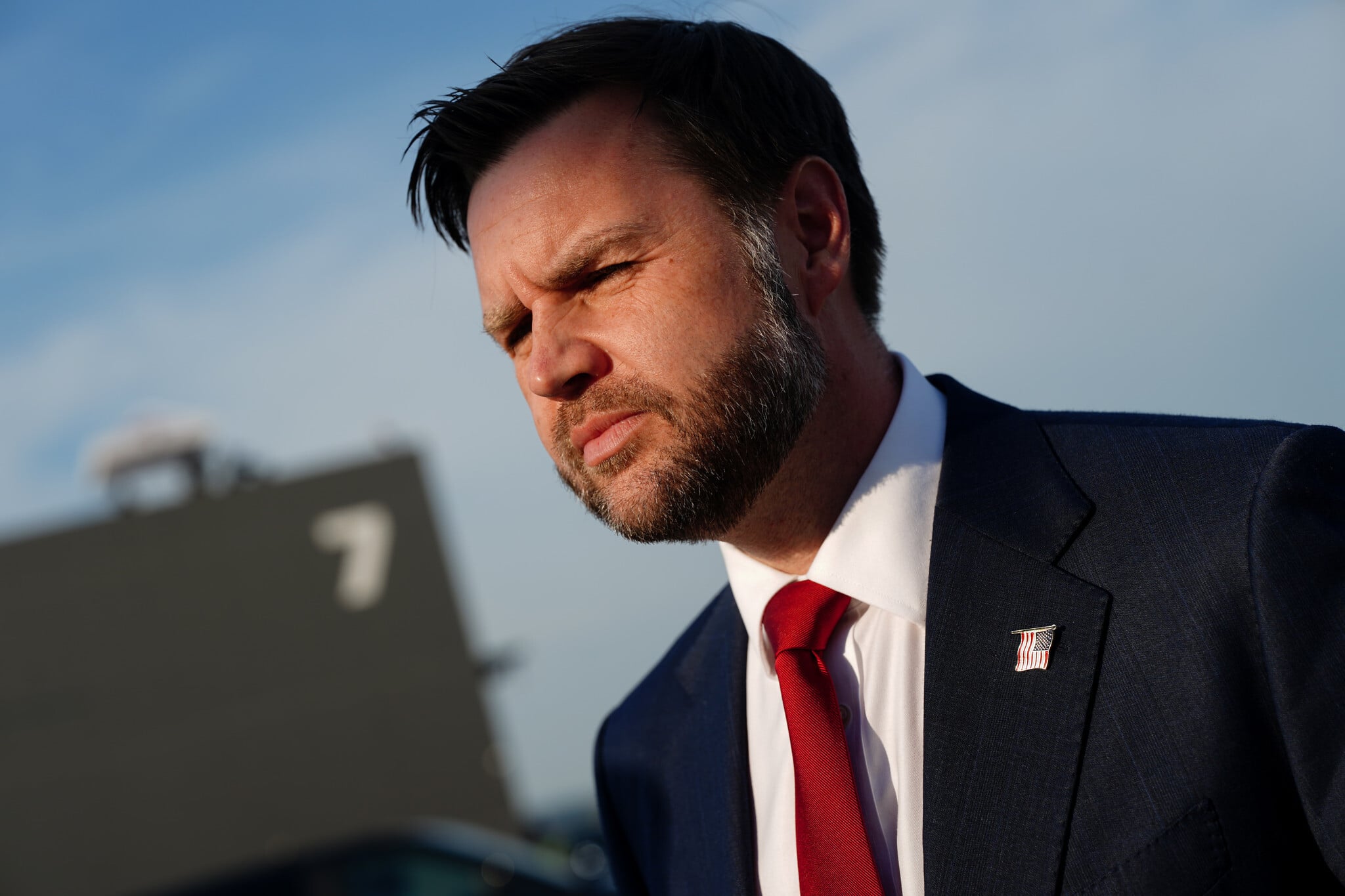
US Vice President JD Vance before boarding Air Force Two at Emmen Military Air Base, Emmen, Switzerland, Monday, June 22, 2026, after the U.S. and Iran held high-level talks at the Lake Lucerne Summit. (Nathan Howard/Pool Photo via AP).
On June 25, 2026, Vice President JD Vance announced that the United States will place Iran’s Islamic Revolutionary Guard Corps (IRGC) in the same room as CENTCOM officers in Doha. According to Vance, the IRGC will “sit with” and “hang out with American commanders to ‘settle’ disputes over the Strait of Hormuz and Lebanon. This is not diplomacy. This is a suit of surrender, carrying the authority of the American vice presidency.
The IRGC is a terrorist organization that also functions as a state within a state. Through construction monopolies, smuggling networks, and sanctions evasion, these thugs control an economic empire that generates between $30 billion and $50 billion annually. The Quds Force—the clandestine branch of the IRGC responsible primarily for foreign operations and unconventional warfare—created and directs Hezbollah, the terrorist organization that murdered 241 American Marines in Beirut in 1983 and that has fired thousands of rockets at northern Israel since October 2023.
In 2019, Washington designated the IRGC as a Foreign Terrorist Organization (FTO) for compelling reasons. Opening a formal military channel with these butchers reverses that designation in practice. Such a move grants legitimacy to the force most responsible for American deaths in the region and for the broader architecture of instability stretching from the Levant to the Persian Gulf.
While Vance sells this arrangement as pragmatic progress toward keeping the Strait of Hormuz open and managing a ceasefire in Lebanon, Iran retains the ballistic missiles, naval mines, and swarms of speedboats needed to close that chokepoint whenever its strategic calculations demand it. The proposed mechanism gives the IRGC a permanent seat at the table while preserving its ability to weaponize energy flows against the global economy. America is not neutralizing a threat; it is institutionalizing Tehran’s leverage.
Lebanon presents an even more dangerous case. The proposed deconfliction channel excludes Israel and gives Iran an operational edge because Quds Force officers on the ground can report incidents and shape narratives faster than any US process forced to filter information through Israeli counterparts. The victim of Hezbollah aggression receives no voice in the room while the aggressor’s sponsor effectively writes the rules of engagement. Put plainly, Iran dictates the terms while the United States provides diplomatic cover and logistical support.
Vance claims that Gulf Arab states are already holding economic talks with the IRGC and presents this as proof that his approach is realistic. The opposite is true.
American weakness is forcing allies to hedge their bets. The Abraham Accords rested on the premise of confronting Iranian expansion rather than accommodating it through back-channel normalization. Once Washington treats Tehran’s terrorist army as a legitimate partner in regional security, every capital from Riyadh to Abu Dhabi will draw the same conclusion and accelerate its own accommodation with the regime. The result will be the steady erosion of the anti-Iran coalition that had only begun to take shape.
Vance’s fatal logic is the same scheme that yielded the 2015 nuclear agreement and the series of short-lived ceasefires that followed. Iran gained time, money, and a measure of international legitimacy after each round of accommodation, while its proxy network regrouped, reequipped, and prepared for the next phase of attrition. Direct military-to-military contact with a designated terrorist organization will not moderate the IRGC; unequivocally, such contact will empower the hardliners in Tehran who argue that confrontation with the United States carries no lasting cost.
Congress must immediately prohibit this IRGC-CENTCOM initiative. The IRGC remains designated under US law as an FTO. Formal coordination, information sharing, or joint mechanisms with the group defy the purpose of statutes designed to deny terrorists material support and risk crossing their legal boundaries. Lawmakers should enact explicit legislation banning any US military or official contact with the IRGC. At the same time, Congress should trigger automatic snapback sanctions the moment the Doha arrangement produces further concessions to Tehran or its proxies.
Similarly, the State of Israel cannot outsource its survival to a US administration that treats its main enemy as a negotiating partner. Faced with this American betrayal, Jerusalem must open parallel channels with Russia and China without delay. Russia retains leverage in Syria and over Hezbollah supply lines through its position in the eastern Mediterranean. China purchases the majority of Iranian oil and possesses economic influence that can shape Tehran’s calculations on maritime security and sanctions compliance. Those channels would give Israel independent intelligence and alternative pressure points on its northern front while signaling to Washington that Jerusalem will not accept strategic vulnerability.
The Jewish state must also be exceptionally careful about which intelligence it passes to Washington. Once CENTCOM and the IRGC establish regular channels for dealing with operational information, Israel cannot assume that sensitive intelligence shared with the United States will remain insulated from Iranian access.
Israeli officials should strictly compartmentalize intelligence involving Iranian networks, proxy activities, military capabilities, sources, methods, and prospective operations to prevent it from reaching the very regime it is meant to counter. Diversification is not disloyalty when the “senior” ally—now behaving like a child angry because its pizza slice was voluntarily smaller than everyone else’s—has chosen accommodation over alliance.
JD Vance is emerging as the modern Gorbachev of American foreign policy in the Middle East. Gorbachev’s perestroika and arms-control concessions, pursued in the name of “peace,” accelerated the Soviet collapse by eroding the Kremlin’s will and capacity to sustain the USSR’s disastrous sociopolitical system.
Vance’s “deconfliction efforts” and embrace of the IRGC are dismantling the architecture of Western deterrence in the Middle East without shame. This man is not building peace through strength; he is merely managing the retreat of American power, moral clarity, and strategic credibility.
Therefore, calling Vance a serious threat to US national security is neither hysteria nor partisan excess. The conclusion follows directly from his willingness to treat a terrorist army as a legitimate security partner, sideline a threatened ally, and normalize the force driving Iranian aggression across the region.
As Washington pursues this arrangement, America’s adversaries have absorbed the lesson with lethal clarity. Vance’s Carlsonian rush to ease sanctions, declare victory, and seek an off-ramp has taught Iran, Russia, and China that American pressure has a breaking point.
The mullahs will use the reprieve to rebuild their proxies and edge back toward nuclear breakout. Vladimir Putin will press harder in Ukraine, convinced that Washington’s support expires when political will frays. Xi is already factoring the same calculation into plans for the Strait of Taiwan in 2027: if the United States tires of one confrontation, it will tire of the next. Weakness does not end wars; it just guarantees that the next one arrives sooner and bloodier.
America: If all these “avant-garde moves” are not joining Iran’s ‘Axis of Resistance’, let G-d be the judge.
Related Topics
Related Posts