
Is Bangladesh Turning the CHT Accord Into a Security Issue?
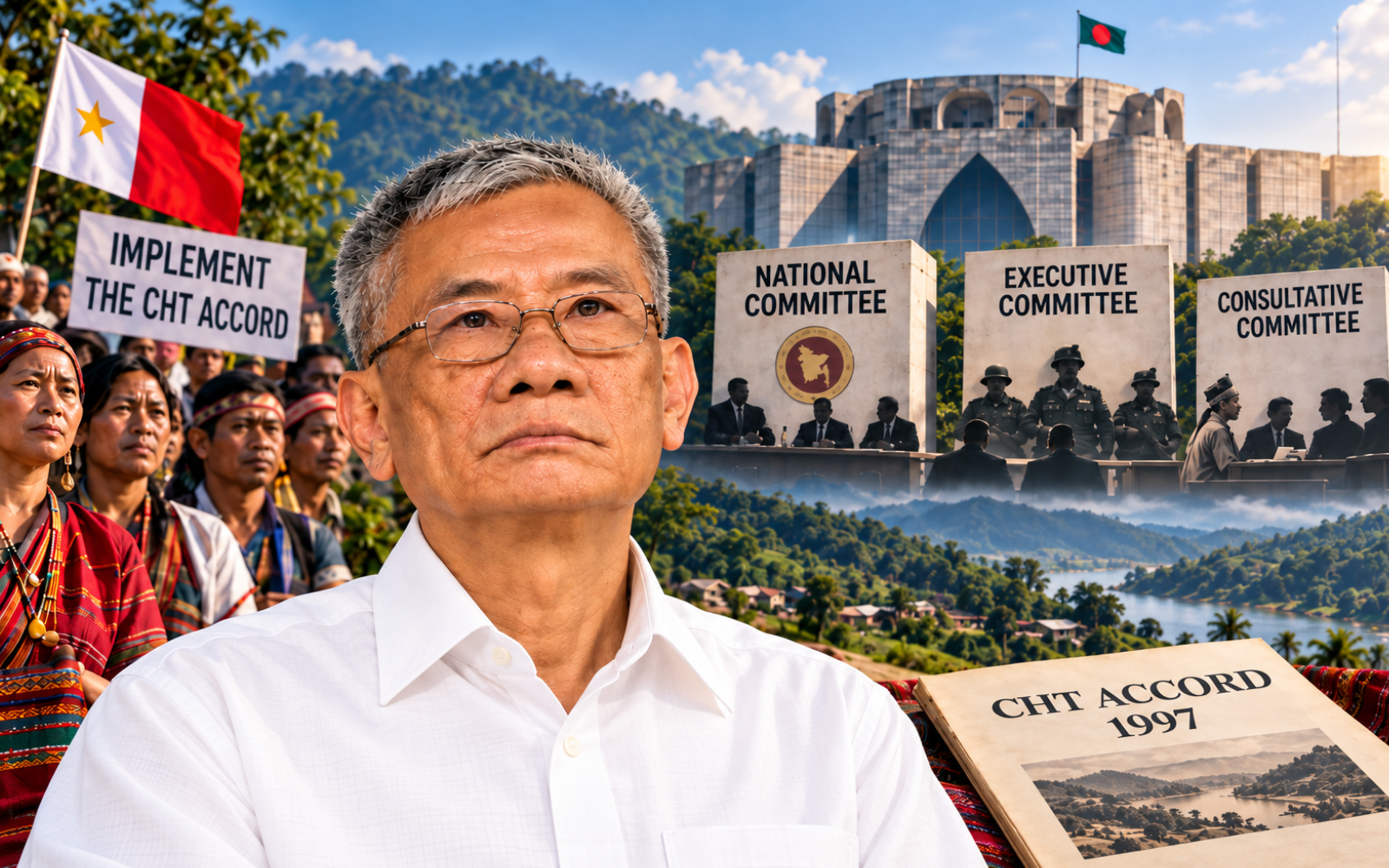
For the Indigenous peoples of Bangladesh’s Chittagong Hill Tracts, three new government committees are raising an old and troubling question: is a political problem that Bangladesh promised to resolve through the Chittagong Hill Tracts Accord being turned once again into a security issue?
On September 10, the government created three bodies with very different powers: the 19-member National Committee on Chittagong Hill Tracts Affairs, the 15-member Executive Committee on Chittagong Hill Tracts Affairs and the nine-member Consultative Committee on Chittagong Hill Tracts Affairs.
At the top is the National Committee, chaired by the prime minister. It sets major priorities and includes senior ministers alongside the Armed Forces Division, National Security Intelligence and the Directorate General of Forces Intelligence, or DGFI.
The security role goes beyond simple membership. The adviser responsible for the Defence Ministry and Armed Forces Division serves as chief coordinator of the National Committee, while the DGFI director general serves as its member-secretary.
The Executive Committee, chaired by the home secretary, prepares the national strategy. Its members include the police, DGFI, NSI, Border Guard Bangladesh, the Armed Forces Division, the army’s 24th Infantry Division and other security agencies.
DGFI again occupies a central position: its director general serves as chief coordinator of the Executive Committee, giving military intelligence an executive role in both powerful bodies.
The Consultative Committee is different. It gives greater representation to the Regional Council and three Hill District Councils, but its principal role is to make recommendations rather than determine policy.
That difference is central to the controversy. The prime minister-led National Committee sets priorities, the security-heavy Executive Committee develops strategy, while the committee with greater CHT representation mainly advises.
The concern becomes sharper when the Executive Committee’s mandate is examined. It has been asked to prepare a national strategy on terrorism and separatism in the Chittagong Hill Tracts, border security, communal harmony and development. It may also review existing laws, regulations and provisions of agreements and recommend amendments or reforms.
Bangladesh has legitimate security concerns. Armed organizations, illegal weapons, extortion and political violence exist in the hills. But confronting armed groups is not the same as placing an unresolved political settlement under an increasingly security-centered structure.
The Accord was a political settlement
On December 2, 1997, the Bangladesh government and the Parbatya Chattagram Jana Samhati Samiti, or PCJSS, signed the Accord after more than two decades of conflict.
The agreement was reached within Bangladesh’s sovereignty and territorial integrity. It sought to resolve politically a conflict rooted in land, displacement, representation, administration and the distinct identity of the peoples of the hills.
The Accord strengthened the Chittagong Hill Tracts Regional Council and the three Hill District Councils. It also addressed land disputes, refugees, internally displaced people and the withdrawal of temporary military camps.
Nearly three decades later, Indigenous communities still consider several core issues unresolved, especially land and the transfer of meaningful authority to regional institutions.
For an Indigenous family, implementation cannot simply mean counting clauses if ancestral land remains disputed or institutions created under the Accord remain weaker than central agencies deciding the region’s future.
The PCJSS has rejected the new structure and called for all three committees to be cancelled. Even Jyotirindra Bodhipriya Larma, widely known as Santu Larma, chairman of the Chittagong Hill Tracts Regional Council and leader of the PCJSS, was not directly included in the Consultative Committee; a representative was included instead.
To outsiders, that may look bureaucratic. To Indigenous communities, it matters because the Regional Council was supposed to stand near the center of the post-conflict political order.
The concern is not limited to the PCJSS. Fifty-two Bangladeshi academics, lawyers, rights defenders and civil-society figures have also warned that the committees could deepen militarization.
The government presents a different picture. CHT Affairs Minister Sa Ching Prue Jerry told parliament on September 10 that 65 of the Accord’s 72 provisions had already been fully implemented.
That claim should be acknowledged, but a peace agreement cannot always be measured by arithmetic. Land disputes, displaced populations, regional authority and the security structure of the hills carry far greater political weight than a simple count of provisions suggests.
International IDEA has recommended full implementation of the Accord, stronger Indigenous participation and protection of customary land rights. Human Rights Watch has separately warned that new legislation weakened safeguards, including the ability of the National Human Rights Commission to directly investigate alleged abuses by security forces.
For Indigenous people in a historically militarized region, greater security influence combined with weaker independent oversight is hardly reassuring.
As Islamist pressure grows
There is another development Indigenous communities cannot ignore: Islamist political forces have regained influence in Bangladesh’s national debate.
Bangladesh is not governed by an Islamist party, and ordinary Bangladeshi Muslims should never be equated with extremists. But organizations such as Jamaat-e-Islami and Hefazat-e-Islam have shown a growing ability to mobilize supporters and pressure mainstream politics.
For the Indigenous peoples of the CHT, this matters greatly. Many are Buddhist, while others are Hindu, Christian or followers of traditional beliefs. For them, pluralism is closely connected to cultural survival.
At an international seminar at the Geneva Press Club on October 2, Germany-based South Asia scholar Dr. Siegfried O. Wolf warned about ideological polarization, religious conservatism and pressure on secular and minority voices in Bangladesh.
His warning matters because the CHT’s Indigenous communities may increasingly find themselves caught between two pressures: stronger religious majoritarianism nationally and stronger security control regionally.
The three committees do not themselves prove an attempt to Islamize the CHT. The deeper concern is that political safeguards for a largely non-Muslim Indigenous region may be weakening while religious hard-line politics gains greater influence nationally.
Why this matters beyond the CHT
Bangladesh has never established diplomatic relations with Israel. In 2026, it restored the words “except Israel” to Bangladeshi passports, again formally excluding Israel from normal passport validity.
Bangladesh was also among the delegations that left the UN General Assembly hall or their seats during Israeli Prime Minister Benjamin Netanyahu’s September address. Many governments protested Israeli policy, so the walkout alone should not be treated as evidence of extremism.
But the broader direction deserves attention. Bangladesh is a strategically important Muslim-majority country where Islamist organizations have regained political leverage while official hostility toward Israel remains deeply entrenched.
At the same time, one of Bangladesh’s most culturally distinct non-Muslim regions is seeing military and intelligence institutions move closer to the center of policymaking.
The danger is not that the three committees automatically make Bangladesh an Islamist state. It is that Indigenous political safeguards may erode at the same time that religious majoritarian politics becomes stronger.
The first people to feel the consequences would be Bangladesh’s own ethnic and religious minorities.
Bangladesh does not have to choose between national security and Indigenous rights. It can confront armed groups while strengthening the Regional Council and Hill District Councils, make the Land Commission effective and prosecute crimes without treating legitimate Indigenous grievances as separatism.
Most importantly, it can complete the Chittagong Hill Tracts Accord instead of allowing parallel security structures to gradually replace its political logic.
The 1997 Accord ended a long armed conflict without partitioning Bangladesh or changing an international border. It proved that Indigenous political aspirations and Bangladesh’s territorial integrity did not have to be enemies.
But peace cannot survive indefinitely on an agreement that Indigenous communities believe the state is weakening. If continued violations convince people in the hills that peaceful political solutions no longer work, the CHT could once again become a serious conflict flashpoint in South Asia.
That is why the present moment matters. Bangladesh still has a choice: honor the settlement it signed, resolve long-standing land disputes and allow the institutions created through compromise to exercise meaningful authority.
Security agencies can monitor threats, police can confront criminals, soldiers can defend borders and intelligence agencies can gather intelligence. But none of them can substitute for a political settlement.
The Chittagong Hill Tracts Accord was supposed to transform a military conflict into a political peace. Bangladesh should be careful not to transform that peace back into a security issue.
October 5, 2026
Tokyo, Japan