


Is Every Child a World Entire?
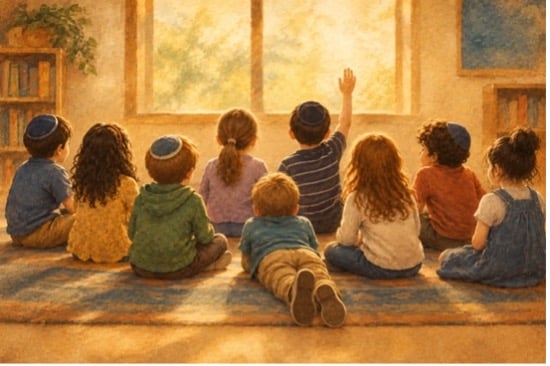
Is every child a world entire? I found myself asking that question after rereading something I had written myself: an email to our kindergarten team that I nearly filed away as routine.
I had written to thank them for something that, on paper, barely qualifies as news: they know their students. Not just names and reading levels, but the small, particular facts that make each five-year-old different from every other student in the class, and in the entire school. Who needs five quiet minutes before circle time. Who tells you everything by telling you nothing. Who is picking up new concepts quickly, demonstrating real understanding, even on the days their body has more energy than the lesson does. Who checks in with a classmate sitting alone, unprompted, because someone should. I meant the email as a small thank-you note. It has stayed with me longer than I expected.
On Simchat Torah we will begin the Torah anew, starting our weekly reading of the Parsha with Breisheet, the creation of Adam. An old teaching, tucked into the Mishnah of Sanhedrin (the tractate concerned mostly with courts and testimony, an unlikely home for something this tender), asks why the world began with only one person in it. Why not create humanity all at once, a crowd from the start? The Mishnah gives several answers, and I have been turning one of them over for a week.
Sanhedrin continues: A human being stamps a hundred coins from a single seal, and every coin comes out the same. God stamped every person from the seal of the first human, Adam, and not one of us came out the same as another. I often teach my students that we are all created in the image of God, and yet, none of us look alike. That, the Mishnah says, is why each of us is permitted, even obligated, to say: the world was created for my sake. And it closes with the line most people already half-know, even if they have never opened the tractate it comes from: whoever sustains a single life, it is as if they sustained an entire world, עולם מלא, olam malei.
Read that against a kindergarten classroom, and it stops sounding like theology and starts sounding like a job description. An entire classroom, one curriculum, one seal; each student entirely different people walking out from under it. The sameness is not the point. The sameness is just the material. The point is what a teacher notices in spite of it, barely two months into a school year, when the easier thing would be to see a grade level instead of a room full of worlds.
I am, admittedly, better at quoting that Mishnah than at living up to it on any given day. I sit through schedules and budgets and enrollment data and strategic thinking more hours a week than I would like to admit, all of it necessary, none of it the reason I do this work. A school that only ever sees the roster loses the child. And a school that only ever sees the child, one at a time, forgets that it is also building something larger: a community those children will grow up inside of, together, a place where everyone belongs. Holding both at once, the whole and the singular, is the actual craft. A trait my kindergarten team consistently models.
None of this was a grand pedagogical initiative. Nobody set out to prove a two-thousand-year-old Mishnah correct on a Tuesday afternoon. A few teachers just did their jobs, one child at a time, closely enough that I noticed and wrote them a thank-you note I did not expect to still be thinking about a week later, a thank-you for truly knowing each of their students.
Every Jewish day school I know of is trying to hold that same pairing at once: a shared curriculum (the one seal), a room full of children none of whom came out the same (the coin that will not match the one beside it), and the old, stubborn idea that noticing the second thing is not a distraction from the first; it is the whole job. That is a demanding thing to ask of a teacher, an easy thing to forget to say out loud when it is working, and, I think, the best answer we have for what a Jewish day school is actually for: not a headcount, not a spreadsheet, but nine, or three hundred, or three thousand entire worlds, walking through the door each morning, one seal, and none of them the same.