
Political and social entrepreneur activist in Israel and Palestine
Featured Post
Is Hamas really rebuilding or is Israel preparing the ground for more war?
Deadlocked over Hamas disarmament, the sides should adopt the kind of international guarantees that helped end the Northern Ireland conflict
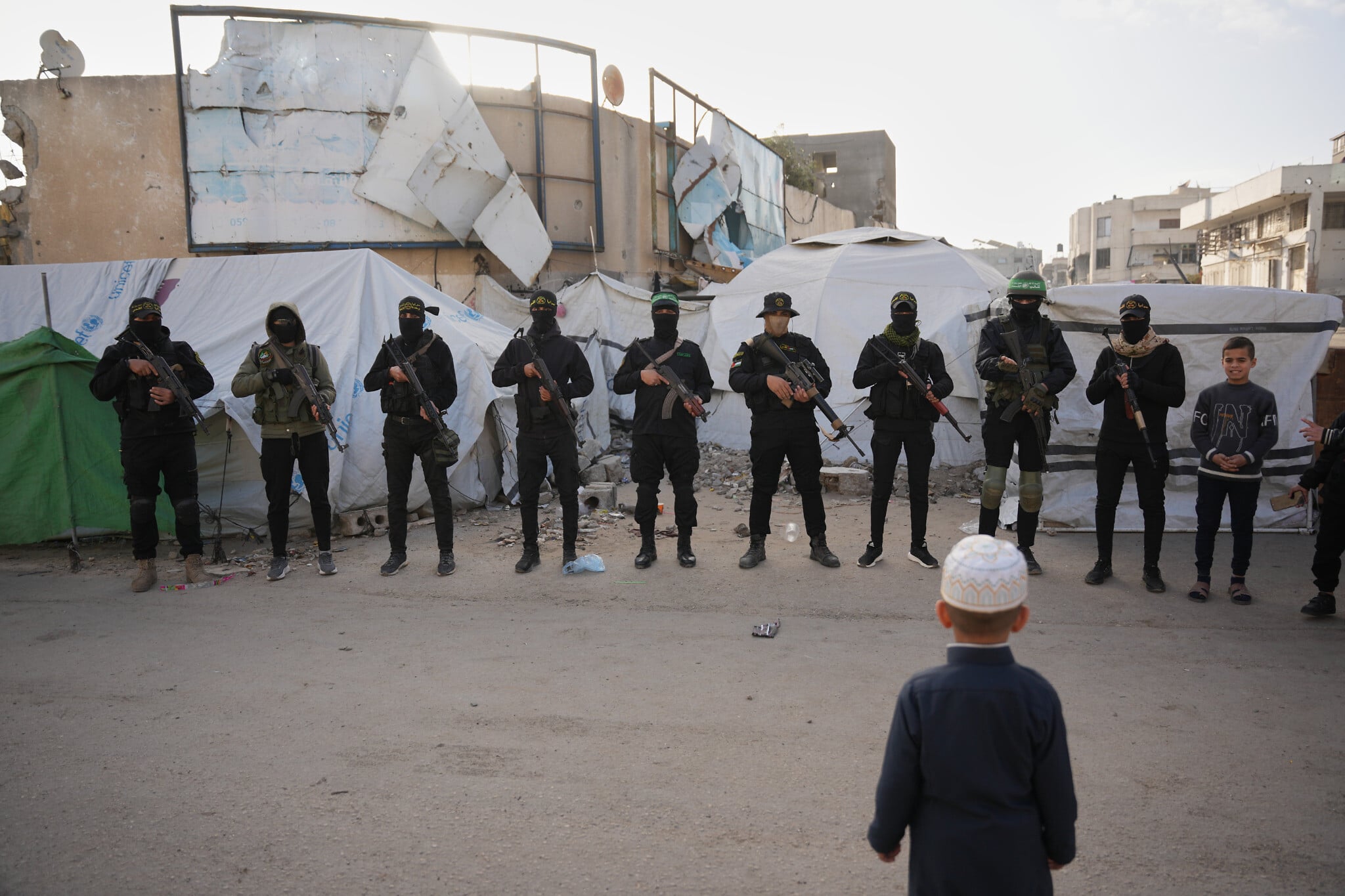
Armed Palestinian militants from Hamas and Islamic Jihad gather next to Eid al-Fitr prayers in Gaza City, March 20, 2026. (AP Photo/Abdel Kareem Hana)
In recent weeks, more and more reports and intelligence assessments have been published in Israel regarding a “renewed military strengthening” of Hamas in the Gaza Strip. The message is clear: Hamas is rebuilding its power, reorganizing, gathering weapons, and preparing itself for the next confrontation. The Israeli public is being left with the impression that only another military operation can prevent the “return of the threat.”
But behind this campaign lies a far more complex reality – and perhaps also a deliberate attempt to prepare Israeli and international public opinion for the renewal of the war.
The reality in Gaza today is very far from the image of a flourishing and powerful terrorist organization. Gaza is devastated, the population exhausted, and the civilian system has almost completely collapsed. Hamas itself is also experiencing profound distress. According to many sources inside Gaza, Hamas is suffering from an extremely severe financial crisis. It has no regular ability to pay salaries – neither to its fighters nor to employees of the civilian administration. The public in Gaza is exhausted from the war, and many oppose the continuation of Hamas rule in its current form.
And yet Hamas continues to be the controlling force in those parts of Gaza where the Palestinian population remains. Why? Not because Hamas currently enjoys broad public legitimacy, but because Israel refuses to allow the entry of the Palestinian technocratic committee (NCAG) that was intended to assume civilian administration of the Strip.
Five months after the end of the war, this committee has still not been allowed to enter Gaza and begin operating. Without an agreed and functioning governing alternative, the resulting vacuum continues to leave Hamas as the only organized force on the ground.
It is important to understand: according to messages coming from inside Gaza, Hamas is prepared to immediately transfer full civilian control to the technocratic committee – including the police, internal security, and the management of government ministries. This is no longer simply a question of who will rule Gaza, but rather whether Israel and the Americans are truly prepared to allow the creation of a new reality in the Strip.
This is precisely where the current deadlock lies.
The negotiations between the United States and Hamas are stuck around the issue of disarmament. The American position – which in practice adopts the Israeli demand – is that Hamas must commit in advance and unequivocally to the complete dismantling of its weapons before the other commitments are implemented: significant humanitarian aid, medical equipment, temporary housing units, heavy machinery for clearing rubble, the entry of the technocratic committee, the establishment of a new Palestinian police force, and a phased Israeli withdrawal in accordance with the understandings that were presented.
Hamas, for its part, argues that it is prepared for a gradual process of disarmament in parallel with the implementation of Israeli and international commitments, including phased Israeli withdrawal from Gaza. From its perspective, this is fundamentally a question of trust: why should it surrender its main leverage in advance when there is no guarantee whatsoever that the other side will fulfill its obligations?
Instead of addressing the real crisis of trust, the Americans have chosen to place additional pressure on Hamas and warn that if there is no full prior agreement to disarmament, they will not be able to prevent Israel from renewing the war.
The issue of mediation itself has also become part of the problem. In the eyes of many within Hamas, the representative of the Peace Council, Nikolay Mladenov, is perceived not as a neutral mediator but as someone who has effectively adopted the Israeli positions. This further deepens the distrust and makes reaching agreements even more difficult.
At the same time, an interesting development is taking place inside Gaza itself that has received almost no attention. Hamas has held internal elections, and the new leadership in Gaza is regarded by many as more realistic and pragmatic than the leadership abroad. The leaders inside Gaza are themselves living through the destruction, the hunger, and the daily suffering of the population. They understand better than anyone that continuation of the war could lead to total catastrophe.
The central question now is not whether Hamas is “rebuilding its strength,” but whether there exists genuine political will to prevent the renewal of the war and create a credible mechanism for political transition, reconstruction, and phased disarmament.
The real problem today is not only the issue of weapons – it is the complete absence of trust. Hamas does not believe Israel will fulfill its commitments after Hamas gives up its weapons in advance. Israel and the United States do not believe Hamas will ultimately agree to the full dismantling of its military capabilities. In this vacuum, each side waits for the other to make the first move – and the war could resume.
Therefore, a new mechanism is required to break the deadlock.
One possible solution may be the establishment of a small international panel composed of individuals with global experience in conflict resolution, disarmament of armed organizations, and political transition processes. People who do not currently represent governments, but who possess international credibility and the professional capacity to supervise, mediate, and provide guarantees to both sides.
Such a panel could:
- supervise implementation of reciprocal commitments;
- establish a phased and verified disarmament mechanism;
- simultaneously ensure the entry of humanitarian aid and reconstruction efforts;
- provide international guarantees for a phased Israeli withdrawal;
- and prevent the renewed collapse of agreements.
Models of this kind have worked elsewhere in the world before – including in Northern Ireland – where disarmament processes succeeded only when a credible international mechanism was created that gave both sides confidence that commitments would actually be honored.
Without a credible mechanism of guarantees and oversight, the lack of trust will continue to dictate reality – and the path toward renewed war will become very short indeed.
The world must understand: Gaza does not need another war. It needs a credible political pathway that can provide both security for Israelis and a future for Palestinians.
Related Topics
Related Posts