


Is Israel the last Western country?
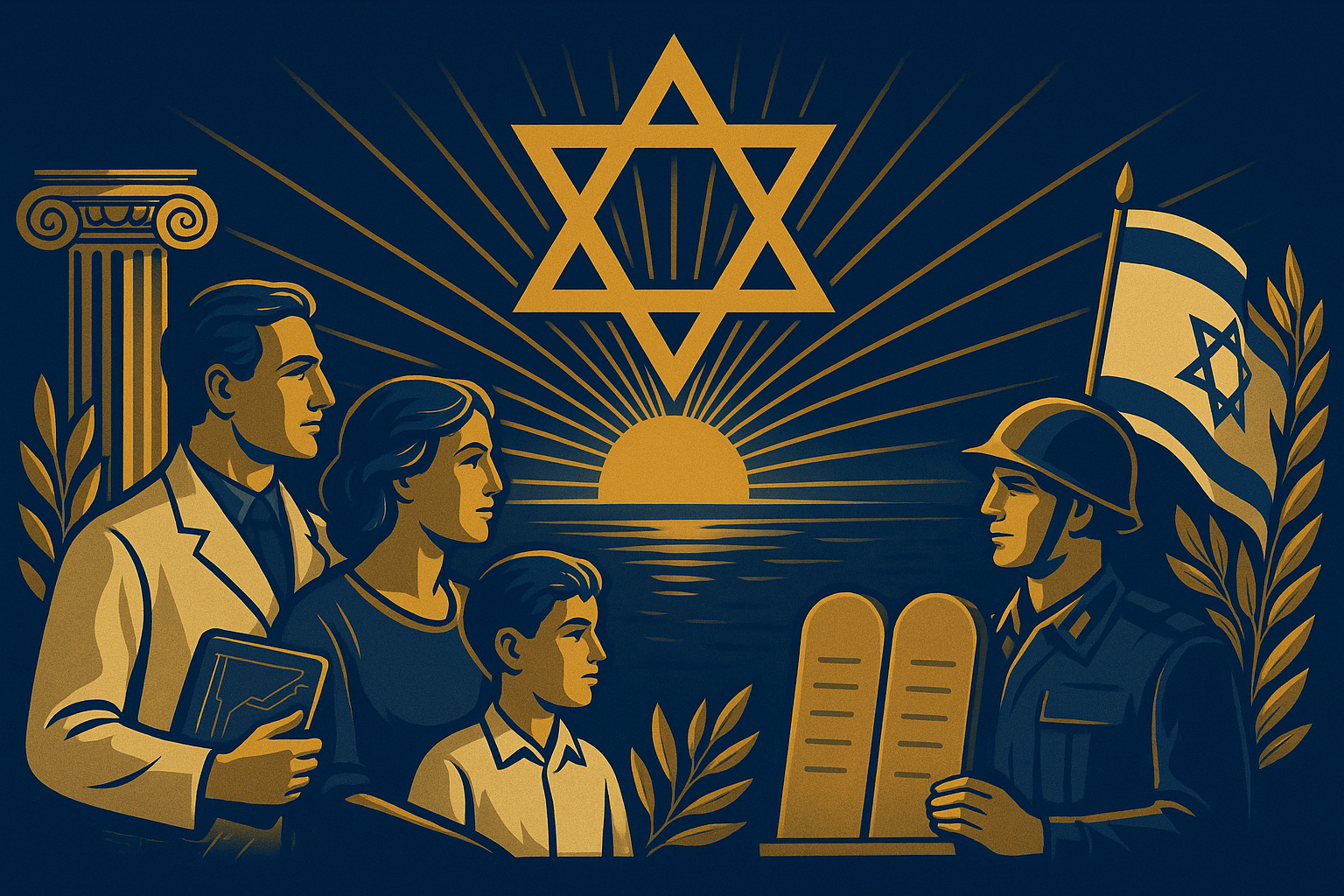
Brendan McCord’s recent essay, “On Western Dynamism,” argues that the West’s power doesn’t come from enforced unity but from a live tension among three rival visions of the good life: the heroic, the philosophic, and the biblical. Societies thrive when these visions contend without any one of them flattening the others. That friction creates surplus energy for art, science, enterprise, and renewal.
Most Western countries have tried to dissolve that tension into a kind of therapeutic politics. Israel has done the opposite. Israel cultivates the friction. It is, in practice, a biblical country, a philosophical country, and a heroic country all at once. And because it keeps those three traditions alive in public, it has something almost no Western country has today: the confidence to create new life: literally. Israel is the only country in the developed West whose fertility remains above replacement. That matters because it means Israel is not only the West’s best current expression. It is, more than any other, the West’s future.
The West’s Three Traditions Are Alive in One Place
McCord frames Western civilization as a dynamic order, “driven by tension” among the heroic life (Homer to the citizen-soldier), the philosophic life (Athens to modern science), and the biblical life (revelation, covenant, family). The Enlightenment tried to resolve the tension; the 20th century often tried to enforce it; both moves tended to fail. The West works when citizens are free to choose and inhabit these rival excellences and when institutions protect that freedom.
Israel keeps that balance on purpose and by necessity. Its citizens argue like Athenians, pray like Jerusalem, and fight like Sparta. None of these ways of excellence cancels the others; each critiques and completes the others. That is Western dynamism in the wild.
A Biblical Country
Israel is biblical not only because Scripture is native to its land and language but because the organizing moral grammar of the country is covenantal, anchored in peoplehood, time, and family. Shabbat actually slows the acceleration of modern life every single week so that communities can remember who they are. Jewish holidays structure the public calendar. Law and politics wrestle openly with questions of obligation, justice, and mercy in the language of prophets and sages. This is not theocracy but it’s a civic culture whose deepest sources are biblical and whose public square takes those sources seriously.
A Philosophical Country
At the same time, Israel is philosophical in the most practical, Socratic way: it’s a country of argument. Machloket l’shem shamayim means disagreement for the sake of Heaven. It infuses classrooms, Knesset committees, labs, and boardrooms. It prizes curiosity, method, and falsification. That culture of disputation runs from Talmudic page to semiconductor fab; from the academy to the garage. Israel’s universities, elite tech units, and startup ecosystem feed on relentless questioning of assumptions, leaders, and received wisdom. The result is a society unusually skilled at converting ideas into working systems while remaining open to critique and revision. In McCord’s terms, this is the philosophic tradition operating within, not above, civic life.
A Heroic People (and a Living Monomyth)
Finally, Israel is heroic. The Jewish story is the heroic monomyth with real names and real places: exile and homecoming; defeat, discipline, and return; crossing seas and deserts; building, failing, rebuilding. Modern Israel has added new chapters: Aliyah and revival of a language; kibbutzim and cities; wars survived; hostages brought home; terror defeated; neighborhoods rebuilt. The IDF’s citizen-soldier model is a school of courage and duty: the willingness to risk for goods beyond the self.
In that monomythic arc, the Holocaust is the abyss: the descent into the underworld from which few return unchanged. It is the supreme ordeal that shatters certainty yet forges an unbreakable covenant: Never Again as a duty to protect Jewish life and the dignity of all human life. The “return” carried the elixir of memory and moral clarity, which they poured into the institutions of a reborn state: schools that teach history without anesthetic, a strong defense ethos, and a social compact that prizes mutual responsibility. In this reading, the Shoah is the darkest threshold before re-ascent, sharpening Israel’s heroic virtues: courage, loyalty and honor while binding them to humility, vigilance, and the sanctity of life.
Putting it Together
Put together, these three traditions form Israel’s civic alchemy. Israelis argue fiercely (philosophic), yet most arguments happen inside a frame of shared texts, seasons, and obligations (biblical). When danger comes, arguments pause and people act (heroic). Afterward, the debates resume: often sharper, sometimes wiser. That cyclical pattern keeps courage from becoming cruelty, piety from becoming coercion, and reason from becoming technocratic domination. It also produces a citizenry unusually comfortable with uncertainty. A crucial trait when you’re inventing the future.
The Proof of Confidence: Children
Civilizations advertise their optimism through birth. Here the contrast is stark. Across the OECD and wider West, fertility has collapsed; policy tweaks and subsidies have not reversed the trend.
Israel is the profound exception. According to the OECD’s 2024 Society at a Glance, Israel’s total fertility rate (TFR) was 2.9 in 2022, the only OECD country above replacement, while peers like France and Ireland were well below replacement. More recent analyses still show Israel far above other developed nations. It’s a culture-level signal that life is felt to be good and worth continuing.
Why does this matter? Because a society that chooses children is a society betting on itself. It is committing to raise and educate the next generation; to build homes, schools, and businesses; to steward institutions across time. A country that renews itself biologically can plausibly renew itself culturally, economically, and militarily. In a West aging into hesitation, Israel’s birthrate is a loud yes.
Freedom to Choose the Best Lives
McCord stresses that the West’s strength isn’t unanimity about “the good life” but the freedom to try on the best lives: to be genuinely called to devotion, to inquiry, or to action, and to let those callings interrogate one another. Israel is the rare place where that experiment still happens at scale, in public, under pressure. The country’s messiness, its cacophony of parties, newspapers, courts, rabbis, activists, and founders is the sound of Western civilization doing its work.
Israel: The Last Western Country?
Israel is not perfect and no living civilization is. But where much of the West has traded its civilizational friction for materialism and inertness, Israel has kept the bowstring taut. It is biblical without theocracy, philosophical without sterility, heroic without nihilism. And it alone, among Western nations, is still replacing itself. Meaning Israel alone can say with confidence that its experiment will continue.
If the West is a tradition more than a map, then Israel today is its most faithful practitioner and its most credible heir. Israel is the Western civilization. Not because others have zero claim, but because Israel cultivates the very dynamism the West requires and, crucially, has the will to carry it forward. In that sense, Israel is not just a Western country. It is the last one. Standing, building, arguing, worshipping, defending, and welcoming children into a story that still believes tomorrow is worth making.