Does protesting the draft count as Torah study, too?
Here’s my religious Zionist response to Israel’s Haredi draft bill, the IDF manpower crisis, and the tension between Torah study and shared national service.
I believe deeply in Torah study. I believe it sustains the Jewish people, shapes the Jewish state and gives meaning to the sacrifices made to defend it.
But believing in the value of Torah study does not require me to accept every political demand made in its name.
IDF Chief of Staff Lt. Gen. Eyal Zamir has now warned Prime Minister Benjamin Netanyahu, Defense Minister Israel Katz, and Knesset committee chairman Boaz Bismuth that legislation freezing enforcement against Haredi draft evaders is incompatible with the army’s needs. The proposed law would suspend arrests and other enforcement measures for at least seven months and provide protection to tens of thousands of men who have failed to report for service. Zamir warned that it would actually encourage more young men not to report.
His objection should be taken seriously, especially by those of us who identify as religious Zionists.
The IDF is not merely Israel’s military. It is one of the great social levelers of Israeli life. Young men and women from different ethnic, economic, geographic and religious backgrounds meet one another, depend upon one another and learn that the state belongs to all of them — and that all of them bear responsibility for it.
My son sometimes reminds me that, because I did not serve in the IDF, I will always remain, in a certain sense, an oleh hadash, a new immigrant. I understand what he means. No matter how deeply one loves Israel, there is an experience shared by those who put on the uniform that those who did not serve can never fully possess.
Military service creates a common Israeli language. It opens doors socially and professionally, but it also imposes obligations. It means missed holidays, interrupted studies, financial sacrifice, frightened parents, and, for reservists, repeated separations from spouses, children, and businesses.
That burden has become even heavier during nearly three years of war. The IDF has told the Knesset that it is short approximately 12,000 soldiers, a gap expected to grow as current personnel complete their service.
Against that background, the demand for a broad exemption cannot simply be defended by repeating the words “Torah study.”
There are unquestionably exceptional scholars whose full-time learning should be supported. The State of Israel should be proud to sustain serious Torah scholarship. Religious Zionists do not want empty batei midrash (study halls) any more than we want empty army bases.
But not every person registered in a yeshiva is destined to become a great Torah scholar. Nor should an entire community be treated as though every young man within it is performing the same indispensable national role.
And then there are the demonstrations.
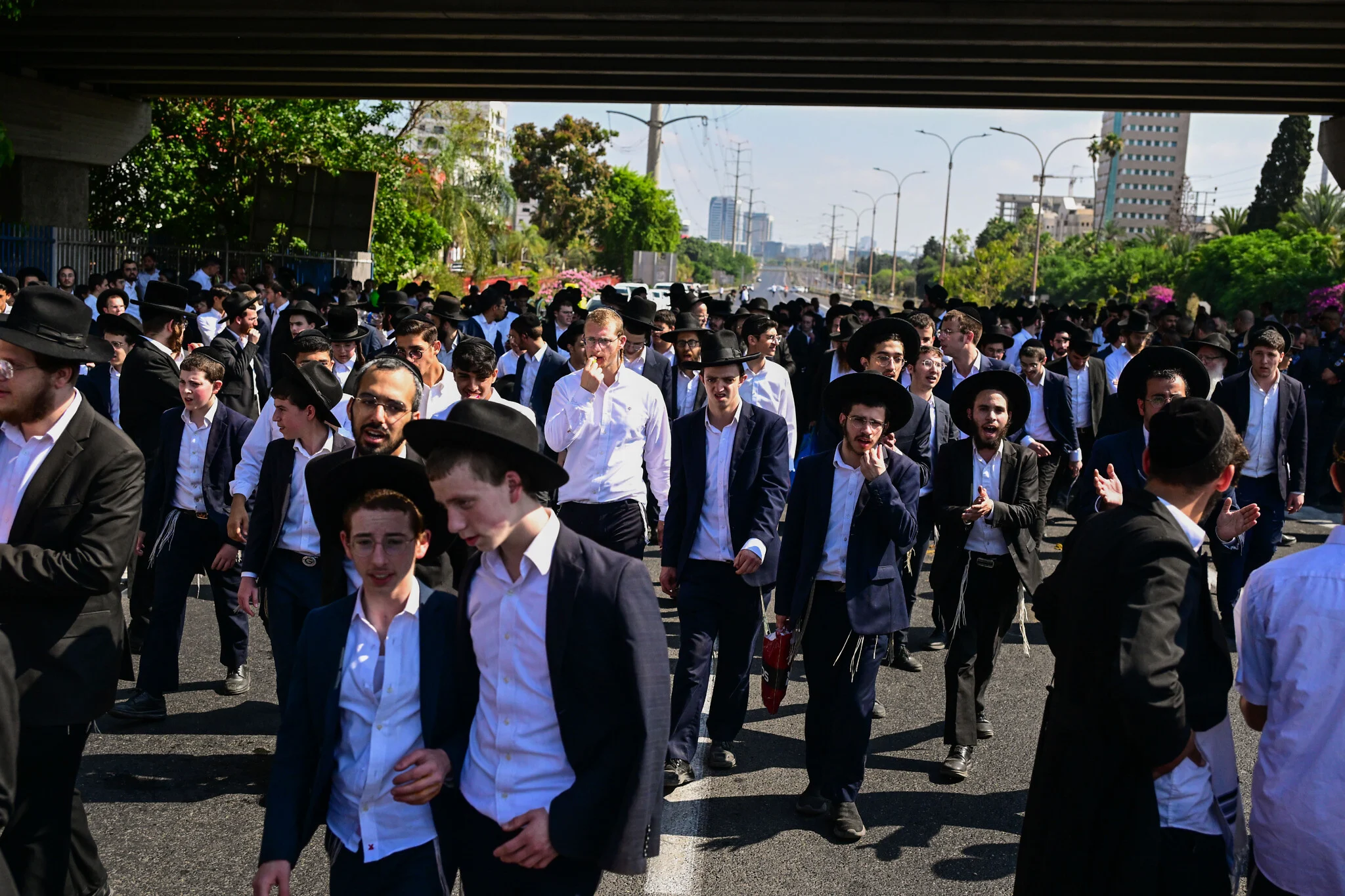
Tens of thousands of Haredi men have repeatedly found the time and energy to leave their neighborhoods and study halls to protest efforts to enforce military service. Major demonstrations have shut roads and disrupted Jerusalem and central Israel.
Not every protester is necessarily a draft-eligible yeshiva student, and attendance at a demonstration does not prove that a particular person is neglecting his studies. Fairness requires acknowledging that.
Still, the spectacle raises an unavoidable question: If tens of thousands can be mobilized to defend exemption from service, is it credible to claim that their contribution to the nation must consist exclusively of uninterrupted Torah study?
Is protesting the draft Torah study, too?
Religious Zionism has always rejected the idea that Torah and national responsibility belong to separate worlds. We believe in Torah that enters history, Torah that builds communities, Torah that settles the land and Torah that accepts responsibility for the physical protection of the Jewish people.
Those who serve in the IDF do not lack faith in Torah. Many soldiers study Daf Yomi, pray three times a day, observe Shabbat under extraordinarily difficult conditions and enter battle carrying both weapons and sefarim (holy books). Hesder students have demonstrated for generations that serious Torah learning and military service can strengthen one another rather than compete.
The solution cannot be to throw unprepared young men into an army that makes no effort to protect their religious lives. The IDF and the government must provide credible frameworks in which Haredi soldiers can serve without being asked to surrender their identity or observance.
But accommodations are different from exemptions. Gradual implementation is different from permanent avoidance. Respect for Torah scholars is different from granting immunity to an entire population.
Zamir is also right that the IDF should not be forced to administer mass exemptions while demanding extraordinary sacrifice from everyone else. The army’s responsibility is to identify and train those who can serve — not to become the agency that certifies who may remain home.
A Jewish state must value Torah. It must also defend Jewish lives. Those are not competing obligations.
The religious Zionist response should therefore be clear: Preserve and honor genuine Torah scholarship. Build appropriate pathways for Haredi service. But reject legislation that places political convenience above military necessity and tells one group of Israelis that the burden carried by their brothers and sisters is not theirs to share.
Torah study is a foundational Jewish value. So is responsibility for one another.