Journalist, Commentator on Middle East Issues
Is the Israeli Media Really Free? Yes. Is It Clean? That’s Another Question.
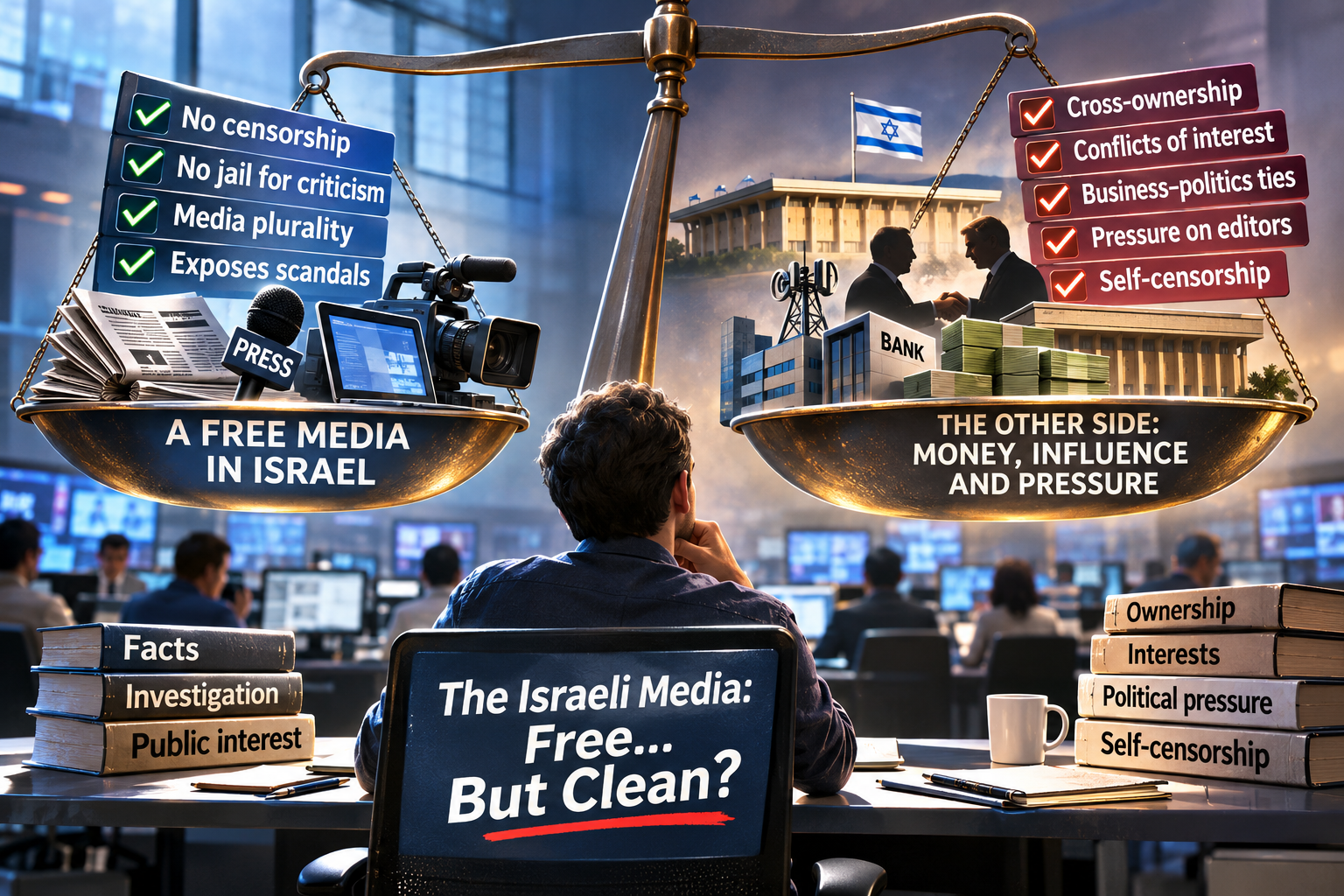
AI Creation (my prompt)
After more than three decades working in this field, I find that this question remains unresolved, with each side choosing the answer that best suits its narrative. The right speaks of a “left-wing media” waging a campaign against elected officials. The left speaks of “government propaganda” dominating the public sphere. Both are partly right, yet both miss the fundamental point.
Let us start with the facts. Israel has no censorship of opinions. Journalists are not jailed for criticizing the government, and those in power do not decide what gets published tomorrow. By international standards, Israel has a vibrant, pluralistic media that exposes scandals and brings down powerful figures. But freedom from government control is only half the story. The other half is freedom from money.
And this is where the real problem begins: cross-ownership and conflicts of interest. When a media proprietor also owns businesses in telecommunications, banking, real estate or broadcasting, every report on regulation and oversight becomes a commercial matter affecting their own interests as well.
Our history is full of media owners who needed favors from the government, and governments that knew exactly how to turn those favors into editorial considerations. Then comes the most dangerous relationship of all: the “professional friendship” between wealthy businesspeople and politicians, in which no one needs to issue an order, and no one needs to receive one. A hint is enough.
Editorial independence is the newsroom’s last line of defense, and it is also eroding. An editor who knows that the owner is seeking a new license does not need a phone call. The editor can read the room. This is the most effective form of censorship ever devised: self-censorship. The story that was never written, the question that was never asked, the interview postponed “because of scheduling pressures.” No one knows what we chose not to publish. That is precisely what makes this system so powerful.
And what about journalists who serve those in power? They exist, and there is no point pretending otherwise. Some have turned into disguised government spokespersons, asking questions designed to give the prime minister a platform in return for “exclusive” stories and direct access. This phenomenon is not confined to the right. On the other side, too, there are journalists who have made opposing the government their profession, catering to audiences that simply want to hear what they already believe. In both cases, the damage is the same: citizens can no longer tell whether they are reading journalism or an agenda.
Is the media politically biased? In almost every country, journalists have personal opinions, and that is not a crime. The problem begins when opinion is presented as fact, when an agenda finds its way into the opening lines of a news report, and, above all, when the public stops believing anyone. The greatest damage is the erosion of trust. An audience convinced that “everyone is biased” stops checking the facts. And when that happens, the loudest lies win.
So what should be done? Full transparency in media ownership; restrictions preventing media proprietors from simultaneously holding business interests before the regulatory authorities; legal safeguards for editorial independence; and a public that learns to consume news with its eyes open.
The Israeli media is free. The real question is: Is it free enough?
No legislator can settle that question through legislation. It will be decided in newsrooms, at the moment a journalist chooses whether to ask the difficult question, or walk away from it.
Related Topics
Related Posts