
Is the Palestinian Emirates Plan a Viable Option?
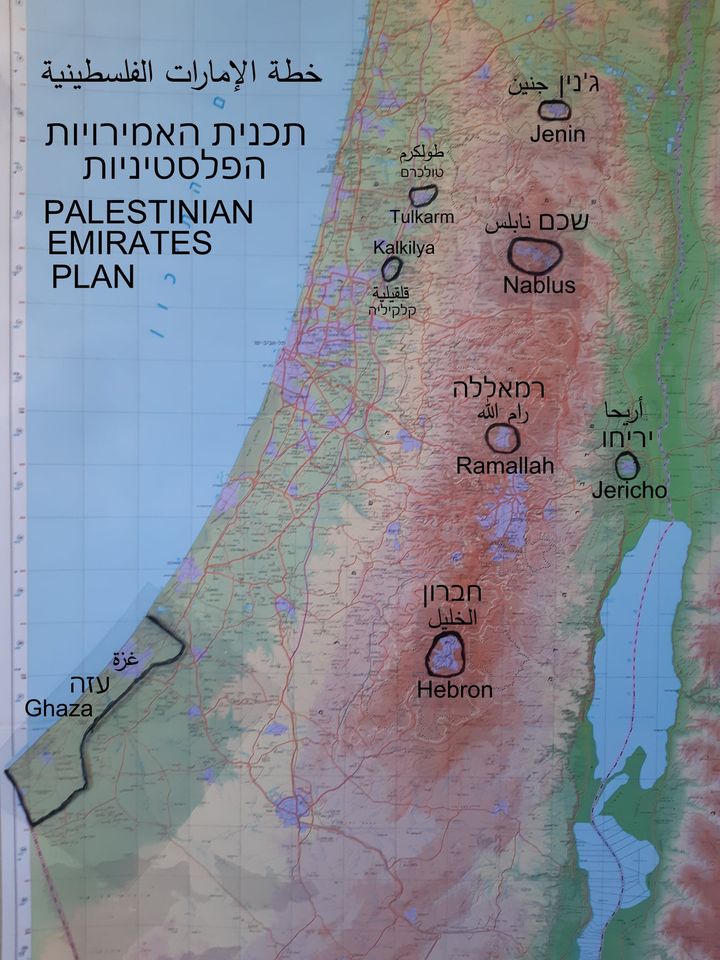
On July 7, a Wall Street Journal (WSJ) op-ed quoted Palestinian Sheikh Wadee’ al-Jaabari and a handful of other anonymous sheikhs stating that they want to secede from the Palestinian Authority (PA) and join the Abraham Accords with Israel through their own “emirate” in the city of Hebron. The report has returned the so-called “Palestinian Emirates Plan”, long advocated by many on the Israeli right, into public discourse. Though al-Jaabari’s family and many other Palestinian clans were quick to denounce his statements, it is worth considering the viability of the Palestinian Emirates Plan for Israel from a security standpoint.
According to the Emirates plan, the Palestinians would receive autonomy in seven separate districts in the West Bank based on their tribal lineage and centered around major cities, rather than a single contiguous sovereign state under the PA. Dr. Mordechai Kedar – who developed the Palestinian Emirates Plan – reasons that it is a more stable option than the two-state solution because Arab society retains a traditional and tribal structure better suited for local governance than nation states. He compares Arab nation states that are unstable, such as Libya, Syria, and Iraq, to the more stable United Arab Emirates (UAE), which does govern through a more traditional tribal system, to make his point.
However, a meaningful and significant distinction between the UAE’s system and the Emirates plan Dr. Kedar and some in the current Israeli government propose is that the Palestinian tribes would remain under the control of an external entity, in this case Israel. Empowering seven autonomous tribes under Israel’s sovereignty would have radically different security implications than in the UAE.
The plan would further isolate the Palestinians without meaningfully increasing their civil liberties. From a security perspective, hard borders are created on the ground wherever a government stops issuing civil liberties to a given population, such as possessing citizenship and having the right to vote in the national elections of the given central government. While the Palestinian “emirates” would technically be enclaves within Israeli territory, in practice Israel would be creating non-contiguous, isolated entities with hard borders around them. Each emirate would still lack Israeli civil liberties and would remain disconnected by Israeli settlements, populated by Israelis with full Israeli civil liberties throughout the West Bank, which would create a more complicated and burdensome security situation for Israel in the West Bank.
As of now, Israel is able to prevent terrorist attacks stemming from Areas A and B in the West Bank by coordinating with the centralized Palestinian Authority Security Forces (PASF) and sometimes by even entering those areas when necessary. However, under the Palestinian Emirates Plan, not only would Israel be unable to enter the seven districts with their strengthened autonomy, but there would likely be no centralized security force within them for Israel to coordinate with. The disconnection and hard borders between the seven emirates would make it significantly difficult for them to sustain viable economies within their respective localities and risk collapsing into power vacuums.
Furthermore, what constitutes a Palestinian “tribe” and which tribe will be in control of each given emirate is not so straightforward. In his book, Networks of Power in Palestine: Family, Society, and Politics since the Nineteenth Century, Dr. Harel Chorev-Halewa discusses how the Palestinian tribes are not always organized by blood ties, but also based on common family economic and or political interests. Thus, the structure, leadership, and organization of each tribe are distinct, making it difficult to carve them up into seven separate districts where they would maintain social cohesion and stability.
Indeed, the Emirates plan poses security challenges for Israel as well. The WSJ article acknowledges and references members of Israel’s security establishment concerned by the security complications that would come with fragmenting Palestinian autonomy. For instance, Major-General (ret.) Gadi Shamni, who led the IDF Central Command (responsible for the West Bank) from 2007-2009, is quoted as such: “How do you deal with dozens of different families, each of them armed, each under its own control? The IDF would be caught in the crossfire—it would be a mess, a disaster. The national aspirations of Palestinians will (not) disappear and you (cannot) deal with each tribe separately. There is no way to control the West Bank and manage life there without the central authority.”
The Palestinian Emirates Plan would also pose a security problem for Israel, not only by how it fundamentally changes the challenges it would face, but also by how taxing it would be for the Israel Defence Forces (IDF). Commanders for Israel’s Security (CIS), which is an organization of over 550 retired Israeli military generals, may outline a rough estimate of the security costs for Israel without such a central authority for the Palestinians. In their 2018 report on the security ramifications of annexing Area C of the West Bank, CIS projects that Israel would need an additional 45 IDF companies, 2,000 staff, and hundreds of security personnel to secure the area. The map of the Palestinian Emirates Plan is similar to the map of Area C, so it is reasonable to assume that they would require around the same amount of investment to secure the areas around the isolated emirates.
Israel cannot afford to have such a burden on its military in a post-October 7 era. While there were a variety of reasons why Israel was especially vulnerable on October 7, one of the main factors was that it was over invested in the West Bank. According to Israeli-American journalist and historian Gershom Gorenberg, there were already about twice as many Israeli battalions as normal in the West Bank prior to October 7 and that some units usually stationed at the Gaza border were deployed in the West Bank when the war began. He points out that the Israeli army claims that the “extra units in the West Bank weren’t pulled from the Gaza border, but from training courses. If so, that’s a less direct, but still significant way in which protecting settlements left the army less prepared for the war.”
Israel has finite military and intelligence resources. The more unstable the West Bank is and the more entrenched the settler presence there gets, the more troops will be required to secure the area and prevent terror attacks, making it harder to secure its borders elsewhere. Israel needs to be as physically separate from the Palestinians as possible and a centralized Palestinian leadership it can cooperate with on security matters to ensure it has the sufficient security personnel and resources to prevent another catastrophic infiltration into its territory like there was on October 7. Plans that require Israel to permanently deploy more troops into the West Bank are not in line with this security doctrine.