


Is there a place for the “A Place For Us All” party?
This is a follow-up to my previous article “Will the new Jewish-Arab party help to defeat Netanyahu and defend Israeli democracy?” It’s based on the fact that on Friday I went to a house meeting in north Tel Aviv with Alon Lee-Green, the co-leader of the party who was one of the co-heads of “Standing Together” who has taken a leave of absence from the movement to devote his energies to promoting the new party towards the coming critical elections. Alon Lee-Green at the house meeting in north Tel Aviv. (Photo: Author)
As I said during the Q and A part of the meeting, I agree with virtually all of the points that he made. Yes, we need younger generation leaders to emerge, we need both male and female leaders – the party leader is the Palestinian-Israeli female co-head of “Standing Together,” Rula Daoud, making it the only party today led by a woman. And yes, we must place the fact of the horrors of Gaza and the occupation on the Israeli agenda, what it is doing to the Palestinians, and also to the prospects for Israeli democracy. And yes, we must place the need for a negotiated peace back on the Israeli agenda, where it was during the days of the Oslo Process. And Israeli Jewish-Arab cooperation is essential for achieving a democratic state, an end to the occupation and a peaceful resolution of the conflict.
Workers’ rights activist and Standing Together
Alon described his own personal development, as a successful activist for workers’ rights when he was working at a café, together with an Arab colleague. This eventually led to the founding of the impressive “Standing Together” movement, based on joint Jewish-Arab partnership. He also noted that he was a parliamentary assistant to MK Dov Khenin, in his and my view one of the best members of Knesset in recent times, so he knows his way around the political arena. And unlike older politicians, he has a lot of followers on TikTok and Instagram!
Alon noted that he is 38 years old, and that many members of his generation are saying that if Netanyahu isn’t defeated in the coming elections, they will leave. He added that this is not only true for young Jewish Israelis, it’s also true for Palestinian Israelis. And I would add, it’s also true for young educated Palestinians in the West Bank. I said that my son is also 38, and many of his friends have already left for what they consider greener, safer pastures, in Berlin, London and New York.
Will they pass the Knesset threshold?
But the question that concerned almost everyone at the meeting was, does the party have a chance of passing the electoral threshold of 3.5% of the vote, at least 154,000 votes in the last 2022 elections, and if not, will their votes be wasted?
Alon said that they have a problem being listed in the polls since the pollsters only tend to list existing parties that have been in the Knesset, even Benny Gantz’s “Blue and White” party that has been consistently under the threshold. They have talked with pollsters and TV channels about this, so far without success. They have even had talks with Ha’aretz about what they consider unfair criticism of their initiative. He said that an Arab polling company that covers the Arab sector did carry out polls for them but didn’t say what the results were.
When asked on what they base any sense of optimism about their prospects, he said that they are having a series of meetings every day in many Arab towns and villages where they are greeted by a tremendous sense of enthusiasm by young people and women who feel they are not adequately represented by the four predominantly Arab parties, Hadash, Ta’al (Tibi), Ra’am (Mansour Abbas) and Balad.
 Leaders of the 4 predominantly Arab parties, all men. (Photo: Haaretz)
But is that enough to enable them to pass the electoral threshold?
Currently, polls estimate that only about 45-50 percent of the Arabs will vote, though if the Joint List is formed, the number could be higher by at least 10 or even 20%. A high percentage of Palestinian Israelis voting is one of the keys to defeating the current extreme right-wing government.
Talking with other party leaders
They are also talking with leaders of the parties, the Arab parties and The Democrats. Concerning the latter, he said they clearly had no interest in cooperating with the new party. He added that The Democrats policy platform doesn’t mention the occupation by name and calls for Israeli military control of the border with Jordan, and I agree with his criticism on those points. Yet he also said that the platform doesn’t support a Palestinian state and a two-state solution, only separation from the Palestinians. He ignores the fact that the platform, written in 2025, calls for negotiations with the Palestinian Authority for a demilitarized Palestinian state alongside the State of Israel, and the fact that Palestinian President Abbas committed to the idea of a demilitarized Palestinian state in a letter to President Macron. https://democrats.org.il/wp-content/uploads/2025/10/eng-vision0925.pdf
One thing that Alon didn’t mention is the fact that since the trauma of October 7, and the ongoing war in Gaza, and also with Iran and in the north, security is a primary concern for the average Israeli. The Democrats and all the other parties focus on that. While the Likud, Lieberman, Bennett and Lapid, and to a lesser degree Eisenkot only talk about security, at least the Democrats say that security has to be accompanied by diplomatic initiatives in all the arenas. In Alon’s presentation, security was not a priority, a weakness in his analysis to Jewish audiences.
The primary criticism of the predominantly Arab parties that he heard and agrees with is that they have no younger people and women among their candidates for the coming elections.
“We will not waste votes”
Alon repeated his commitment not to waste votes in the struggle to replace Netanyahu’s extreme right-wing government, which he said is the first priority. He said they have two months to decide whether to submit a list of candidates to the election committee. The minimum of 3.5% of the votes means getting four seats in the Knesset, and he said because that is on the edge, they will want to be listed as getting at least five seats before they commit to running. He said they have about two months to decide before the mandatory final date to submit a list of candidates, which can’t be withdrawn. He added that this is not just an initiative for the coming elections. They are in it for the long run.
Alon noted that the opposition parties will probably not get the needed majority of 61 seats – polls currently list them at around 59-60 seats – and most of the party leaders (except for Yair Golan of The Democrats), have said they will not agree to form a government with the Arab parties, but they will have to. I said in the end they will. He responded that then we have to get ready for a vicious right-wing response to the “treacherous” readiness to form an alliance with the Arabs after October 7.
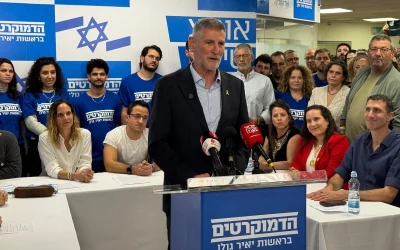 Yair Golan, leader of The Democrats party, the only one of the opposition parties that calls for cooperation with the predominantly Arab parties: (Photo: Times of Israel)
And if they don’t run?
And what will they do if they decide not to run? He suggested that they could try to negotiate an arrangement with one of the existing parties, probably either Hadash or the Joint List if it is formed, that would enable presumably Rula Daoud to be a candidate on their list, bringing in the votes of the people he mentioned who have been excited by the new initiative who said they had no one to vote for before.
He hopes that prominent anti-occupation pro-peace activists will be nominated for The Democrats candidate list in the primaries, without naming their names.
Hopefully “A Place for Us All” is our future.
But with all their best and worthy intentions, my bottom line view remains that in these critical elections they do not appear to have a chance of reaching the 3.5% electoral threshold and the responsible thing will be to not submit a list of candidates for this election. If they can negotiate an arrangement with one of the Arab parties to bring in new voters and leadership, that could be a positive contribution to defeating Netanyahu.
To be realistic, the goal of the Israeli peace camp and pro-democracy activists should be to mobilize as much support for the Democrats as possible, to enhance their influence on the policies and direction of a hoped-for “Government of Change,” in my view led by Eisenkot rather than Bennett. Why Eisenkot? That’s another story.