
Middle East Analyst
Is Trump Preparing to Attack Iran—or Negotiating Through Threats?
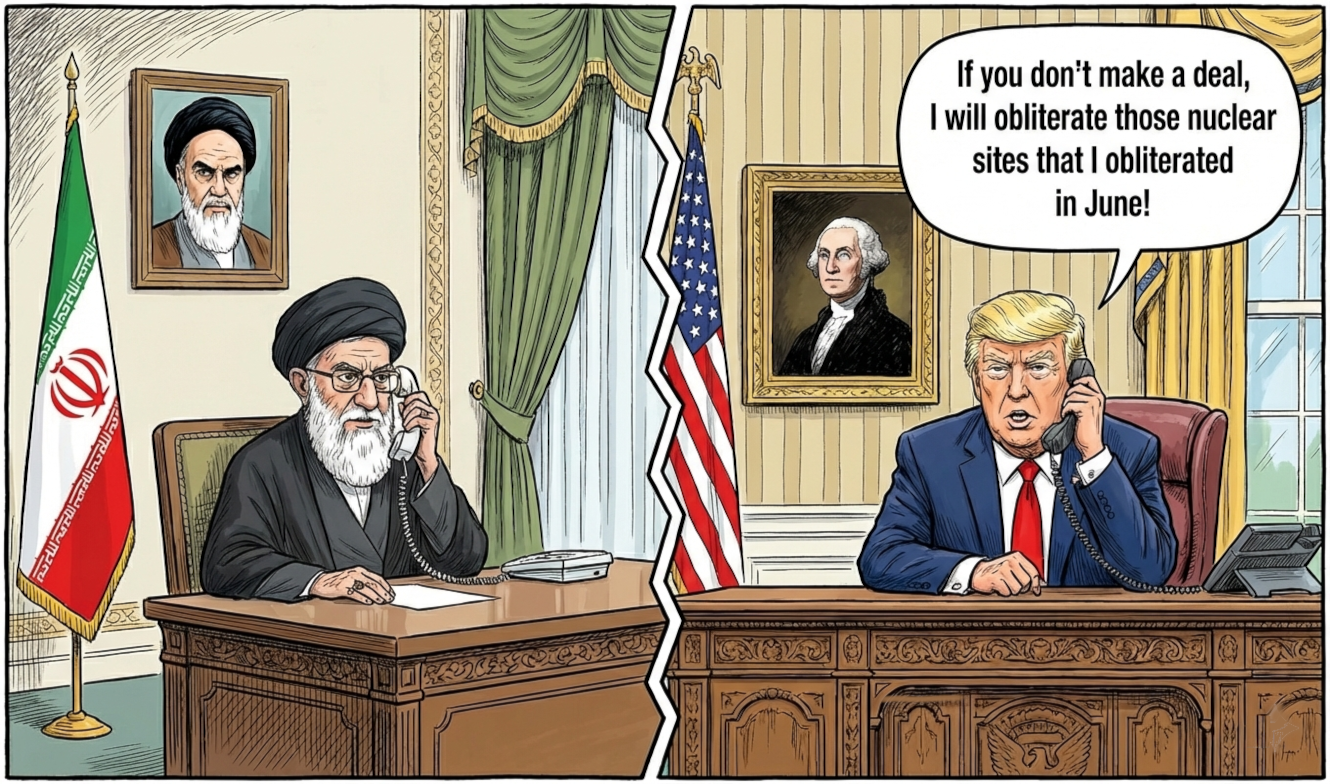
by author
Whether President Donald Trump is preparing to attack Iran or using the threat of force as leverage has become one of the central strategic questions of early 2026. His public statements, selective leaks from U.S. officials, surrogate media narratives, and regional reactions point in different directions. Military signaling, rhetorical escalation, and diplomatic ambiguity overlap in ways that blur the line between coercive diplomacy and genuine war preparation. Yet when these data points are organized systematically, a clearer picture emerges.
Trump’s public messaging remains more rooted in coercive negotiation rather than explicit war intent. He has repeatedly urged Iran to “come to the table,” warning that any future U.S. attack would be “far worse” than the June 2025 bombing campaign that struck three Iranian nuclear-related sites. He has described U.S. naval deployments as an “armada” moving toward Iran—language designed to project overwhelming force while stopping short of committing to its use. In these remarks, military power is framed as leverage, not as an end in itself. His stated objectives are familiar and limited: constrain Iran’s nuclear program, restrict ballistic missile development, and curtail support for regional armed groups. Notably absent is any explicit declaration of regime change or a plan to dismantle the Islamic Revolutionary Guard Corps (IRGC), the regime’s core coercive institution.
At the same time, anonymous U.S. officials cited in reports by Reuters and CNN paint a more aggressive internal debate. According to these accounts, Trump is weighing targeted strikes on Iranian security forces and leadership figures with the explicit goal of “creating conditions for regime change.” The theory—outlined by unnamed officials—is that striking commanders associated with Iran’s recent and bloody crackdown on protesters could catalyze renewed unrest and embolden demonstrators. Other leaks suggest consideration of a broader strike intended to have a “lasting impact,” possibly against nuclear or missile infrastructure. These reports depict a president at least entertaining options that go beyond leverage and toward internal regime destabilization.
Trump’s surrogate media ecosystem adds a third, reinforcing layer. Pro-administration commentators consistently portray Iran as brittle, internally divided, and vulnerable. They emphasize the regime’s brutality during the crackdown and argue that its legitimacy is eroding. Some suggest that limited U.S. military action could serve as a catalyst for popular uprising; others insist Iran’s nuclear and missile programs remain dangerous despite the June strikes, implying further action may be necessary. This narrative amplifies the idea that Iran is nearing collapse and that external pressure could tip the balance—even though such arguments rest more on aspiration than on demonstrated historical precedent.
Regional actors, by contrast, offer a far more cautious assessment. Israeli and Arab officials quoted in the same Reuters reporting warn that air power alone cannot topple Iran’s clerical system. They emphasize that the IRGC is deeply entrenched, ideologically committed, and structurally designed to absorb external shocks. Iran itself has adopted a dual posture: publicly preparing for confrontation while quietly keeping diplomatic channels open. That stance suggests Tehran views U.S. threats as serious but not yet decisive. Meanwhile, Saudi Arabia, Turkey, and the United Arab Emirates are recalibrating their positions amid shifting alliances, internal Iranian unrest, and the risk of regional spillover. None appears eager for a war that could destabilize energy markets, disrupt maritime routes, or invite Iranian retaliation.
U.S. public opinion adds a critical constraint. Recent polling consistently shows that support for military action against Iran is narrow and highly conditional. Surveys indicate that only about half of Trump’s own supporters favor any form of intervention, with strong opposition among Democrats and independents. While narrowly framed questions about preventing an Iranian nuclear weapon can generate plurality or marginal majority support, broader questions about military intervention or escalation produce clear majorities opposed. Historically, no U.S. administration has sustained a major military operation without majority public backing, and support almost invariably erodes once casualties or economic consequences appear. This political reality sharply limits the feasibility of any large or prolonged campaign.
The operational question of ground forces further clarifies intent. Reports that certain Iranian targets—deeply buried nuclear facilities, hardened command centers, or dispersed missile infrastructure—would require ground operations are analytically significant. Air and naval power alone cannot reliably eliminate these capabilities. Any serious attempt to do so would require multi-domain operations involving cyber, special forces, and potentially conventional ground units. Such a campaign would dramatically increase the risk of Iranian retaliation against Israel, Gulf infrastructure, or U.S. bases, and would demand a level of political commitment and public support that does not currently exist.
There is also an unresolved contradiction at the heart of the administration’s messaging. If, as Trump claimed, Iran’s nuclear sites were “obliterated” six months ago, why are officials now discussing additional strikes on nuclear infrastructure? The most plausible explanation is that the June strikes degraded but did not eliminate Iran’s capabilities, or that Tehran has reconstituted elements of its program faster than anticipated. Either interpretation underscores the gap between political rhetoric and technical reality—and confirms that the nuclear issue remains a live driver of U.S. strategy despite public claims of decisive success.
The regime-change theory faces its own strategic problems. Iran’s leadership has already demonstrated a willingness to kill tens of thousands of its own citizens to retain power. External military attacks—particularly by the United States or Israel—risk reinforcing the regime’s narrative that domestic unrest is foreign-instigated, thereby strengthening internal cohesion rather than weakening it. Historically, authoritarian systems under external threat tens of are more likely to consolidate than collapse.
Taken together, the signals point in multiple directions: Trump’s public rhetoric emphasizes negotiation; anonymous officials describe regime-change aspirations; surrogate media amplifies Iranian vulnerability; regional actors warn of escalation; public opinion remains skeptical; and the military requirements for decisive action are immense. When weighed collectively, these factors point toward a single, coherent interpretation.
Trump appears to be pursuing coercive diplomacy rather than preparing for a full-scale war. The military signaling is real, but it is calibrated to pressure Iran into negotiations rather than to launch a regional conflict. Regime-change language from unnamed officials reflects aspirational thinking more than operational intent. The political, strategic, and military constraints—both domestic and regional—make a sustained intervention unlikely.
Bottom line: Both Trump and Khamenei have motive to create distractions from domestic problems. Consequently, limited face-saving strikes are possible. However, it is more likely that Trump is simply negotiating through intimidation, not preparing for a conflict.
Related Topics
Related Posts