
Is Turkey Togarmah?
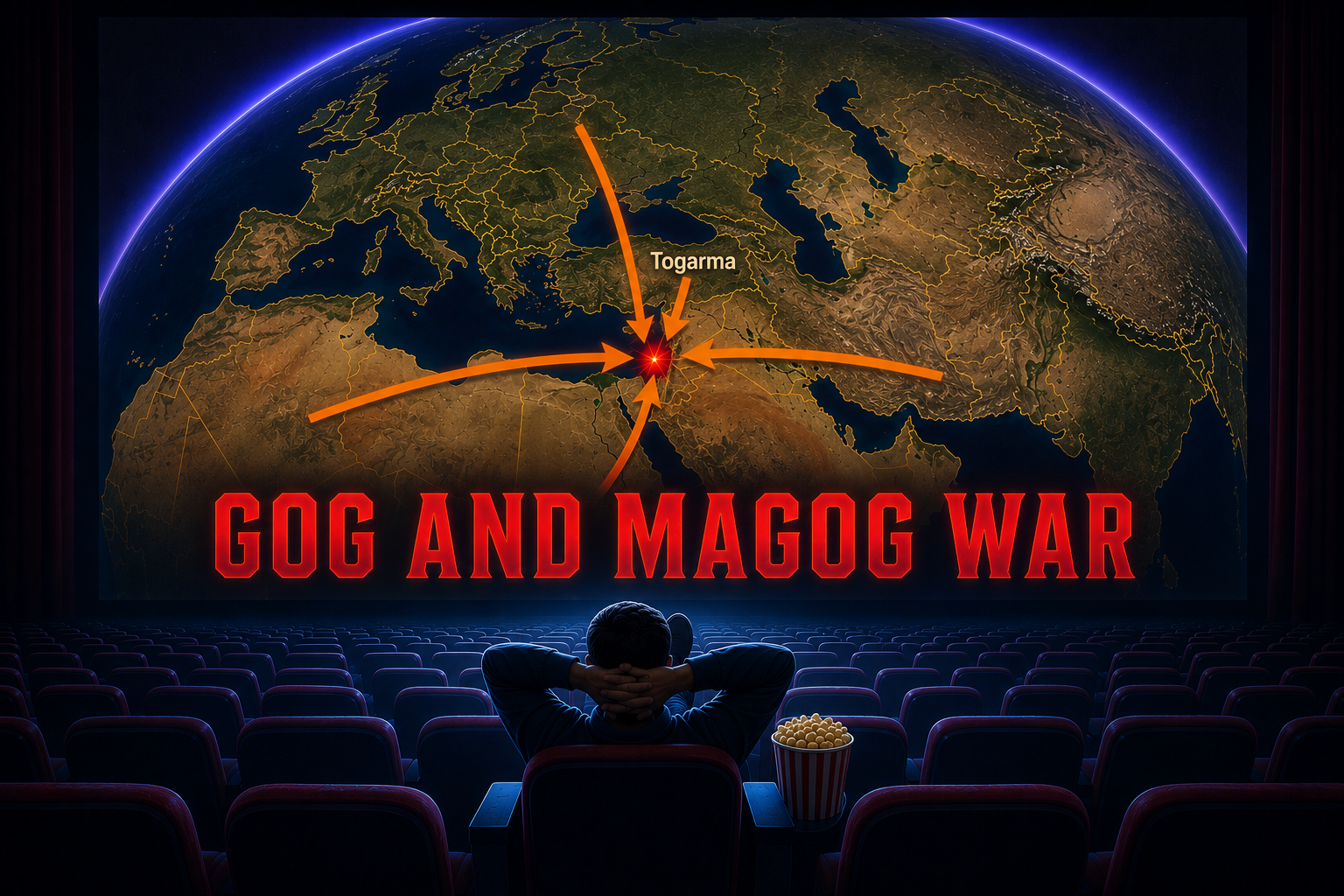
Yes. Obviously yes. Short of relocating eighty-five million Turks, their army and their borders to Siberia, the ground Ezekiel named sits inside Turkey and will keep sitting there.
Beth-togarmah was a fortified town the Assyrians called Til-garimmu, on the frontier between Kammanu and Tabal, in the highlands above the upper Euphrates. Today that spot is Gürün, in Sivas province. Anyone can drive there. Rock-cut caves and Hieroglyphic Luwian inscriptions in the Şuğul canyon are most of what the ground has yielded; almost everything else we know comes from Hittite and Assyrian tablets rather than from excavation.
So the question answers itself, and the interesting part starts one sentence later.
Til-garimmu sold horses. Ezekiel names it twice, and the first time it is nobody’s enemy: in chapter 27 it turns up at Tyre’s fairs with horses, war horses and mules, doing business. Sennacherib burned it around 695 BCE. When the prophet wrote the name into chapter 38, roughly a century later, the town itself was long gone. The name survived as a people and a region, the way Babylon survives now.
That gap is worth holding onto, because the modern equation skips it. Ezekiel did not write “Turkey.” He wrote a place name. The Turks were not in Anatolia when he wrote it and would not arrive for another fifteen centuries. The town spoke Luwian, answered to Assyria, and belonged to a Neo-Hittite world with no descendant in Ankara. Between Til-garimmu and the Republic of Turkey there is no continuity of language, people, religion, or state. What carries over is the terrain, and nothing else.
Compare Persia. Iran occupies the same ground, its people are largely the same stock, the language descends from the same root, and the country was called Persia until 1935. That identification carries weight the Togarmah one does not, and the two sit side by side in the same verse as though they were equivalent.
Then there is the accident of the map itself. When the Ottoman Empire lost the First World War, the victors imposed the Treaty of Sèvres in 1920, which carved it up and handed much of eastern Anatolia to an independent Armenia, with autonomy promised to the Kurds. The sultan signed. Mustafa Kemal’s nationalists refused, fought a war of independence, and won. The treaty never took effect. Three years later the Treaty of Lausanne redrew everything with the Turks at the table, and produced the borders Turkey still has. Gürün fell on the Turkish side by roughly three years and one lost war. Under Sèvres it would sit in Armenia today, and the prophecy charts would fly a different flag.
None of which settles what the reader actually wants to know: whether this Turkey, Erdoğan’s Turkey, is the Togarmah of Ezekiel 38.
Start with what came before him. It was the opposite. For half a century the two countries were quietly on the same side. Turkey recognized Israel in 1949, the first Muslim-majority state to do so. Both were secular, both were pro-Western, both were surrounded by Arab governments that distrusted them, and both answered to Washington. The friendship peaked in 1996 with a military cooperation agreement: Israeli engineers modernized Turkish F-4 and F-5 aircraft, Israeli pilots trained in Turkish airspace, and hundreds of thousands of Israeli tourists spent their summers on Turkish beaches. Whatever Ezekiel described, that was not it.
But that friendship had one owner, and it was not the Turkish public. It was the Turkish army’s project. The Kemalist generals were the guardians of the secular republic, they held real veto power over any government, and they were the ones who wanted Israel close. Ordinary Turks were never asked.
Erdoğan took office as prime minister in 2003 and spent his first decade stripping those generals of their power. Once they were gone, the alliance had no patron left. It also no longer fit the country’s new ambition: Turkey stopped courting Brussels and began competing for leadership of the Muslim world, a contest in which friendship with Israel costs votes rather than earning them.
He also came out of a political tradition that had never accepted the friendship in the first place. Necmettin Erbakan’s Milli Görüş, or National Vision, held that Turkey’s westward turn had been a historical mistake, that the country belonged with the Muslim world rather than with Europe, and that Jerusalem was a central cause. Erbakan reached the prime ministry in 1996 and the generals forced him out a year later. Erdoğan was his protégé.
The break turned physical in May 2010. A Turkish NGO sent six ships toward Gaza to break the Israeli naval blockade. Israeli commandos boarded them in international waters; five gave up without a fight, and on the flagship, the Mavi Marmara, the passengers fought back. Israel says its soldiers were attacked with iron bars and knives and fired in self-defense. The organizers say the shooting started first. Nine Turkish citizens died. Ambassadors were withdrawn, and Ankara could now speak of Israel as a country that had killed Turks. The relationship never recovered its old shape.
Erdoğan hosts Hamas leaders in Istanbul and calls them a resistance movement rather than a terrorist organization, and says so on camera. Gaza did not start any of this. It removed the last reason to be discreet about it, and by May 2024 Turkey had cut off all trade with Israel.
Which is the point. The same coordinates produced an ally and an adversary inside a single lifetime, and what changed was not the map.
Now this week. On the night of August 18, Israeli aircraft put eight strikes into the runway at Abu al-Duhur in Idlib, roughly seventy kilometres from the Turkish border, on a field Ankara had been rehabilitating after years out of service. Netanyahu said afterward that Israel would not tolerate a Turkish military buildup pushing south, and that a message had been sent. Turkey denied any planned deployment. Prophecy accounts lit up the map.
Read the sequence, though. Israel did not attack Turkey; it struck a Syrian base. Ankara answered with a communiqué. Tom Barrack, the American ambassador in Turkey, said Turkish forces had no idea the aircraft were coming or what they were after, and could reasonably have scrambled their own believing they were under attack. He added that calm heads kept it from getting worse. A technical deconfliction channel, brokered by Azerbaijan in 2025, already existed; it simply was not used.
Barrack also relayed something else. Trump had asked Erdoğan why Turkey did not just take Syria, given the part it played there. Erdoğan said they did not want it, that they wanted Syria sovereign and independent.
Now try writing that into the chapter:
And the prince of Beth-togarmah gathered his horsemen and turned toward the land of Israel. But the king of the West sent him a letter, and he did not go up.
No such verse exists. Nothing resembling it exists. In Ezekiel 38 there is no broker, no alliance to answer to, no letter, no deconfliction cell. The only outsiders are Sheba and Dedan, the trading peoples of southern and northwestern Arabia, and the merchants of Tarshish, the far west of the known world, who watch the army assemble and ask one question: have you come for plunder? They bring no weapons and no restraint. The coalition marches because nothing in the world is positioned to stop it.
That is the whole distance between this week and that chapter. Not the geographic coordinates, which match. The architecture, which does not.
So the honest answer is that we cannot know. Erdoğan’s Turkey resembles Ezekiel’s Togarmah far more than the Turkey of the beach holidays did, and resemblance is not identity. What holds this one in place is a set of arrangements: NATO membership, an American president who can make two phone calls in an afternoon, an F-35 sale worth staying friendly for. Every one of those is a human arrangement, and the trade that once belonged on that list is already gone.
Which is the part the maps never show. Whatever happens to the prophecy, one day Trump will die, and Erdoğan will die, and Netanyahu will die. But as long as Turkey stands where Togarmah stood and Israel stands where Israel stands, the prophecy stays alive.
So no, this week was not it. The ground matches and nothing else does, and the arrangements holding the two apart held again. Unless one day they change drastically. And we have seen how fast things change in this part of the world.
Who besides God can know that?